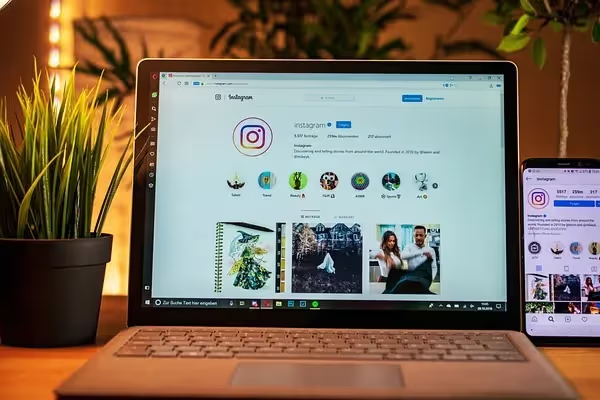



Social screening has become a foundational practice for organizations making high-stakes decisions in hiring, admissions, immigration, brand safety, and trust. This beginner-friendly guide explains what social screening is, how it works, why it is essential in 2026, and how automated tools help organizations analyze publicly available social media data responsibly, ethically, and at scale.
- Social screening in 2026 means reviewing public social media content to flag risk or policy violations before a decision is final.
- Employers, universities, government agencies, and brands all run these checks, each against its own risk thresholds.
- The process runs in 4 steps: set policies, collect public data, analyze context, then report findings for human review.
- Automation is the 2026 norm because manual checks are slow, vary between reviewers, and miss older posts at scale.
- Phyllo runs an automated social screening API that collects public data across platforms and produces audit ready reports.
Digital footprints now influence real-world decisions more than ever before. What someone posts publicly on social media can affect hiring outcomes, university admissions, brand partnerships, immigration decisions, and even access to financial or government services. As we move into 2026, organizations are under increasing pressure to make decisions that are not only fast, but also safe, compliant, and defensible.
This is where Social Screening has emerged as a foundational practice.
Social screening helps organizations systematically review publicly available social media data to identify potential risks, inconsistencies, or policy violations before decisions are finalized. For beginners, the topic can feel complex, technical, or sensitive. This guide is designed to break social screening down in clear, practical terms and explain how it works, why it matters, and how it is evolving in 2026.
What Is Social Screening?
Before tools or technology are discussed, it is important to clearly understand the concept.
Social screening is the structured process of reviewing publicly available social media content to assess risk, credibility, safety, or alignment with predefined rules or policies. It is used as an additional layer of due diligence alongside traditional background checks or verification processes.
At a beginner level, social screening typically involves:
- Reviewing public posts, comments, captions, and bios
- Identifying behavioral patterns over time
- Understanding the context behind language, images, or affiliations
- Verifying consistency between online activity and declared information
Social screening does not involve hacking, surveillance, or private data access. It focuses strictly on content that individuals have chosen to make public.
Why Social Screening Is Becoming Essential in 2026
Social screening is not new, but its importance has increased sharply in recent years.
Digital behavior has become more persistent, searchable, and influential. At the same time, regulators, institutions, and brands are expected to justify their decisions and demonstrate that reasonable checks were performed.
Key reasons social screening is critical in 2026 include:
- Growing regulatory and compliance expectations
- Increased risks related to misinformation, hate speech, and extremism
- Higher accountability in hiring, admissions, and vetting decisions
- Expansion of social media platforms and content formats
- Demand for transparent and auditable decision-making processes
For beginners, the key takeaway is simple. Social screening has shifted from being optional to becoming a standard risk-management layer in many industries.
Who Uses Social Screening and for What Purpose?
Social screening is used across sectors, each with different objectives and risk thresholds.
Common Social Screening Use Cases
Understanding real-world use cases helps beginners see how social screening is applied in practice.
Organizations that commonly use social screening include:
- Employers evaluating candidates for cultural and policy alignment
- Universities screening applicants for safety or compliance risks
- Government agencies reviewing visa, immigration, or security cases
- Brands vetting influencers, creators, or partners
- Platforms enforcing trust and safety guidelines
While criteria differ, the goal remains consistent: reduce risk and make better-informed decisions using publicly available data.
What Social Screening Is Not
Misunderstandings around social screening are common.
Social screening does not mean:
- Accessing private or locked social media accounts
- Monitoring individuals without defined purpose
- Judging personal beliefs unrelated to risk or policy
- Making automated decisions without human review
Responsible social screening is focused, proportional, and policy-driven.
How Social Screening Works Step by Step
Breaking the process into steps makes social screening easier to understand.
Step 1: Defining Screening Objectives and Policies
Every effective social screening program starts with clear objectives.
Organizations first determine:
- What risks they are screening for
- Which platforms are relevant
- What time period should be reviewed
- What policies guide interpretation and decisions
Without defined objectives, screening becomes inconsistent and unfair.
Step 2: Collecting Public Social Media Data
Once objectives are clear, data collection begins.
This usually includes:
- Public posts, captions, and comments
- Profile descriptions and bios
- Public images and videos where relevant
- Engagement context that explains intent
Modern organizations rely on automated systems instead of manual searches to ensure coverage and consistency.
To understand how automated social screening works at scale, explore Phyllo social screenin api.
Step 3: Contextual Analysis and Interpretation
Raw data alone does not indicate risk. Context is critical.
Analysis focuses on:
- Language tone and sentiment
- Topic relevance to defined risk areas
- Frequency and repetition of behaviors
- Historical patterns versus isolated incidents
- Visual and textual cues interpreted together
Advanced screening systems distinguish satire, discussion, or news sharing from genuinely concerning behavior.
Step 4: Reporting and Human Decision Support
The final step turns analysis into actionable insights.
Typical outputs include:
- Clear summaries of findings
- Flagged content with timestamps and context
- Risk categories aligned with internal policies
- Documentation suitable for audits or reviews
Social screening supports human decisions rather than replacing them.
Manual vs Automated Social Screening
Beginners often wonder whether social screening can be done manually.
Limitations of Manual Social Screening
Manual screening may work for very small volumes, but it introduces significant risks.
Common limitations include:
- High time and labor costs
- Inconsistent interpretation between reviewers
- Missed historical or platform-specific content
- Difficulty documenting decisions
- Inability to scale across large volumes
As volume increases, manual screening quickly becomes unsustainable.
Why Automation Is the Standard in 2026
Automated social screening has become the norm.
Automation enables:
- Consistent application of rules and policies
- Faster turnaround times
- Cross-platform coverage
- Reduced bias through standardized workflows
- Continuous or periodic monitoring
For this reason, most organizations adopt automated screening solutions by default.
Ethics, Privacy, and Fairness in Social Screening
Ethical considerations are especially important for beginners.
Privacy and Legal Compliance
Responsible social screening respects individual boundaries.
Best practices include:
- Using only publicly accessible data
- Aligning with data protection regulations
- Limiting screening to relevant risk factors
- Maintaining transparency where required
Ethical screening protects both organizations and individuals.
Reducing Bias and Ensuring Fairness
Bias is a legitimate concern when screening people.
Modern screening focuses on:
- Behavior rather than identity
- Policy-aligned criteria
- Contextual interpretation
- Mandatory human review of flagged content
Technology assists decision-making but does not replace judgment.
Key Benefits of Social Screening for Beginners
Understanding benefits helps justify adoption.
Risk Reduction and Trust Building
Social screening helps identify potential risks early, reducing exposure and strengthening trust with regulators, partners, and stakeholders.
Faster and More Confident Decisions
Structured screening results provide clarity and confidence, reducing uncertainty and delays in decision-making.
Social Screening Trends Shaping 2026
Social screening continues to evolve.
Continuous and Ongoing Monitoring
Organizations are shifting from one-time checks to ongoing screening to capture new behavior over time.
Emphasis on Explainability and Audits
Decisions must be traceable and defensible.
Explainable screening outcomes are now essential for compliance and governance.
How Beginners Should Choose a Social Screening Solution
Choosing the right tool is critical.
Key factors to evaluate include:
- Platform coverage
- Customizable screening rules
- Contextual analysis capabilities
- Privacy and compliance standards
- Reporting and audit readiness
Final Thoughts: Social Screening as a Core Practice in 2026
Social screening has become a foundational component of trust, safety, and risk management. For beginners, the most important takeaway is that social screening is not about intrusion. It is about responsibly understanding public digital behavior to make safer and more informed decisions.
As digital footprints continue to influence real-world outcomes, social screening will only grow in importance. Organizations that invest early in ethical, automated, and well-defined screening practices will be better prepared for the complexities of 2026 and beyond.
FAQs:
What is social screening in simple terms?
Social screening is the review of publicly available social media content to assess potential risks, inconsistencies, or policy violations before making decisions.
Is social screening legal and ethical?
Yes, when conducted responsibly. Ethical social screening uses only public data, follows data protection laws, and applies consistent and transparent criteria.
Who typically uses social screening?
Employers, universities, government agencies, brands, and platforms commonly use social screening to support safer and more informed decisions.
Can social screening be automated?
Yes. In 2026, most organizations rely on automated social screening tools to ensure consistency, scalability, and faster turnaround times.
What is social screening in simple terms?
Social screening is a structured review of publicly available social media content to judge risk, credibility, and policy fit before a decision like hiring or admissions is made.
Is social media screening legal for employers?
Yes, when it is done responsibly. Legal social screening sticks to publicly accessible data, follows data protection laws, and applies consistent, job relevant criteria to everyone.
Who uses social screening and for what purpose?
Employers, universities, government visa teams, brands vetting creators, and platforms enforcing trust and safety all screen public content to reduce risk before they decide.
How does social screening work step by step?
Four steps: define objectives and policies, collect public posts and profile data, analyze that content in context, then report flagged items with timestamps for human review.
Can social screening be automated?
Yes. Most organizations now use automated screening because it applies rules consistently, covers several platforms at once, and returns results far faster than manual review.
Does social screening look at private accounts?
No. Screening covers only content a person has chosen to make public, so there is no hacking, no password request, and no access to locked or private social accounts.
How do you keep social screening fair and unbiased?
Focus on behavior rather than identity, tie criteria to written policy, read every post in context, and require human review of anything flagged before a decision is made.
What should you look for in a social screening tool?
Check platform coverage, customizable screening rules, contextual analysis, privacy and compliance standards, and whether the reports are ready for an audit or internal review.
What is the Phyllo social screening API?
Phyllo's social screening API is social data infrastructure that automates collection and analysis of public social media content, so checks stay consistent and audit ready at scale.
Which social screening trends matter in 2026?
Two shifts stand out: continuous monitoring in place of one time checks, and explainable, auditable outcomes so an organization can defend each screening decision it makes.



.avif)