

TL;DR Summary: Building a creator economy platform requires reliable, consent‑based access to social media data, but integrating each social media API natively is time‑consuming, expensive, and fragile. Instead, you can use a social data API or creator data provider that handles authentication, normalization, and rate‑limiting so you can ingest authenticated social data via a single endpoint. This “buy‑vs‑build” approach cuts engineering costs, speeds time‑to‑market, and scales cleanly as you add TikTok, YouTube, Instagram, and more platforms.
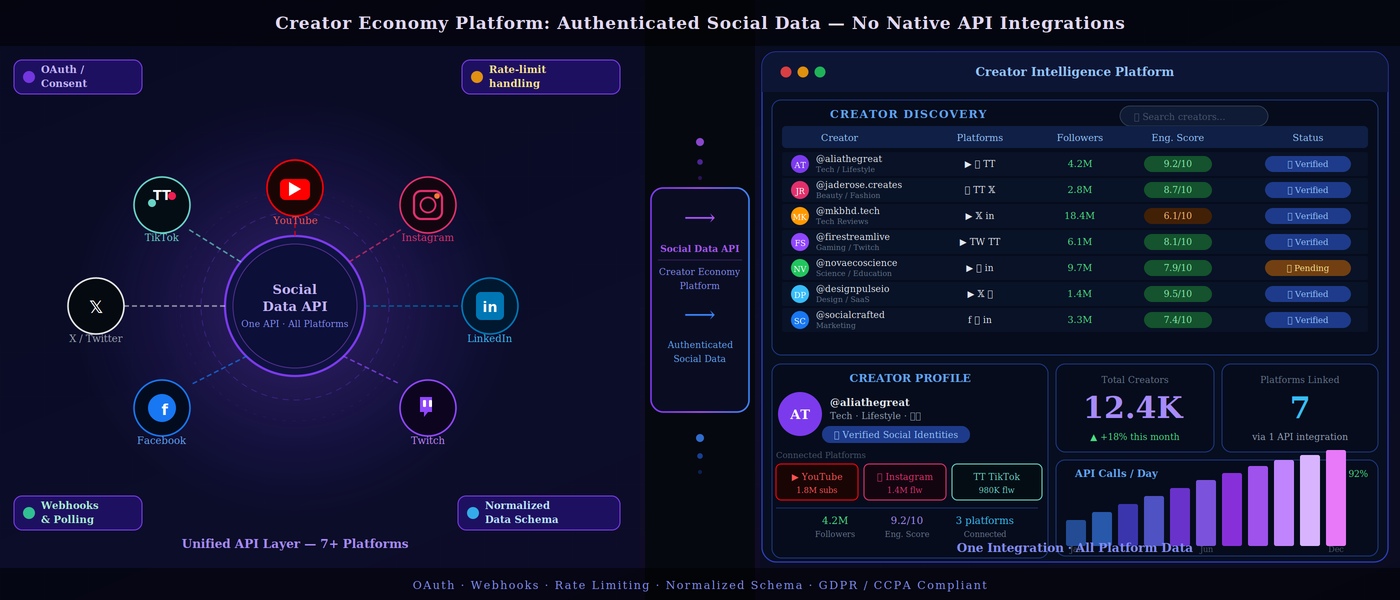
- A creator economy platform can skip native integrations by calling one social data API that handles OAuth, webhooks, rate limits, and data mapping.
- Native integrations for YouTube, TikTok, and Instagram take months each, while a unified layer ships a multi-platform product in weeks.
- Unified social data APIs cover 10 to 50+ sources versus 1 or 2 with a single-platform API.
- Consent based OAuth flows keep data collection aligned with GDPR, CCPA, and platform policies.
- Endpoints like /creators/{id}/analytics return verified followers, engagement, and handle mapping across TikTok, YouTube, and Instagram accounts.
To develop a creator economy platform without building dozens of native social media API integrations, connect to a social data API (a unified creator‑data layer) that already integrates with major platforms. That provider manages OAuth, webhooks, rate limits, datamapping, and compliance, and exposes one social media data API you can call to get creator profiles, engagement metrics, and authenticated social data. This lets you focus on your core product—discovery, vetting, lending, or analytics—while offloading the heavy lifting of social media API integration to a specialized partner.
The Challenge: Why Native API Integrations Don’t Scale
Most teams building a creator economy platform start by thinking: “Let’s integrate Facebook, YouTube, TikTok, Instagram, and X/Twitter.” But that path quickly hits a wall:
- Each platform has its own rules
Different auth flows (OAuth, scopes, app‑review), rate‑limiting models, and data‑schema quirks. - Maintenance overhead is huge
Every breaking API change, privacy‑policy update, or permission‑model shift means engineering work on your side. - You’re building data infrastructure, not product
Time spent on polling loops, webhooks, retries, and data‑normalization is time not spent improving UX, underwriting, or analytics.
Search volumes like “social media API integration” (~50) and “social media data API” (~30) reflect that developers are actively searching for ways to simplify this work instead of reinventing the wheel for each platform.
A Better Way: The Social Data API Pattern
Instead of wiring up each social media API, you can adopt a social data API:
- Single integration layer
One API endpoint to ingest creator profiles, engagement data, and sometimes even audience metrics, across platforms. - Pre‑built OAuth & webhooks
The provider already handles consent flows, refresh tokens, and platform‑specific UX (especially for Instagram, YouTube, TikTok). - Normalized schema
You get a consistent creator object with id, name, platform, followers, engagement_rate, etc., instead of five different response formats. - Compliance & consent baked in
Data is collected via consent‑based, OAuth‑driven flows, which helps you stay aligned with GDPR, CCPA, and platform policies. - Scalable polling and caching
The provider’s backend handles rate‑limiting, back‑offs, and sometimes even real‑time or webhooks‑backed updates.
This pattern is essentially the “API‑as‑a‑middleware” version of social media API integration and has become the default for serious creator‑economy products.
When to Use a Social Data API (vs DIY)
Ask yourself:
- Are you building creator lending, insurance, or income‑advance products that need verified social identity and engagement across platforms?
- Do you want to launch MVP in weeks rather than months?
- Do you want to avoid hiring a team just to maintain API‑glue code?
If yes, a social data API is usually the right move. If you’re building a narrow, single‑platform app (e.g., only YouTube analytics for internal teams), native YouTube Data API or Instagram Graph API integrations may suffice—but for a true creator economy platform, you’ll pay a heavy maintenance cost across time.
How It Works in Practice: A Typical Flow
Here’s a realistic flow for a creator economy platform that uses a social data API instead of native integrations:
Creator onboarding
- Creator signs into your platform (email + password or SSO).
- Your UI presents “Connect TikTok, YouTube, Instagram…” buttons powered by the social data API.
- When the creator clicks, the provider’s consent‑flow opens, asks for permissions, and redirects back with a short‑lived code.
Data ingestion
- Your backend exchanges that code for a long‑lived access token (managed by the provider).
- The provider then polls or listens for changes via webhooks and normalizes the data.
- You call the social data API (e.g., /creators/{id}/profiles, /creators/{id}/analytics) to get:
- Authenticated social profiles.
- Verified followers, engagement, and recent content.
- Cross‑platform handle mapping.
- Sometimes, audience‑segment signals or fraud‑risk flags.
Product‑level logic
- Use the data to:
- Verify creator identity and authenticity.
- Calculate income‑proxy scores or engagement‑based credit limits.
- Power discovery engines (filter by platform, follower‑range, niche).
- Build dashboards and reporting modules.
- Because the API already normalizes the data, your business logic stays clean and platform‑agnostic.
This architecture lets you “build vs buy” in a smart way: you build your creator economy platform; you buy the social data API plumbing.
Benefits of Avoiding Native API Integrations
Picking a unified social data API gives you:
- Faster time‑to‑market
You can ship a multi‑platform creator economy platform in weeks, not months. - Reduced engineering cost
You’re not paying for a team to maintain every edge‑case of each social media API. - Easier compliance
The provider usually handles consent flows, privacy notices, and data‑handling in line with GDPR/CCPA and platform‑level policies. - Elastic scalability
Add new platforms (Snapchat, Twitch, Discord, X) without rewriting your core data‑ingestion code. - Resilience to API changes
When Instagram tweaks scopes or TikTok changes rate‑limits, the provider updates their integration, and your platform keeps working.
These benefits are the main reason the “social data API” (~140) keyword is growing among developers who want to offload API‑glue work and focus on product.
Comparison 1: DIY Native vs Using a Social Data API
Comparison 2: Single‑Platform vs Unified Social Data API
Conclusion
If you’re building a creator economy platform in 2026, you don’t need to reinvent the wheel for every social media API integration. A social data API lets you consume authenticated social data—profiles, engagement, and sometimes income proxies—via a single, well‑defined endpoint. That approach dramatically cuts engineering time, simplifies compliance, and keeps your product roadmap focused on discovery, scoring, lending, or analytics rather than fragile plumbing.
Ready to build your creator economy platform without building native social media API integrations?
Start with a unified social data API →
See how a social media data API powers lending, analytics, and influencer‑marketing platforms →
Frequently Asked Questions (FAQs)
1. What is a social data API in the creator economy?
A social data API is a unified endpoint that exposes creator profiles, engagement metrics, and sometimes audience or authenticity signals from multiple social platforms. It sits between your creator economy platform and the official social media APIs, normalizing data so you don’t have to build dozens of native integrations.
2. Can I avoid building native social media API integrations entirely?
Yes, if you use a social data API that already handles authentication, rate‑limiting, and data‑mapping with each platform. You call that provider’s API instead of wiring up Facebook, YouTube, TikTok, etc., on your own.
3. How does a social data API handle OAuth and consent?
A good social data API provides pre‑built consent flows for each platform (e.g., “Connect Instagram,” “Connect TikTok”). When a creator clicks, the provider handles OAuth, stores tokens securely, and surfaces profile and analytics data via a single endpoint, reducing your UX and compliance burden.
4. Is using a social data API compliant with GDPR and CCPA?
Many social data APIs are designed with GDPR and CCPA in mind, using consent‑based, OAuth‑driven access and clear privacy notices. Always check the provider’s documentation and data‑handling policies, but in general, this architecture is more compliant than scraping or pseudo‑logins.
5. What kind of data can I get from a social data API for creators?
Typical data includes creator profiles (name, handle, platform, avatar), follower counts, engagement rates, recent content, and cross‑platform mapping. Some providers also expose audience‑segment hints, fraud‑risk signals, and estimated earnings, depending on available permissions.
6. Does a social data API support real‑time or webhooks‑based updates?
Some social data APIs support real‑time or near‑real‑time updates via webhooks; others rely on polling and cache layers. The provider usually manages rate‑limits and retries, so your platform gets reasonably fresh data without you having to build complex polling logic.
7. How does a social data API reduce the cost of social media API integration?
By centralizing social media API integration work, a social data API lets you avoid building, testing, and maintaining separate clients for each platform. You pay for one integration instead of engineering time for ten, and you can scale new platforms effortlessly, which is especially valuable for creator economy platforms aiming for global reach and multi‑platform support.
What is a social data API for a creator economy platform?
A social data API is one endpoint that returns creator profiles, follower counts, and engagement from many platforms, sitting between your product and each official social media API.
Can you build a creator economy platform without native API integrations?
Yes. The provider already handles auth, rate limits, and data mapping per platform, so you call one social data API instead of wiring up YouTube, TikTok, Instagram, and X yourself.
How long does it take to launch a multi-platform creator platform?
Weeks with a unified social data API, against months of engineering when you build native integrations one platform at a time, plus the upkeep that follows every launch.
How does a social data API handle OAuth and creator consent?
Pre-built connect flows run the OAuth handshake for each platform, store and refresh tokens, then expose profile and analytics data through a single endpoint you call.
Is a social data API compliant with GDPR and CCPA?
Consent based OAuth access with clear privacy notices is built for GDPR and CCPA alignment, and it holds up better than scraping. Still read the provider's data handling docs.
What creator data can you pull from a social data API?
Expect profiles, verified follower counts, engagement rates, recent content, and cross platform handle mapping, plus audience segment or fraud risk signals where permissions allow.
When should you use a native platform API instead?
A narrow single platform tool, say internal YouTube analytics, runs fine on the YouTube Data API. Cross platform creator products pay a heavy maintenance cost going native.