
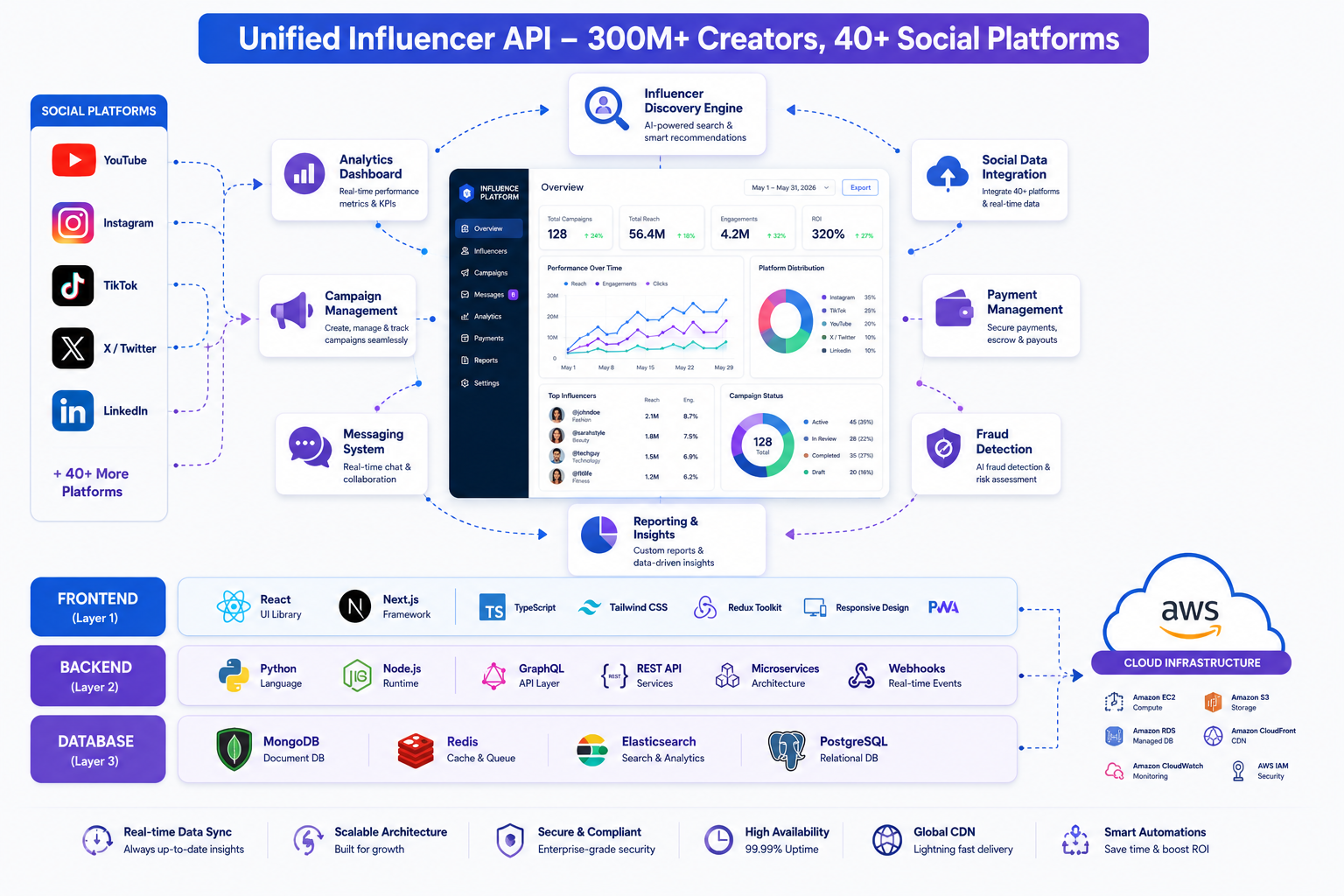


TL;DR Summary: Learn how to build a scalable influencer marketing platform using modern APIs, AI tools, cloud infrastructure, and analytics systems in 2026. This guide explains the complete influencer marketing platform tech stack, including influencer discovery engines, real-time reporting, and fraud detection systems. It also covers real-world scenarios, unified influencer API integrations, and the latest trends shaping influencer marketing software.
- An influencer marketing platform in 2026 needs eight core modules, including creator discovery, campaign management, fraud detection, and payment management.
- React and Next.js handle the frontend, while Node.js or Python services power APIs, analytics, and authentication.
- MongoDB stores flexible creator metadata, Redis caches real-time sessions, and Elasticsearch indexes creator search for fast filtering.
- YouTube, Instagram, TikTok, LinkedIn, Facebook, and X each impose their own rate limits, so most teams use a unified API instead of separate integrations.
- A startup example scaled its platform to 5 million creator profiles and 50,000 campaign reports using Node.js microservices, PostgreSQL, and Elasticsearch.
The economy of content creators and influencers is evolving rapidly and brands/businesses started investing primarily in campaign analytics, creator collaborations, influencer discovery, and social commerce. Indeed, creating a modern influencer marketing platform in 2026 needs much more than a simple influencer database.
Modern brands always expect AI-driven analytics, campaign automation, real-time social data, scalable APIs, and fraud detection. Here the key is to understand the right architecture and appropriate integrations to create a robust influencer marketing platform that can scale globally.
Prime Components of an Influencer Marketing Platform
Any successful influencer marketing platform contains the following primary modules:
- Influencer Discovery Engine
The main role of an influencer discovery engine is to use certain filters and search for competent creators for a specific influencer marketing project.
- Analytics Dashboard
Analytics dashboard helps brands, developers, and marketers to track different engagement metrics of an advertisement campaign.
- Campaign Management
As the name highlights, the campaign management module of an influencer marketing platform manages workflows and companies’ collaborations.
- Messaging System
Messaging system establishes communication of a brand/brands with creator/creators.
- Social Data Integration
Social data integration helps to fetch the creator data from different APIs.
- Payment Management
Payment management tool deals with invoices and payouts.
- Fraud Detection
Brands must essentially identify genuine influencers and content creators for their influencer marketing projects from the pool of online influencers. Here comes the role of a fraud detection tool. It identifies fake engagement to detect and prevent fraudulent activities largely.
- Reporting and Insights
Reporting and insights tool generates regular performance reports of influencers.
A Few Ideal Tech Stacks for an Influencer Marketing Platform
Any proper influencer marketing platform needs a few of the ideal tech stacks, which include the following:
Frontend Technologies
The frontend technologies must provide an intuitive and a fast user experience for creators, agencies, and brands. Also, such stacks should include a few key features, like real-time dashboards, campaign analytics, creator profile pages, advanced filtering, mobile-responsive design, and messaging interfaces. React and Next.js are the two primary frontend technologies for this 2026 based on their scalability and server-side rendering abilities.
Backend Infrastructure
The backend infrastructure powers authentication, APIs, analytics processing, and other database operations. A few of the recommended backend infrastructures/technologies are Python, Node.js, GraphQL, and REST APIs.
Significance of Backend Infrastructure
Any modern influencer marketing software platform can process social media data in bulk. Accordingly, backend systems should handle-
- API rate limits
- Data synchronization
- Webhook processing
- Analytics aggregation
- User authentication
- Background processing
Developers mainly use the microservice architecture to separate campaign management, analytics, creator search, and reporting systems.
Database Layer
The database strategy determines both performance and scalability. A few of the recommended databases and their use cases are as follows-
- MongoDB is used as a flexible creator metadata
- Redis is useful for real-time sessions and caches
- Elasticsearch is perfect to index the influencer search
Elasticsearch is especially used to create an advanced influencer discovery platform, as it gives support to fast filtering across many creator profiles.
APIs for an Influencer Marketing Platform
APIs serve as the backbone of almost every modern influencer platform. Hence, the influencer marketing API should integrate with almost every social platform API. Each API provides access to the follower counts, profile metrics, engagement data, audience demographics, video statistics, and content performance. These include:
- YouTube APIs
- Instagram APIs
- LinkedIn APIs
- TikTok APIs
- Facebook APIs
- X/Twitter APIs
Each API provides access to the follower counts, profile metrics, engagement data, audience demographics, video statistics, and content performance. However, many social platforms apply rate limits, strict restrictions, and key compliance policies. In this situation, developers and marketers use a unified influencer API provider for the social networks rather than creating separate integrations.
Unified Influencer APIs
Unified APIs simplify the development process by offering standardized access across diverse platforms. In this situation, developers and marketers use a unified influencer API provider for the social networks rather than creating separate integrations. The prime benefits include:
- Reduced engineering efforts
- Possesses only one integration layer
- Promotes fast deployment
- Real-time webhooks
- Unified creator analytics
- Improved scalability
Unified approach is consistently becoming a standard in 2026, as social platforms bring frequent changes to the API policies.
Steps to Build an Influencer Marketing Platform
Building any influencer marketing platform consists of creating a bridge between creators and brands with the help of a data-driven architecture. Key steps involved in the development process are-
Defining the Scope and Architecture of a Project
To start, marketers associated with different brands should assemble a professional team consisting of analysts, product managers, and developers. The respective team must outline the essential features. These include the campaign management, influencer discovery, and performance tracking.
Select a Specific Development Method
Select an MVP i.e. Minimum Viable Product to test the products’ core features, like the basic search and easy signup before you should scale to any full-featured application.
Choose a Specific Tech Stack
Now, you need to decide and choose the most beneficial tech stack. If you want a tech stack for mobile phones, choose cross-platform frameworks to reduce the overall cost.
Integrate the Necessary APIs
Secure the vital credentials and use sandbox environments to allow third-party data integrations for real-time synchronization, influencer metrics, and social media authentication.
UI/UX Design
You should focus on intuitive onboarding for both influencers and brands to achieve clear dashboards and easy-to-use search filters.
Database and Backend Development
Create a robust database for storing the profiles, handling role-based and secure authentication, and normalizing the available data derived from diverse social APIs.
Quality Assurance and Deployment
Lastly, we recommend you conduct thorough testing to identify the rate limits, security, and error handling before launching an influencer marketing platform.
Essential Features to Include in the Influencer Marketing Platform
Marketers and brands should consider the following essential features to incorporate in an influencer marketing platform:
Relationship Management
Status tracking, contract signing, and automated messages to launch active campaigns
Discovery Engine
Use advanced search with filters for engagement rates, audience demographics, and niche
Real-time Analytics
Dashboards displaying reach, ROI, and conversion data by simply connecting your campaign data with the sales metrics.
AI Enhancements
AI-powered matching and automated outreach to boost the overall efficiency for launching large-scale campaigns.
Payment Automation
Payment models based on results to deal with escrow services and invoices securely.
Real-World Scenarios of Building an Influencer Marketing Platform
Scenario 1-
A startup company is seeking to create an enterprise-level influencer marketing/discovery platform for digital marketing companies/agencies.
Key Challenges
The company needs the following:
- Creator search across diverse social platforms, like TikTok, YouTube, and Instagram
- Real-time tracking of campaigns
- AI-powered recommendations
- Audience analytics
- Automated reporting
Solutions/Actions
The development team of the startup company implemented the following:
Frontend development via Next.js or React platform
- Node.js microservices
- PostgreSQL analytics storage
- Elasticsearch creator search
- AWS cloud deployment
- Unified influencer API integration
Positive Results and Success
The influencer marketing platform obtained many positive results by successfully handling the following-
- 50,000 campaign reports
- 5 million profiles of content creators
- Dashboards to highlight the real-time analytics
- Synchronization of multiple platforms’ creators
Other than that, the application of unified APIs has significantly reduced the overall development period.
Scenario 2-
An e-commerce company willing to automate its influencer partners across diverse countries.
Challenges/Problems
The company faced many problems/challenges while managing its influencers manually, which are as follows-
- Inconsistent creator data
- Delay in the reporting process
- Poor tracking of performance and advertising campaign
- Slow onboarding
Implementation of the Influencer Marketing Platform
The company implemented a new influencer marketing platform by following the steps and using the features/aspects-
- Automated onboarding of creators
- Shopify integrations
- AI-based recommendations on creators and influencers
- Real-time tracking of user engagement
- Fraud detection systems
Positive Outcomes
The influencer marketing platform developed by the e-commerce company obtained the following positive outcomes/improvements-
- Influencer response times
- Campaign efficiency
- Accuracy in reporting
- ROI measurements
Simultaneously, the company/business scaled many global influencer campaigns without expanding its internal operations.
Conclusion
Creating a modern influencer marketing platform for this 2026 depends solely on scalable cloud architecture, real-time APIs, AI-powered analytics, fraud detection systems, and advanced discovery engines. Companies investing in robust backend infrastructure and unified API integrations may create influencer marketing software to support creators and global campaigns.
Frequently Asked Questions
1. What is an influencer marketing platform?
An influencer marketing platform is software that helps brands discover creators, manage campaigns, track analytics, and automate influencer collaboration workflows across social media platforms.
2. What technologies are commonly used in influencer marketing software?
Modern platforms use React, Node.js, Python, PostgreSQL, Elasticsearch, Docker, Kubernetes, and cloud services like AWS or Google Cloud.
3. Why is an influencer API important?
An influencer API provides access to creator metrics, audience insights, engagement data, and content analytics from social platforms, enabling automation and reporting.
4. What is an influencer discovery platform?
An influencer discovery platform helps brands search and filter creators based on audience demographics, engagement rates, niche, location, and campaign relevance.
5. How do influencer platforms detect fake followers?
Platforms use AI algorithms to analyze engagement quality, audience authenticity, suspicious follower growth, and bot-like activity patterns.
6. What are the biggest challenges in building influencer marketing software?
Major challenges include API rate limits, multi-platform integrations, real-time analytics processing, data normalization, and compliance with platform policies.
7. What is included in an influencer marketing platform tech stack?
An influencer marketing platform tech stack usually includes frontend frameworks, backend APIs, databases, cloud infrastructure, analytics systems, AI tools, and social media integrations.
How do you build an influencer marketing platform?
Start by scoping features with a product team, ship an MVP with basic search and signup, choose your stack, integrate social APIs in sandbox, then test rate limits before launch.
What tech stack do you need for an influencer marketing platform?
React and Next.js cover the frontend, Node.js or Python run the backend with REST or GraphQL, and MongoDB, Redis, and Elasticsearch handle metadata, caching, and creator search.
Which social media APIs does an influencer platform need?
YouTube, Instagram, TikTok, LinkedIn, Facebook, and X APIs supply the follower counts, engagement data, audience demographics, and video stats behind creator profiles.
Why use a unified influencer API instead of separate integrations?
A unified influencer API gives you one integration layer across networks, which cuts engineering work, adds real-time webhooks, and absorbs the frequent platform API policy changes.
What does Phyllo do for influencer marketing platforms?
Phyllo is a social data infrastructure platform with one unified API for creator data across networks, covering public profile metrics and consented, authenticated account data.
How do influencer platforms detect fake followers?
Fraud detection models score engagement quality, audience authenticity, sudden follower spikes, and bot-like activity, so brands can filter out creators with fake engagement.
What are the hardest parts of building influencer marketing software?
API rate limits top the list, followed by multi-platform integrations, real-time analytics processing, normalizing creator data, and staying compliant with each platform's policies.
How much does influencer marketing API access cost?
API access commonly runs $500 to $3,000 a month as an add-on to platform fees in 2026, while narrower niche influencer data APIs sit closer to $100 to $300 a month.
Which database should power influencer search at scale?
Elasticsearch is the pick for influencer discovery because it filters across large volumes of creator profiles fast, with MongoDB holding metadata and Redis caching live sessions.