

TL;DR Summary: All four major social APIs - Instagram, TikTok, LinkedIn, and YouTube - are free to access at the base level, but each is gated behind a different approval process, serves a different data model, and has a distinct set of gaps that matter enormously depending on what you are building. Instagram wins for influencer marketing platforms. TikTok leads for content publishing and social commerce. LinkedIn is the only option for B2B creator use cases despite its restrictive access model. YouTube's Analytics API provides the deepest per-channel data depth. If your product needs to work across platforms, or requires data that no native API exposes - audience demographics for third-party creators, cross-platform identity, earnings data - a unified consent-based API layer is the more practical architecture than building four native integrations sequentially.
- Build Instagram first for influencer marketing, TikTok first for publishing or TikTok Shop, LinkedIn only for B2B creators, YouTube for channel analytics.
- No native API returns audience demographics for a creator who has not authorised your app.
- Approval waits run from about a week for TikTok sandbox to four months for LinkedIn Marketing Developer Platform.
- The Instagram API caps calls at 200 per hour per account, and YouTube Data API v3 starts at 10,000 quota units a day.
- Phyllo covers 25+ platforms in one schema with a median 7 day integration, against 12 to 18 months in-house.
Instagram API vs TikTok API vs LinkedIn API: Which Should You Integrate First?
Build Instagram first if you are making an influencer marketing platform. Build TikTok first if you are making a publishing tool or anything touching TikTok Shop. Build LinkedIn first only if your creators are B2B, because nothing else covers them. Build YouTube first if your product is a channel analytics dashboard.
All four APIs are free at the base tier. All four gate the useful data behind an approval process, and the wait ranges from about one week for TikTok to three or four months for LinkedIn. One fact matters more than any of that: none of the four returns audience demographics for a creator who has not authorised your app. If your product depends on that data, the order you build them in is not your real problem.
Everything below is current as of July 2026.
Which API should you build first?
It depends on your product type, not on which API is easiest. Here is the short answer for each of the six most common builds.
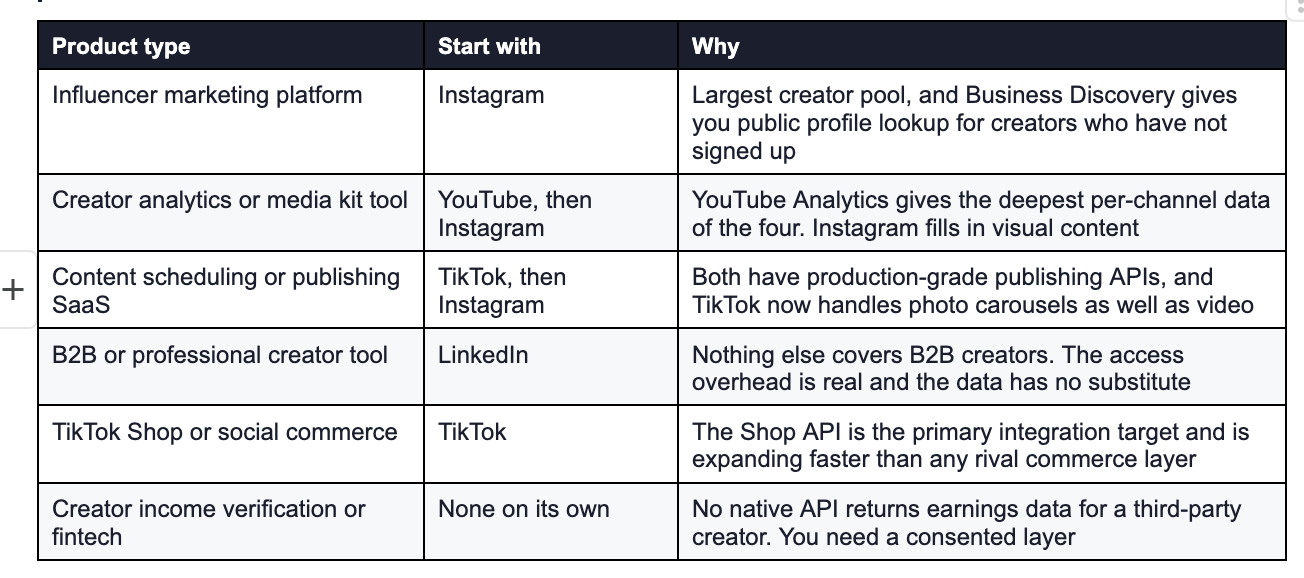
Two notes on that table. First, your starting platform is not your only platform. It is the one that delivers product value fastest for your users. Second, if you serve several product types at once, start where you will learn the most, not where the code is easiest. TikTok's sandbox gets you a first call in an afternoon. LinkedIn can take four months. That gap should shape your sequence even when LinkedIn data matters more in the end.
How do the four APIs compare on the things that matter?
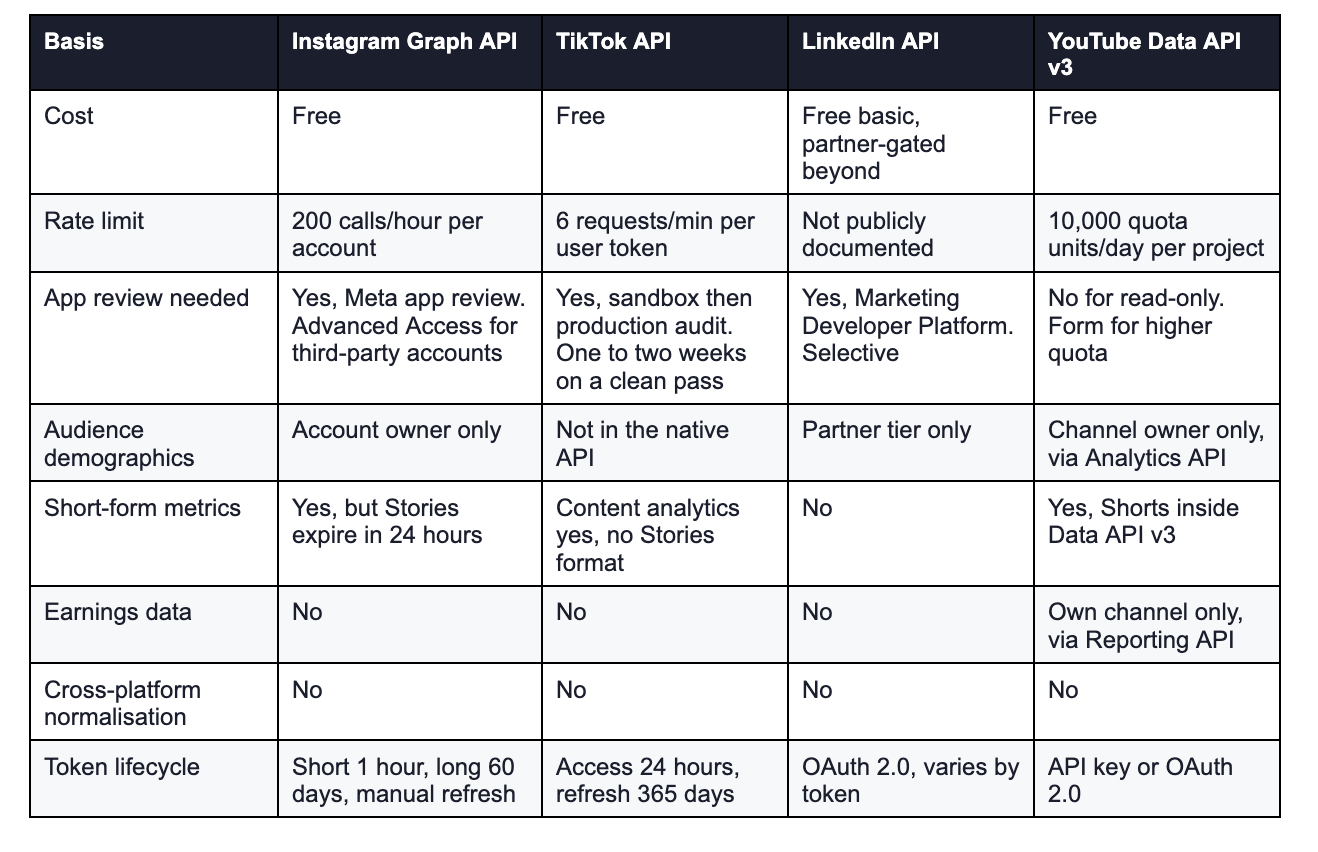
On cost they are identical and free. On everything else they diverge sharply. Read the rate limit and app review rows first, because those two decide your timeline.
Building against more than one of these? Phyllo returns creator profiles, engagement, and audience demographics from 25+ platforms through one schema. Median integration time across our customers is 7 days, against 12 to 18 months for a full in-house build. Sign up free and get API keys. Link: dashboard.getphyllo.com
What can the Instagram Graph API actually do?
It is the most mature option for influencer marketing platforms, creator analytics, and scheduling tools. It is also the only option left. Meta retired the Instagram Basic Display API in December 2024, so any integration still on it has already stopped working.
What it does well
Business and Creator accounts get media, comments, hashtag search, mentions, and audience demographics by age, gender and location for the account owner. The Business Discovery endpoint returns public profile data such as follower count, media count and bio for other Business or Creator accounts, which makes basic creator discovery workable.
The limit that will shape your product
Audience demographics come back only for the account that authorised your app. If a brand wants to see the audience breakdown of a creator they are considering, and that creator has never signed in to your platform, the native API cannot help you. This is not a gap you engineer around. It is how Meta's data model works.
Rate limits in practice
The Business Use Case model allows 200 calls per hour per account, not per app. That sounds generous until you manage a few thousand connected creators. Scaling past that point needs batching, caching, webhooks instead of polling, or a layer that handles quota distribution for you.
Stories data expires and will not come back
Stories vanish after 24 hours and the API reflects that exactly. Once a story expires its metrics are gone. Historical Stories reporting means running a background job that polls every connected creator throughout the day, every day. Most teams discover that infrastructure cost after they have committed to the feature.
Token lifecycle
Short-lived tokens last one hour. Long-lived tokens last 60 days. Neither refreshes on its own. Without explicit refresh logic your integration will fail silently in production, and it will fail on a Tuesday two months after launch when nobody is looking.
What changed in TikTok's API in 2026?
Four things, and one of them broke integrations on a fixed date. TikTok is the fastest-moving of the four APIs, which is good for capability and bad for maintenance.
Photo carousels are supported
The Content Posting API used to accept video only. It now accepts photo carousels, which removes the workarounds image-first tools previously needed.
Sandbox mode is the default
Every new app starts in sandbox, where you can run the full OAuth and upload flow against real TikTok infrastructure without publishing anything. One behaviour catches people out: content from an unaudited app is forced to private visibility no matter what privacy setting the user picked at the consent screen.
TikTok Shop is now the biggest surface
The Shop Open API covers Products, Orders, Inventory, Fulfillment and Analytics. Since 17 June 2026 the gateway accepts HTTPS only, so any integration still sending plain HTTP broke on that date. The Shop API also added auction products and three new versioned Analytics APIs that bring metric parity with the Seller Center dashboard.
The rate limits to plan around
The Content Posting API allows 6 requests per minute per user token for upload initiation, plus a daily publishing ceiling of roughly 15 to 25 videos per account that varies by account tier and is shared across every API client posting for that account. App-level daily caps exist, are not published, and change without notice. Full detail is in our TikTok API rate limits guide, and the setup walkthrough is in our TikTok API integration guide.
What TikTok does not give you
Audience demographics. No age breakdown, no gender split, no geography. Follower counts and basic engagement come through the Display API, but the audience-level data brands actually use for campaign decisions is not there. For an influencer marketing platform this is the single biggest reason not to treat TikTok as a complete integration.
How hard is LinkedIn API access really?
Harder than the other three, and worth it only for a specific set of products. Expect three to four months for Marketing Developer Platform approval, and expect rejection to arrive without a stated reason.
What the free tier gives you
Name, headline, profile photo, and Sign In with LinkedIn. That is the whole dataset available without a formal application. Follower counts, engagement analytics, audience demographics and company insights all require Marketing Developer Platform or partner-tier access.
What approval actually involves
A formal application, a verified company page, legal entity verification, a real privacy policy, a working product demo, and a manual review with no published timeline. Common rejection categories include sales automation tools, CRM enrichment products, and creator discovery platforms aimed at LinkedIn profiles. We break down the tiers, the process and the rejection patterns in our guide to LinkedIn API access.
Rate limits are undocumented
Instagram, TikTok and YouTube all publish their limits. LinkedIn does not, at least not consistently. That makes capacity planning guesswork until you have approval and can measure in production.
When to build on it anyway
LinkedIn is the only source of professional identity data at scale. If you vet B2B creators, verify professional credentials, or run LinkedIn-native publishing workflows, there is no alternative and the overhead is the price of entry. For consumer influencer marketing, it is not where you start.
How deep is YouTube's analytics data?
Deepest of the four for creators who authenticate, and useless for creators who do not. That is because YouTube is really two products with different rules.
YouTube Data API v3 handles metadata, channels, playlists, search and comments. Every Google Cloud project starts at 10,000 quota units per day, and the cost per call varies enormously. A videos.list call costs 1 unit. A search.list call costs 100. An app doing frequent searches burns the whole daily quota in 100 requests. Raising it means a formal extension request to Google. There is no paid tier, and spinning up extra projects to multiply the free quota breaks the Terms of Service.
YouTube Analytics API is the separate product for watch time, audience demographics, traffic sources, engagement and revenue. It needs OAuth from the channel owner. You cannot pull analytics for an arbitrary third-party channel, which means an influencer platform reporting on channels it has no relationship with gets nothing from Google's native stack.
There is no standalone Shorts API. A vertical video of 60 seconds or less is classified as a Short automatically inside Data API v3, and you filter for them with the videoDuration and videoDimension parameters. Shorts performance also appears in the Analytics API for the channel owner. Treat Shorts as a content type, not a product.
What data does no native API give you?
Four things, and they are the four that most creator economy products are built on. This table is the reason architecture matters more than build order.
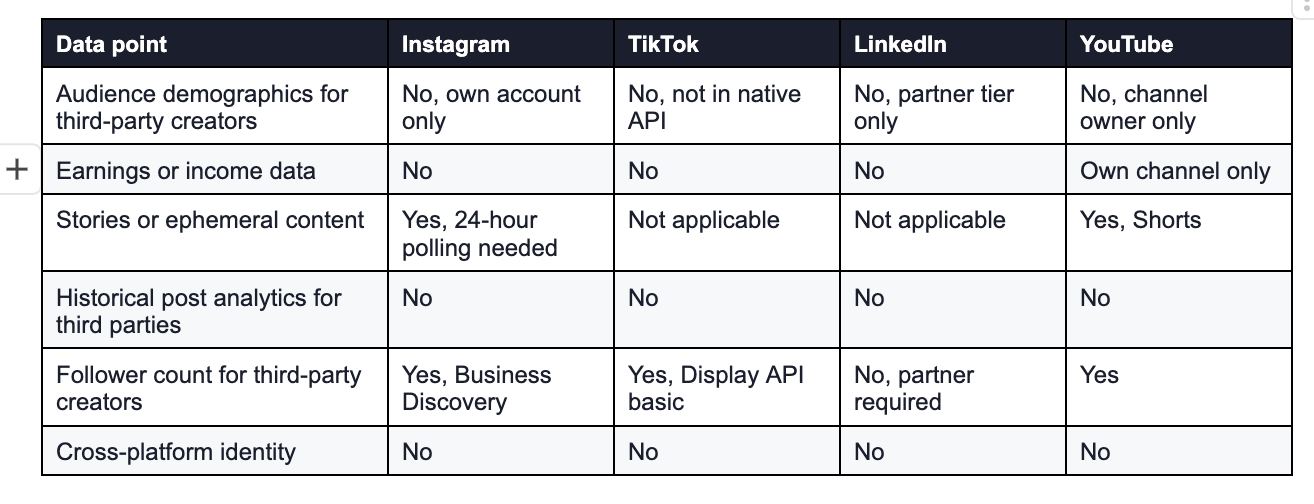
These are not edge cases. Audience demographics, historical analytics for creators you have not onboarded, and earnings data are core fields for influencer marketing platforms, creator income verification, and audience authenticity products. The distance between what the native APIs hand over and what those products need is exactly where a consented data layer operates.
Fill before publishing. Add one Phyllo number here, in this section. Suggested framing: across the profiles Phyllo indexes, [INSERT: N] percent of creators are active on more than one of these four platforms, which means a single-platform integration misses [INSERT: N] percent of their reach. Have the data team confirm real figures. Do not publish an estimate.
When does a unified layer beat four native integrations?
When the data you need is in that gaps table, or when you need more than two platforms. Below that threshold, native integrations are fine and cheaper.
Every native integration carries the same three costs. The build itself, meaning OAuth, endpoints and normalisation per platform. The maintenance, as platforms version APIs, retire endpoints and change auth. And the gaps, which no quality of engineering closes.
A consented layer addresses all three at once. The creator connects their accounts through your product, the layer handles the OAuth and the normalisation, and when TikTok changes token behaviour or Meta retires an endpoint the way it did with Basic Display in December 2024, the layer absorbs it and your team does not redeploy.
Phyllo is built for that shape. We are not a scheduler, not a monitoring dashboard, and not a scraper. We are consent-driven infrastructure for platform builders and fintech teams that need authenticated creator data across 25+ platforms from one integration. You can see the current field coverage per platform on our coverage page. The data includes fields no public API exposes: real impression counts, Stories performance, audience demographics, and earnings where platforms release them. Pricing starts at $199 per month with usage-based scaling, full platform coverage from the first tier, and no annual commitment at entry.
The honest trade-off. A consented layer needs the creator to act. A creator who has not connected an account does not exist in your data. If your main job is brand-side discovery, screening creators who have never heard of you, a public index such as Modash covers that stage better than we do. Plenty of teams in 2026 run both in sequence: a public index for discovery, a consented layer for verified data after onboarding. We go into that comparison in detail in consent-based vs public social APIs.
So the real question is not which of the four to build first. It is whether what those four return is enough for the product you are building. For most teams the native APIs are a starting point and a consented layer is the production architecture.
CTA 2, closing block. Primary button: Get API keys free, linking to dashboard.getphyllo.com. Secondary: Talk to us about coverage at scale, linking to /get-demo. Proof line underneath: median 7-day integration, 99.99 percent uptime, SOC 2, 220M+ profiles indexed.
Frequently asked questions
Which social media API is easiest to start with in 2026?
TikTok. Sandbox mode means you can make a first API call the same day you register an app. YouTube Data API v3 is close behind for read-only calls with a standard API key. Instagram needs a Business or Creator account linked to a Facebook Page before any access is possible. LinkedIn's free tier is minimal and real access needs an application that can take months.
Why can I not get audience demographics for creators who have not signed up?
Every platform restricts audience demographics to the account owner for privacy reasons. Age, gender and location come back through the API only when that creator has authorised your app. No access tier changes this. A consented layer that requires creator authentication is the architecture that fills the gap.
Is the Instagram Graph API better than the TikTok API for an influencer platform?
For most influencer marketing use cases in 2026, yes, as a starting point. Instagram has the largest creator pool, returns audience demographics for authenticated accounts, and has a more mature analytics surface. TikTok's native API has no audience demographics at all, which is a real gap for campaign decisions. TikTok moves faster on capability though, and most platforms end up on both.
What data does no native social API provide?
Audience demographics for third-party creators, earnings or income data for any creator, cross-platform identity linking, and historical analytics for creators who have not authorised your app. These gaps are deliberate design decisions about privacy and data monetisation, not temporary omissions, so waiting for them to close is not a strategy.
When does a unified social API make more sense than native integrations?
When you need more than one or two platforms, when you need data the native APIs do not expose, or when your engineers are spending more time on platform maintenance than on product. Maintenance cost compounds with each platform added, because the normalisation work grows faster than the integration count.
Which social media API is easiest to integrate first in 2026?
TikTok. Sandbox mode lets you make a first API call the day you register an app, while real LinkedIn access needs an application that can run three to four months.
Why can't I get audience demographics for creators who haven't signed up?
Audience demographics come back only for the account owner who authorised your app. Age, gender and location stay closed for every other creator, and no access tier changes that.
Is the Instagram Graph API better than the TikTok API for influencer platforms?
As a starting point, yes. Instagram returns audience demographics for accounts that authenticate, while TikTok's native API returns none at all, which hurts campaign decisions.
How long does LinkedIn Marketing Developer Platform approval take?
Three to four months, and rejections arrive without a stated reason. You need a verified company page, legal entity verification, a real privacy policy, and a working demo.
What are the Instagram Graph API and YouTube Data API rate limits?
Instagram allows 200 calls per hour per account, not per app. YouTube Data API v3 starts at 10,000 quota units a day, and a single search.list call spends 100 of them.
What data does no native social media API give you?
Four things: audience demographics for third-party creators, earnings data, cross-platform identity linking, and historical analytics for creators who never authorised your app.
What is Phyllo and when does it beat four native integrations?
Phyllo is consent-driven social data infrastructure covering 25+ platforms through one schema. Median integration runs 7 days, and pricing starts at $199 per month with no lock-in.