
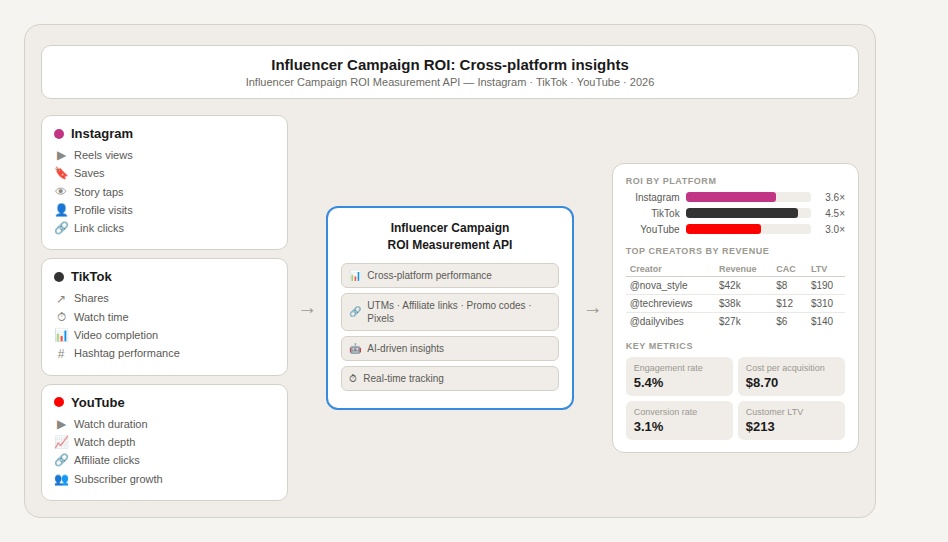


TL;DR Summary Modern influencer marketing relies heavily on ROI measurement APIs to track campaign performance across Instagram, TikTok, and YouTube. These APIs help brands monitor engagement, conversions, audience quality, and revenue using advanced analytics and attribution models. With features like real-time tracking, AI-driven insights, and cross-platform reporting, businesses can optimize creator partnerships and improve influencer marketing ROI effectively.
- An influencer campaign ROI measurement API pulls conversions, watch time, and affiliate clicks from Instagram, TikTok, and YouTube into one dashboard.
- Attribution runs on promo codes, affiliate links, UTM parameters, pixel events, and server side conversion signals, not last click alone.
- Instagram Stories expire after 24 hours, so ROI tracking needs real time story taps, saves, and shares.
- Creator ROI APIs report four metric layers: engagement, audience, conversion, and cost, including cost per acquisition and customer lifetime value.
- In a 45 day campaign with 35 creators, YouTube drove the highest average order value while TikTok drove reach and traffic spikes.
How do platforms track influencer campaign ROI across Instagram, TikTok, and YouTube?
Brands use ROI measurement APIs that collect performance data — like conversions, engagement, watch time, and affiliate link clicks — from each platform and centralize it into a single dashboard, using attribution methods such as UTM parameters, pixel tracking, and promo codes to link creator activity to real business outcomes.
Modern brands always look for measurable business outcomes, like the revenue, conversions, lead generation, app installs, and customer retention to drive their influencer marketing campaigns. This has led to an increase in demand of advanced APIs and related analytics platforms in 2026.
Creator and influencer campaigns today run across diverse channels, which include TikTok, YouTube, and Instagram. However, every platform provides diverse attribution models, analytics formats, and engagement signals. To solve the issue, businesses and brands have now started relying on sophisticated ROI measurement APIs. These APIs centralize the available creator data to transform them into actionable insights.
Effective ROI tracking systems allow brands to measure conversions, engagement, cost of customer acquisition, and campaign revenue from creators that operate across diverse platforms. Accordingly, marketers may improve their campaign performance and scale their partnerships efficiently.
For brands that are new to ROI measurement — including how to set goals, select the right KPIs, and justify spend to stakeholders — our complete guide on measuring influencer marketing ROI covers the full strategic framework before diving into the API layer.
How Does an Influencer Campaign ROI Measurement API Work?
An influencer campaign measurement API or creator analytics API collects performance-related data from diverse social platforms to combine them into a single common dashboard. The API serves as a centralized bridge between advertisers, platforms, analytics systems, and ecommerce stores. The API workflow mainly follows the below steps:
1. Authentication of Content Creators
Influencers or content creators connect their diverse social accounts securely with the help of official APIs and related authentication systems. By doing so, brands may access the performance metrics via their user consent.
2. Data Collection
The ROI Measurement ROI collects different metrics, which include impressions, reach, likes, shares, video views, saves, click-through rates, story taps, conversion events, audience demographics, and watch time.
3. Tracking of Attributions
Tracking systems connect the entire influencer traffic to diverse ecommerce events. For this, it uses affiliate links, UTM parameters, pixel tracking, promo codes, pixel tracking, server-side events, and API-based conversion signals.
4. Performance Analytics
Later, the data collected from diverse social platforms and/or ecommerce events is processed into dashboards for ROI measurements and influencer performance analytics.
5. Insights based on AI Models
Modern APIs use different AI models to analyze the engagement quality, predict the performance of content creators, and success probability of any campaign.
6. ROI Tracking for Specific Social Platforms
Each social platform tracks its user engagement differently. Hence, marketers should understand the differences to measure influencer marketing appropriately.
7. ROI Calculations for Instagram
Instagram is a valuable influencer channel for ecommerce, travel, beauty, fashion, and lifestyle brands. Accordingly, the Instagram API ROIs regularly track the Instagram reel views, saves, story engagement, profile visits, shares, link clicks, conversion rates, and product tag interactions.
Instagram campaigns rely solely on Reels and Stories. Especially, the stories last for only 24 hours, APIs must allow real-time tracking and collection of the performance data. Even the brands monitor shares and saves, as they indicate strong audience intents as compared to the number of likes only.
Common Instagram ROI metrics are cost per engagement, engagement rates, click-through rates, story completion rates, audience quality scores, and conversion rates.
YouTube ROI Calculations and Measurement
YouTube delivers strong purchase intent with long-form engagement. Accordingly, the YouTube APIs can track the following:
- Audience retention
- Watch duration
- Number of clicks associated with an affiliate link
- Sentiments of contents
- Growth in the number of subscribers (genuine subscribers)
- Conversion events
- Depth of a video engagement
Unlike any short-form platform, YouTube videos generate conversions and traffic continuously for months and even for years. Such a long-tail value makes ROI tracking vital. Brands regularly use the integrations of YouTube creators for:
- Obtaining product reviews
- Managing tutorials
- Launching educational campaigns
- Demonstrating software solutions
- Sponsoring games
- Launching new technologies
ROI Measurement for TikTok
Today, TikTok serves as a strong channel for Gen Z engagement and viral reach. Accordingly, the TikTok APIs can track:
- Shares
- Watch time
- Video completion rates
- Trending use of audio
- Attribution of TikTok visitors/traffic
- Hashtag performance
- Viral velocity
- Interaction patterns of the audience
TikTok has its algorithm-driven discovery system that leads to attribution more challenging, as many users see content without clicking the links immediately. Indeed, marketers often use hybrid attribution models, which consist of post-campaign search, promo codes, and conversion tracking from the server side. According to the industry’s benchmarks, TikTok campaigns may generate the highest possible ROI figures among different creators’ platforms.
Real-World Scenarios of ROI Measurement
Scenario 1-Social Platforms’ ROI Measurement for an Ecommerce Fashion Brand
A global ecommerce fashion brand or a fashion retail launches its marketing campaign consisting of the following:
- 10 TikTok lifestyle influencers
- 20 Instagram fashion creators
- 5 YouTube fashion vloggers
For this, the company uses an innovative API-driven tracking system to centralize its campaign data.
Tracking Setup
According to the setup, the retailer assigned:
- Discount codes specific to content creators
- Unique affiliate links
- UTMs at the platform-level
- Pixel tracking events
Results/Outcomes of the Campaign
After 45 days, the e-commerce fashion/retail brand observed the following positive results:
- Instagram creators succeeded to drive the highest possible product savings and wish list additions
- YouTube creators delivered the maximum average order values
- TikTok creators generated a massive reach and a huge spike in the traffic
Without any centralized influencer campaign tracking, the retailers often struggle to identify the right platform for generating the highest profitable customer. The analytics system also highlights that the micro-influencers outperform celeb content creators in terms of conversion efficiency.
Scenario 2-Productivity App Launched by a B2B SaaS Company
A B2B SaaS Company uses creator or influencer marketing for launching its productivity app. For this, the campaign has included:
- Instagram’s business creators
- Tech reviewers of YouTube
- Productivity influencers by TikTok
Key Tracking Strategies Adopted by the SaaS Company powered by API
The SaaS Company integrates different APIs, which include the first-party attribution systems, creator analytics APIs, ecommerce APIs, and CRM APIs. Each creator received an onboarding link to connect directly to the backend SaaS analytics.
Insights Generated
The ROI API adopted by the company succeeded to generate many valuable insights to identify the following:
- YouTube tutorials producing the highest trial and paid conversion rates
- TikTok creators generated a maximum number of app installs
- Instagram creators boost brand awareness but have low conversions
The platforms also measured:
- Retention of trials
- Lifetime value of customers
- Revenue for each creator
- Cost for a single acquisition
- Ratios of signup-to-subscription
The SaaS company identified that the long-form YouTube contents can deliver the strongest and long-term ROI. The reason is that the users trust more on detailed demonstration of the offered products as compared to any short-form ad.
Various Types of Metrics Used in Influencer ROI APIs
Modern social platforms often use multiple data layers for accurate influencer marketing ROI calculations. For a detailed breakdown of the fiv most critical KPIs within these categories — and how to track them across Instagram, TikTok, and YouTube through a single API — see our guide on the key influencer marketing KPIs to track across platforms.
Engagement Metrics
Engagement metrics refer to quantitative measurements, which help you to identify the user friction, gauge the audience interest, and understand the way in which your products drive retention and loyalty. Common examples are likes, shares, comments, watch time, saves, and completion rates.
Audience Metrics
Audience metrics track the number of people consuming the brands’ content, the type of customers, and the mode of their interaction. Audience metrics are critical to evaluate the content performance, and optimize engagement with marketing strategies. Common examples are geographical distribution, demographics, follower growth, authenticity of the audience, and interest categories.
Conversion Metrics
The conversion metrics determine the effectiveness and efficiency of a brand to convert its online audience into loyal and payable customers. Examples are signups, purchases, leads, app installs, and revenue generations.
Cost Metrics
Cost metrics in marketing also serve as viral indicators to gauge the financial viability and efficiency of the marketing strategies. Examples are cost per engagement, cost per click, cost per lead, and cost per acquisition.
Best Practices to Measure the ROI of Influencer Marketing
Both businesses and brands should essentially follow the following necessary practices for boosting the accuracy associated with their ROI measurement:
Use Multi-Touch Attribution
One should strictly avoid following or relying solely on only last-click attribution.
Combine Multiple Tracking Methods
Next, every brand or marketer should use promo codes, affiliate links, pixel tracking, CRM attribution, and API integration.
Look for and Measure Long-term Value with Quality Metrics
Brands and marketers should look for the options that can give long-term value:
- Lifetime value of the customers
- Repetitions in making purchases
- Search growth for brands
- Retention of subscribers
- Focus on Quality Metrics
Modern campaigns always prioritize the number of shares and save, retention, watch time, and qualified leads rather than using only vanity metrics.
Use Unique Dashboards to Centralize the Social Data
Brands should use unified dashboards to compare the performance of creators or influencers across TikTok, Instagram, and YouTube efficiently. For brands looking for a ready-built solution that delivers exactly this — real-time cross-platform ROI tracking, fraud detection, and unified creator analytics across Instagram, TikTok, and YouTube — Phyllo's influencer marketing platform provides all of it through a single API integration.
Conclusion
Influencer marketing has recently evolved as a highly measurable performance channel driven by analytics systems, APIs, and other attribution models driven by API. Modern brands need many things than simply impressions, likes, and shares. Instead, they need deep visibility into conversion performance, engagement quality, audience behavior, and revenue generation for a long time.
Advanced API systems now help brands to track their creator/influencer campaigns across Instagram, YouTube, and TikTok by using only one dashboard. Such platforms help marketers to boost their campaign efficiency, identify the top-performing influencers/creators, and use data-driven decisions and accurate attribution to maximize their influencer marketing ROIs.
Frequently Asked Questions
1. What is influencer marketing ROI?
Influencer marketing ROI measures the revenue or business value generated from influencer campaigns compared to the campaign cost. It helps brands determine campaign profitability and marketing efficiency.
2. Why is influencer ROI difficult to measure?
Attribution is complex because customers interact with multiple platforms before purchasing. Many users discover products through creators but convert later through search engines or direct visits.
3. Which platform delivers the best influencer ROI?
It depends on campaign goals. TikTok often performs best for viral reach, Instagram works well for ecommerce engagement, and YouTube excels at long-form education and high-intent conversions.
4. What are the most important ROI metrics?
Important metrics include engagement rate, conversions, cost per acquisition, revenue generated, watch time, audience quality, and customer lifetime value.
5. How do APIs help measure influencer marketing?
APIs collect creator analytics from multiple platforms and centralize the data into unified dashboards for attribution, reporting, and performance optimization.
6. What is multi-touch attribution in influencer marketing?
Multi-touch attribution distributes conversion credit across multiple customer touchpoints instead of assigning all value to the final click.
7. How does AI improve influencer performance analytics?
AI improves creator selection, predicts campaign outcomes, detects fake engagement, analyzes audience sentiment, and supports smarter attribution modeling.
How does an influencer campaign ROI measurement API work?
Creators connect their accounts through official platform auth, the API collects metrics like reach, watch time, and conversions, then maps that activity to sales in one dashboard.
Which attribution methods link influencer traffic to sales?
Most teams combine creator promo codes, unique affiliate links, platform level UTMs, pixel events, and server side conversion signals, since no single method catches every buyer.
Why is influencer marketing ROI so hard to measure?
Buyers touch several platforms before purchasing. Someone discovers a product through a creator, then converts days later via search or a direct visit, which hides the original source.
Which platform delivers the best influencer ROI?
It depends on the goal. TikTok wins on viral reach, Instagram on ecommerce engagement like saves and wishlist adds, and YouTube on high intent, long form conversions.
What metrics do influencer ROI APIs track?
Four layers: engagement such as saves and watch time, audience quality and demographics, conversions like signups and installs, and cost metrics including cost per acquisition.
How does Phyllo measure influencer campaign ROI?
Phyllo is social data infrastructure for creator economy teams, giving real time cross platform ROI tracking, fraud detection, and unified analytics through one API integration.
What is multi touch attribution in influencer marketing?
Multi touch attribution spreads conversion credit across every touchpoint a buyer hits instead of handing all of it to the final click, so awareness content gets counted too.