


TL;DR Smmary: Social media data APIs are transforming HR tech by automating candidate screening — pulling public profile data from LinkedIn, Instagram, TikTok, and more to run identity checks, content risk detection, and employment validation in minutes instead of hours. Industries like fintech, healthcare, and BPO are already using these tools to cut verification time, reduce fraud, and scale hiring workflows without heavy manual effort.
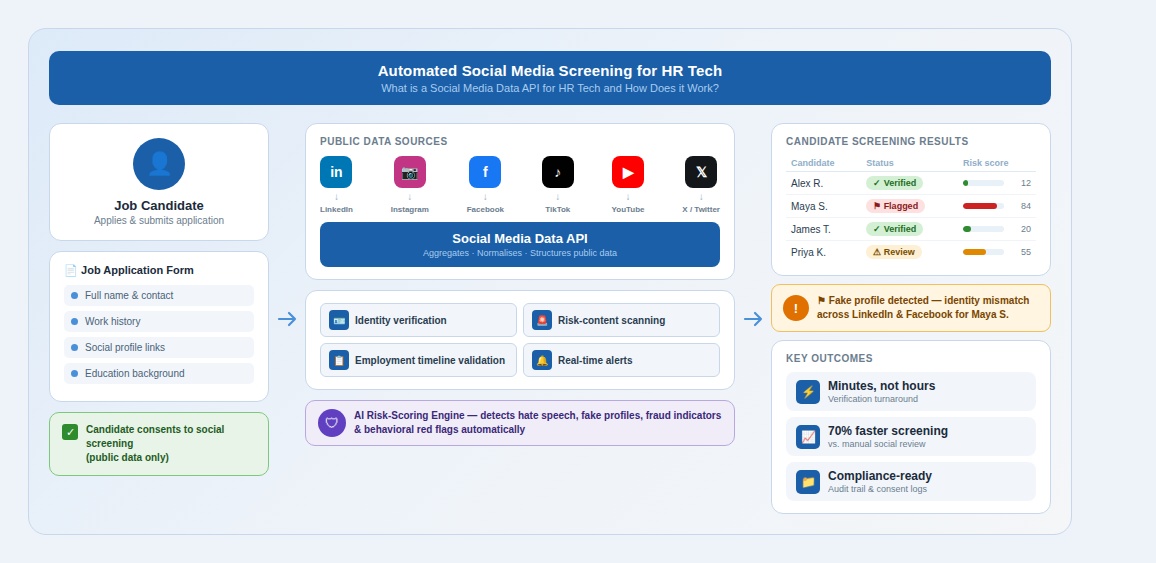
- A social media data API lets HR platforms pull public profile data from LinkedIn, Instagram, TikTok, YouTube, and X after a candidate consents.
- One fintech startup cut candidate verification time by about 70% after adding API screening to its applicant tracking system.
- A global BPO cut hiring turnaround from 10 days to 3 days using automated screening inside its onboarding software.
- AI content scans check public posts against 6 risk categories, including hate speech, harassment, extremism, and explicit violence.
- Fintech, healthcare, education, cybersecurity, and BPO firms use screening APIs most, backed by consent forms and audit trails.
What is a Social Media Data API for HR Tech and How Does it Work?
A social media data API lets HR platforms automatically collect and analyze candidates' public profile data across multiple platforms — verifying identity, flagging risky content, and validating employment history — all within a consent-based, automated background check workflow.
Hiring has now evolved far beyond interviews and resumes. Modern companies look for deep insights into the online presence of a candidate. Also, it checks the applicants’ professional conduct, digital reputation, and communication style before making any sound hiring decision. Such a shift has led to the importance of modern verification tools and social media screening solutions powered by APIs.
As different HR technology platforms are consistently automating the verification and recruitment workflows, there is a rapid growth in the demand for advanced HR tech APIs. Accordingly, the APIs help HR professionals streamline the background check processes of each employee to reduce the manual effort and boost accuracy in the hiring of employees.
Our blog post will thus explore the way in which social media data APIs are regularly transforming HR tech, and their key roles in social media background checks.
Any social media data API helps recruitment programs, HR platforms, and verification companies to access the publicly available social media data securely from different platforms, like YouTube, LinkedIn, Instagram, Facebook, TikTok, and X (formerly known as Twitter). Accordingly, the social media data APIs allows automation in workflows for-
- Identity verification of the candidate
- Reputation analysis
- Validating one’s employment
- Risk assessment of an employee’s behavior
- Profile matching at professional levels
- Content moderation checks
- Fraud detection
Any advanced HR tech social media API allows recruitment companies to integrate the checks directly into different hiring platforms without the need of any manual investigation.
Role of APIs to Automate Workflows in Background Verification
Any social media API may directly integrate into HR software or identity verification platforms. Whenever a candidate consents, the API system automatically collects the necessary public data to create structured reports. Indeed, the automation in the process significantly reduces the overall verification period.
To understand where social media data APIs fit within the broader hiring workflow, our complete guide on the pre-employment screening process walks HR professionals through every stage — from consent forms and identity checks to criminal records, education verification, and social media screening — with a step-by-step checklist.
Interesting Features of any HR Tech social media API
1. Multi-platform Data Access
Modern social media APIs aggregate data from different social platforms. These include Instagram, LinkedIn, TikTok, Facebook, YouTube, and X (Twitter). The unified access will simplify the background check operations on a large-scale.
2. Content Risk Detection
AI-powered systems may scan public posts to detect-
- Racism
- Hate speech
- Extremism
- Harassment
- Explicit violence
- Illegal activities
In this way, social media background check systems provide both scalable and efficient solutions. For a deeper technical breakdown of why building on an API-first architecture is critical for delivering these capabilities at scale — including how standardised screening criteria reduce bias and how real-time data access ensures compliance — see our guide on the API-first approach to scalable and compliant background checks.
3. Identity Matching/Verification
Tech social media data APIs verify the identity of various social profiles to make sure that they belong to the right candidate. Common matching parameters include the candidates’ name, email id, educational background, username, profile photos, and employment details. The verification helps in reducing all sorts of identity fraud at the time of recruitment.
4. Support to Employment Verification
Other than identity verification, social media data API gives support to the employment verification process. Accordingly, it validates the professional timelines of different social profiles to meet the requirements of employers. Common examples are portfolio links, LinkedIn job history, company associations, and public project mentions. In this way, employment verification complements the existing traditional verification methods.
5. Real-time and Automated Alerts
A few social media data APIs continuously monitor the high-risk roles. If any problematic public activity takes place after hiring, the HR team will get automated alerts.
How the Social Media Data API may Benefit in HR Tech
Until now, social media data API benefits in HR Tech in the following ways-
1. Promotes Fast Verification Process
Manual social investigations need spending hours for a single candidate. APIs may reduce the time to only a few minutes.
2. Improved Hiring Decisions
Employers will receive a comprehensive understanding of different applicants/candidates beyond their resumes.
3. Reduction of Fraud
Automated identity checks of applicants help in detecting fake profiles in less time and avoid misleading job histories.
4. Automation of Workflows
Big enterprises hiring about thousands of candidates may automate their workflows efficiently.
5. Support to Compliance Requirements
Modern APIs often have audit trails and consent workflows to give support to compliance requirements.
Real Life Scenarios of Social Media Data API for HR Tech
Scenario 1-Automation of Executive Hiring by a Fintech Startup
A reputed and fast-growing fintech startup was looking for candidates for job profiles involving the access of sensitive financial data. During this period, the company dealt with many challenges, which include-
- Hiring of individuals in high volume
- Limited HR professionals
- Requirement for frequent/rapid verification
- Industry sensitive to reputation
The fintech startup integrated an innovative HR tech social media API into its existing applicant tracking system.
Workflow after the Integration of API
- Candidates submitted their applications and signed their consent forms digitally.
- The API collected social and public professional data.
- AI analyzed other contents to-
- Identify the fraud indicators
- Harmful public behavior
- Consistency of professionals
- HR received the auto-generated reports within a few minutes only.
Results
- Verification time of the candidates reduced significantly by about 70%.
- HR made their executive hiring decisions faster.
- The fintech startup witnessed improvement in fraud detection activities.
- There is a significant reduction in the workload related to manual screening.
Scenario 2-Boosting of Employee Background Checks by a Global BPO Company
A global multinational BPO Company hiring global customer support professionals needed a fully scalable verification system.
Challenges Faced by the Company
- About thousands of applicants in a month
- Remote-based hiring processes
- Applicants from diverse geographic regions
- Risk related to fake identities
The BPO Company adopted and deployed automated social media screening by integrating its onboarding software.
Key Changes Experienced after the Application of API Abilities
The Global BPO Company experienced the following key changes after it applies the API abilities-
- Public-level profile verification
- Matching of identities
- Sentiment analysis
- Detection of toxicity
- Validation of employment timeline
Results/Outcomes Obtained by the Global BPO Company
- A drastic improvement in the detection of fake profiles.
- Significant reduction in the hiring turnaround time to only 3 days from 10 days.
- Decrease in the manual verification costs.
- Compliance reporting has become easy for BPO companies.
Hence, the API-driven workflow has completely transformed the complete employee background check process.
Industries Using Social Media Screening APIs
Today, many industries rely on API and automated verification tools. These include but are not limited to-
Financial Services
Modern fintech companies and banks regularly use screening to prevent fraudulent activities/incidents and let users stay compliant.
Healthcare/Medical
Hospitals verify the professional conduct and check the authenticity of new employees.
Education
Many schools, colleges, and universities regularly access the online behavior of candidates for their staff recruitment.
Cybersecurity and IT
Many cybersecurity and IT companies evaluate digital reputation to fulfill their sensitive roles.
BPO and Customer Support
Automation has benefitted bulk hiring environments required in BPOs and customer support industries.
Future of Social Media APIs in the Industry of HR Tech
The future of the HR verification process will consistently become AI-driven and automatic. A few emerging trends are-
- Monitoring reputation in real-time
- Behavioral analysis powered by AI
- Regular risk assessment of employees
- Identity verification based on blockchain
- Automation in global compliance
- Predictive hiring intelligence
As the recruitment process is regularly becoming digital, social media screening continues to evolve into core abilities of HR technology. For HR tech teams ready to implement these capabilities today, Phyllo's social media background verification platform delivers AI-powered content screening across text, images, audio, and video — with context-aware interpretation, identity cross-verification, and audit trails built for compliance — all through a single API integration.
Conclusion
The frequent rise in digital hiring has transformed the methods adopted by companies to evaluate talents. For this, companies and business organizations are regularly integrating automated social media screening into different recruitment systems. By doing so, organizations may improve the hiring efficiency, strengthen many compliance workflows, and reduce fraud.
Modern APIs now let HR platforms automate reputation analysis, identity checks, and reviews on online behavior at scale. Therefore, social media APIs have their vital roles to create a smart, safe, and scalable hiring ecosystem to deal with the consistent advancement in HR technology.
Frequently Asked Questions
1. What is social media screening in HR?
Social media screening is the process of reviewing a candidate’s public online presence during hiring. It helps employers identify professional behavior, reputation risks, and identity inconsistencies before onboarding employees.
2. How does a social media background check work?
A social media background check uses APIs or manual review methods to analyze public social profiles, posts, interactions, and professional information after obtaining candidate consent.
3. What is an HR tech social media API?
An HR tech social media api is a software integration that allows HR platforms to automate social profile verification, reputation analysis, and online screening workflows.
4. Is social media screening legal?
Yes, it is legal in many regions when employers obtain proper candidate consent, use public data responsibly, and comply with privacy and employment laws.
5. What are the benefits of automated employee background check systems?
Automated employee background check systems improve hiring speed, reduce manual work, enhance fraud detection, and streamline compliance reporting.
6. Can AI detect risky behavior on social media?
Yes, AI tools can identify harmful language, hate speech, fake accounts, and suspicious activity patterns in public social content.
7. Which industries use social media screening APIs the most?
Industries such as fintech, healthcare, BPO, cybersecurity, education, and enterprise technology commonly use automated screening solutions for recruitment and compliance.
What is a social media data API for HR tech?
A social media data API gives HR platforms one secure way to collect public candidate profile data, so identity checks and reputation reviews run inside the hiring workflow.
How does a social media background check work?
After a candidate signs a digital consent form, the API collects public social and professional data, then AI structures it into a report HR receives within minutes.
Is social media screening legal for employers?
It is legal in many regions when the employer obtains candidate consent, uses only publicly available content, and follows local privacy and employment laws.
How much time does an automated background check save?
Manual social investigations run hours per candidate. One fintech startup cut verification time by about 70%, and a global BPO moved from a 10 day turnaround to 3 days.
Which platforms do social media data APIs cover for screening?
Coverage typically spans LinkedIn, Instagram, Facebook, YouTube, TikTok, and X. One unified integration replaces the separate build each network would otherwise need.
Can a social media data API verify employment history?
Employment timelines can be validated from LinkedIn job history, company associations, portfolio links, and public project mentions, complementing traditional verification methods.
Can AI detect risky behavior in a candidate's public posts?
AI content scans read public posts for hate speech, harassment, extremism, explicit violence, and illegal activity, and can also flag fake accounts and suspicious patterns.
Which industries use social media screening APIs the most?
Financial services, healthcare, education, cybersecurity, and BPO or customer support lead adoption, because each hires for sensitive roles or recruits in high volume.
Does Phyllo offer a social media background verification API?
Phyllo is a social data infrastructure platform, and its background verification product screens text, images, audio, and video with identity cross verification and audit trails.