

The Facebook Groups API enables access to posts, comments, and engagement data within groups. It helps businesses and researchers analyze trends, sentiment, and user behavior. When used ethically, it becomes a powerful tool for data-driven decision-making.
- The Facebook Groups API returns five data types: group details, posts, comments and replies, engagement metrics, and member activity trends.
- Graph API calls return a group's name, description, member count, and privacy type, which tells researchers whether a community fits their study.
- Private and secret groups stay off limits without admin or member consent and compliance with Facebook policies.
- Recurring complaints in startup groups led one SaaS company to simplify its email automation and navigation.
- Sentiment checks after product launches and early trend spotting in style communities are two more research uses of Facebook group data.
The Facebook Groups API is a strong part of a broad ecosystem of Facebook. It allows marketers, developers, and researchers to access valuable data from diverse online communities. It also helps users to extract insights from discussions, group interactions, and diverse engagement patterns. Facebook Graph and Facebook Data API may even unlock several relevant research opportunities combined with data-driven strategies when brands and marketers use it responsibly.
What Data Can You Access via Facebook Groups API?
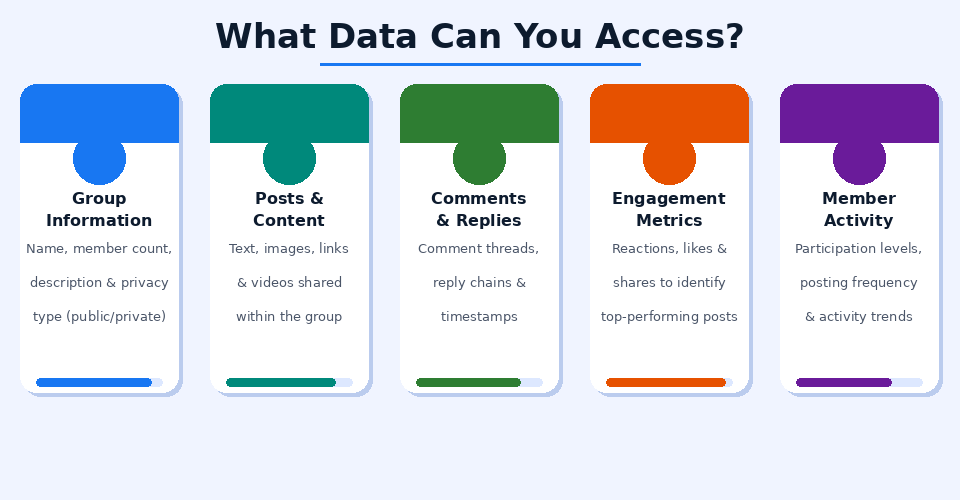
The Facebook Groups API allows users to access different types of data according to the privacy settings and permissions needed. Accordingly, you may retrieve the following types of data:
Information of the Group
You may access a few basic details of any Facebook group, like the name, member count, description, and privacy type i.e. public or private. Each information helps researchers to understand the relevance and scope of a group.
Extracts Post
The Facebook API allows users to extract Facebook posts shared in a group. These include the texts, images, links, and videos. Such details are vital to analyze discussions and identify a few popular topics.
Replies and Comments
You may collect comments on different posts, reply to the respective comments, and timestamps. This data obtained from API lets you understand the flow of conversation and the level of engagement.
Engagement Metrics
Engagement metrics, like reactions, likes, and shares let brands measure the way, in which users interact with media content. Such insights are useful to identify high-performing posts.
Activity of Members
Even though privacy policies give limited access, you may analyze overall member activity trends, like active participation levels and posting frequencies.
Real-World Scenarios of Facebook Groups API and their Benefits
The Facebook Group API gives access to various activities performed by any Facebook community, people engagement, and conversations within the Facebook Groups. Here, we will discuss a few of the real-world scenarios of Facebook Groups API and the benefits it offered to the companies.
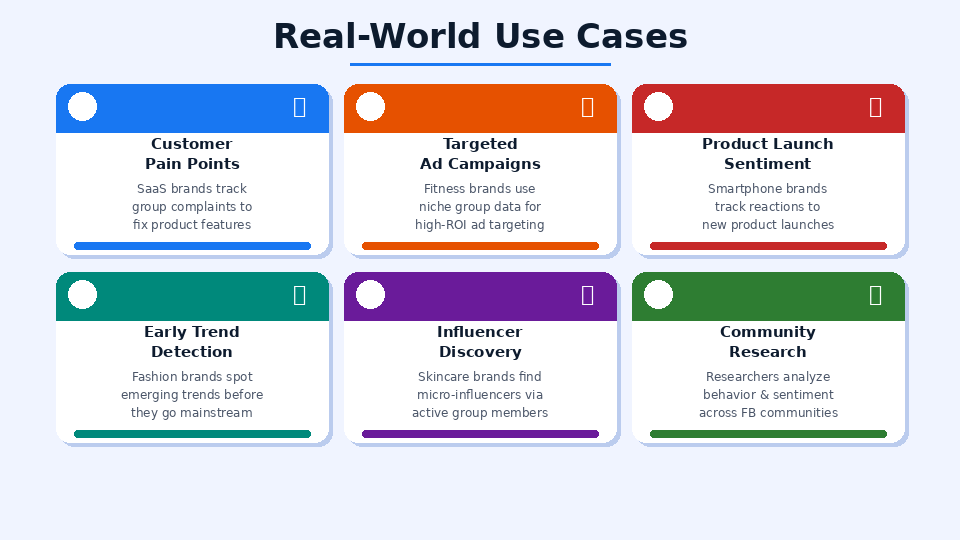
Case 1-Identifying the Pain Points of Customers
Companies and businesses regularly monitor group discussions to identify the problems often faced by Facebook users. For example, a SaaS Company tracks its Facebook posts in both entrepreneur and startup groups. Based on recurring complaints, like complex email automation and tough navigation, developers of the SaaS Company will redesign the product features to solve such problems.
Outcome
API helps the SaaS Company to regularly monitor its users’ Facebook group discussions for identifying real problems of its users.
Case 2-Hyper-Targeted Marketing and Advertising Campaigns
Facebook groups often consist of audiences belonging to diverse niches and have shared interests. For instance, a fitness brand AmFit analyzes its users’ engagement in various health-focused groups in Facebook and identifies the individuals involved in weight loss programs. In this case, Facebook Group API helps the fitness brand AmFit by providing the users insights for designing highly targeted ad campaigns.
Outcome
The Facebook Group API will result in high conversion rates with better returns on investments.
Case 3-Sentiment Analysis at the Time of Product Launch
Brands use Facebook API to analyze the reactions to the newly launched products in relevant Facebook groups. For instance, a smartphone brand tracks discussions in different tech groups after it launches a new mobile. Based on the users’ reactions and comments’ analysis, the Smartphone brand and its marketers identify whether its users are confused, excited, or disappointed.
Outcome
Smartphone Brand will respond to the obtained negative feedback quickly via Facebook API and boost its brand perception.
Case 4-Detect the Latest Trends in Advance
Facebook Group APIs track different Facebook groups to surface the latest trends in advance before they become mainstream. For instance, a leading fashion brand monitors various style communities and tracks increasing discussions across sustainable clothes. It launches eco-friendly products ahead of the competition.
Outcome
The clothing brand receives the benefit of being in perfect pace with the emerging trends.
Case 5-Identification of Influencers and Community Leaders
Active group members in Facebook often play the role of micro-influencers. For example, ABC skincare brand identifies its highly engaged Facebook users in beauty groups, who regularly give advice. Based on Facebook Graph API only, active Facebook group members collaborate to accomplish authentic promotions.
Outcome
ABC skincare brand expects to achieve organic reach and trustworthy Facebook group members via API as compared to any traditional ads.
Conclusion
The Facebook Group API offers a valuable gateway into various community-driven insights. Whether you are a developer, researcher, or marketer, the API transforms raw data into several actionable insights and knowledge. Therefore, brands and marketers should leverage the Facebook API tool responsibly to uncover the latest trends and understand the user behavior to make success-driven and informed decisions.
Frequently Asked Questions
1. What is the Facebook Groups API?
The Facebook Groups API is a feature within the Facebook API that allows developers to access and analyze data from Facebook Groups, including posts, comments, and engagement metrics.
2. Is it possible to access private group data?
Access to private groups is restricted and requires special permissions and user consent, along with compliance with Facebook policies.
3. How is the Facebook graph API related to the Groups API?
The Facebook graph API is the core framework through which the Facebook Groups API operates, enabling structured data retrieval from Facebook.
4. What are the main uses of Facebook data API for research?
The Facebook data API is used for market research, sentiment analysis, trend tracking, and studying online community behavior.
5. Is using Facebook API data legal?
Yes, it is legal if you follow Facebook’s terms of service, obtain necessary permissions, and respect user privacy.
What is the Facebook Groups API?
The Facebook Groups API is the part of the Facebook Graph API that gave developers access to group posts, comments, engagement metrics, and basic group details.
What data can you access with the Facebook Groups API?
Group endpoints exposed five data types: group details such as name and member count, posts with text and media, comments and replies with timestamps, reactions, and member activity.
Is the Facebook Groups API still available?
No. Meta deprecated the Facebook Groups API in Graph API v19 in January 2024 and removed it from all versions on April 22, 2024, so new group data pulls no longer work.
Can you access private Facebook group data?
Private and secret group content was never open. Apps needed consent from a group admin or member, and every request had to comply with Facebook platform policies.
How is the Facebook Graph API related to the Groups API?
The Graph API is the core framework the Groups API ran on. Group endpoints sat inside Graph API versions, so group data came back through the same structured request format.
Which permissions did the Facebook Groups API need?
Two permissions carried group access: groups_access_member_info for member and content data, and publish_to_groups for posting. Meta retired both along with the API in 2024.
How do researchers use Facebook group data?
Researchers read group discussions for market research, sentiment analysis after launches, trend tracking, and community behavior studies, turning posts and comments into insight.
Can Facebook group data help identify influencers?
Yes. The most active members often act as micro-influencers, and skincare brands have used beauty group activity to find frequent advice givers for authentic promotions.
Is using Facebook API data legal?
Yes, as long as you follow Facebook's terms of service, get the permissions each endpoint requires, and respect user privacy. Consent and policy compliance keep the research clean.