

TL;DR Summary Later is a social media scheduling tool for creators and marketing teams. Phyllo is an influencer data and API infrastructure platform built for developers and B2B teams who need programmatic access to creator analytics, audience data, and identity verification across Instagram, YouTube, TikTok, and 50+ platforms. If you're searching for a Later alternative for developers, or need Instagram API access beyond posting and scheduling, Phyllo is purpose-built for you.
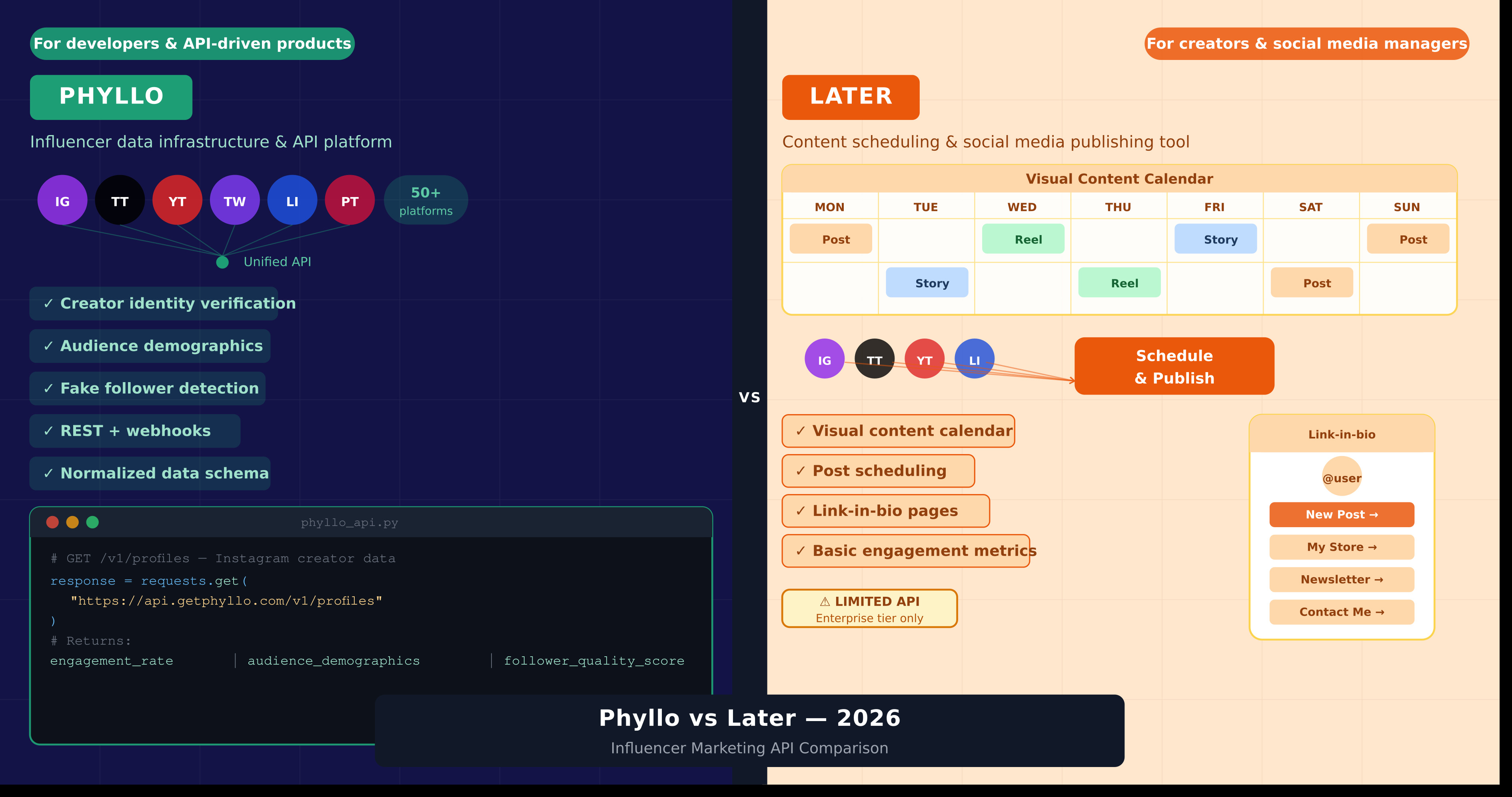
- The Phyllo vs Later split is simple: Later schedules and publishes content, while Phyllo is a creator data API built for developers.
- Phyllo pulls creator identity, audience demographics, and earnings data from 50+ platforms into one normalized API schema.
- Later's API handles scheduling and campaign reporting, not audience demographics or follower quality scoring.
- Pricing differs sharply: Later starts near $18 a month with API access at enterprise tier, while Phyllo bills per API call and has a free sandbox.
- Product teams pick Phyllo when they need programmatic creator data, and Later when the job is planning and publishing posts.
Whether you're building an influencer marketing platform, running creator verification for a fintech product, or integrating social media analytics into your SaaS — you've likely run into the same wall: getting reliable, structured, and normalized data from social platforms is hard.
Later and Phyllo both operate in the creator economy space, but they solve fundamentally different problems. Comparing them is a bit like comparing a publishing CMS to a database API — one is an end-user product, the other is infrastructure. Yet searches for "later alternatives" and "later app alternative" frequently surface both, so this guide exists to give you a clear, honest answer for each use case.
By the end of this article, you'll know exactly which tool fits your workflow — and if you're a developer or technical team, why Phyllo is almost certainly the right choice.
What Later and Phyllo actually do
Later: A Social Media Scheduling and Content Platform
Later (formerly Latergramme) started as an Instagram scheduling tool and has evolved into a broader social media management platform. Its primary users are content creators, small marketing teams, and agencies who want to plan, schedule, and publish content to Instagram, TikTok, Pinterest, Twitter/X, LinkedIn, and Facebook.
Later's core features include:
- Visual content calendar and drag-and-drop scheduling
- Link-in-bio pages (Linktree-style)
- Basic analytics on post performance (likes, comments, reach, impressions)
- User-generated content discovery and reposting
- Hashtag and caption suggestions
- A limited API for scheduling (primarily for agency/enterprise tiers)
THE LATER API LIMITATION: Later's developer API is focused on content scheduling and publishing workflows - it is NOT designed to extract influencer analytics, audience demographics, creator identity data, or cross-platform creator intelligence. If that's what you need, you will hit a wall quickly.
Phyllo: Influencer Data Infrastructure and API for Developers
Phyllo is a unified API platform that lets developers and product teams connect to social media platforms - Instagram, YouTube, TikTok, Twitch, LinkedIn, Pinterest, and 50+ others - to pull structured creator data. Think of it as the Plaid of the creator economy: a single integration that gives you programmatic access to:
- Creator identity verification - confirm a creator owns the accounts they claim
- Audience analytics - demographics, follower quality, fake follower detection, engagement rate analysis
- Content performance data - reach, impressions, video views, saves, shares across all major platforms
- Earnings and monetization data - for platforms like YouTube and Twitch
- Cross-platform aggregation - normalize data from 50+ sources into a single API response schema
- Webhook-based real-time updates - get notified when a creator's metrics change
"Phyllo does what we'd otherwise need 12 separate API integrations and a 6-month engineering sprint to build ourselves." - common feedback from developer teams evaluating creator data infrastructure
Phyllo vs Later: Feature Comparison at a Glance
| Feature / Use Case | Phyllo | Later |
|---|---|---|
| Primary purpose | Creator data API & infrastructure | Content scheduling & publishing |
| Target user | Developers, product teams, enterprises | Creators, social media managers, agencies |
| Instagram API access | Full (analytics, audience, identity) | Limited (scheduling, basic metrics) |
| Audience demographics data | Age, gender, location, language | Not available |
| Fake follower detection | Built-in follower quality scoring | Not available |
| Creator identity verification | OAuth-based ownership verification | Not available |
| Multi-platform support | 50+ platforms via unified AP | 6 major platforms (scheduling only) |
| TikTok data access | Full analytics + audience | Scheduling only |
| YouTube analytics | Revenue, views, subs, audience | Not available |
| Twitch / streaming data | Subscribers, earnings, viewership | Not available |
| Content scheduling | Not available | Core feature |
| Link-in-bio pages | Not available | Core feature |
| Developer-first API | REST + webhooks, full docs | Limited, enterprise-only access |
| Normalized data schema | Cross-platform unified schema | Platform-specific outputs |
| Influencer ROI reporting | Engagement, reach, EMV calculations | Basic post-level only |
| Pricing model | Usage-based API pricing | Subscription tiers (Starter → Agency) |
| Free tier / trial | Free sandbox available | Free plan (limited) |
Want to see Phyllo's follower quality scoring in action? Try the free fake follower checker-no account required.
Instagram API Access: What Each Platform Actually Gives You
If Instagram API access is your primary concern - whether you're building an influencer marketing platform, running a creator verification flow, or pulling engagement data for reporting - the difference between Phyllo and Later is significant.
Phyllo - Instagram API: Built for Data Extraction
- Creator profile data: follower count, bio, verified status, category
- Audience demographics: age, gender, top cities, top countries, language split
- Post-level analytics: reach, impressions, saves, shares, comments, likes
- Stories analytics: views, exits, replies, link clicks
- Reels data: plays, reach, watch time metrics
- Fake follower & audience quality scoring
- Identity verification via creator OAuth consent
- Historical data access (up to 24 months depending on platform limits)
Later -Instagram API: Built for Content Publishing
- Schedule and auto-publish posts, Reels, Stories
- Basic engagement metrics on published content
- Best time to post recommendations
- Hashtag suggestions
- UGC discovery and reposting
- No access to audience demographic data
- No fake follower or audience quality tools
- No cross-creator comparison data
WHY INSTAGRAM API ACCESS MATTERS: Instagram's own Graph API requires platform-by-platform approval, handles rate limits inconsistently, and doesn't provide the normalized data format teams need for influencer benchmarking, campaign ROI, or creator vetting. Phyllo abstracts this complexity - you get clean, structured data through a single API call without managing API keys, rate limits, or platform-specific schemas per social network.
For Developers: Later Alternative that gives you Real API Access
If you've been searching for a later alternative for developers, the framing itself tells the story: Later's API was designed as a feature for agency workflows, not as infrastructure for product builders. Here's what the developer experience looks like on each platform.
Later Developer Experience
Later does offer an API for enterprise and agency customers, but it's scoped tightly to:
- Creating, scheduling, and managing posts programmatically
- Managing media libraries
- User and account management for agencies
It does not provide endpoints for pulling creator analytics, audience insights, or cross-platform data. Rate limits are modest, documentation is limited compared to pure API products, and the use case is firmly content operations - not data infrastructure.
Phyllo Developer Experience
Phyllo is built as a developer-first platform, with:
- Comprehensive REST API with OpenAPI documentation
- Webhook support for real-time event notifications
- SDKs for Node.js, Python, and more
- A connect widget (embeddable UI) for creator OAuth flows
- Sandbox environment for testing without live creator data
- Normalized data schemas - the same field names and response structure regardless of whether the data came from Instagram, TikTok, or YouTube
A typical Phyllo API call to retrieve creator analytics:
# Fetch Instagram profile + audience data for a connected creator
import requests
headers = {
"Authorization": "Bearer YOUR_API_KEY",
"Content-Type": "application/json"
}
response = requests.get(
"https://api.getphyllo.com/v1/profiles",
headers=headers,
params={
"work_platform_id": "INSTAGRAM_PLATFORM_ID",
"account_id": "CREATOR_ACCOUNT_ID"
}
)
profile = response.json()
# Returns: followers, engagement_rate, audience_demographics,
# follower_quality_score, post_count, avg_likes, avg_comments
print(profile["data"])
Compare this to building the equivalent data pipeline from scratch: you'd need to navigate Instagram's Graph API approval process, handle OAuth for each creator individually, deal with rate limits and API deprecations, normalize inconsistent data structures, and replicate this for every additional platform. Phyllo collapses that to a single integration.
Which is the Best Influencer Marketing Platform for your Use Case?
The honest answer is that "best influencer platform" depends entirely on what you're building or what problem you're solving.
Choose Phyllo if you are:
- Building influencer discovery or vetting tools — you need audience data, follower quality scores, and engagement benchmarks across many creators at scale.
- Running an influencer marketing platform or SaaS — you're embedding creator analytics, performance tracking, or creator onboarding flows into your product.
- A fintech or HR platform verifying creator income — you need verified, consent-based access to a creator's earnings, follower count, and platform identity.
- Running campaign performance reporting — you need post-level reach, impressions, and engagement data pulled automatically from creators' accounts post-campaign.
Choose Later if you are:
- Managing a brand's content calendar — you need to plan, schedule, and publish posts across Instagram, TikTok, and other channels efficiently.
- A creator or small agency — you need a simple, visual tool to batch-schedule content and track which posts drive traffic to your bio link.
Pricing: Later vs Phyllo
Later pricing (2026)
- Starter (~$18/month) — 1 social set, limited posts, basic analytics
- Growth (~$40/month) — 3 social sets, unlimited posts, analytics & best time to post
- Advanced (~$80/month) — 6 social sets, priority support
- Agency/Enterprise — custom pricing, API access included
API access is only available at enterprise tier, which typically starts at several hundred dollars per month.
Phyllo pricing
- Free sandbox — full API access for development and testing
- Pay-as-you-go — billed per API call / creator connection
- Volume plans — custom pricing for high-volume data needs (contact sales)
FOR DEVELOPERS: START WITH THE FREE SANDBOX — Phyllo's sandbox gives you full access to test endpoints, mock creator data, and integration flows before committing to production. Visit getphyllo.com/pricing for current plans, or docs.insightiq.ai to start integrating.
See full Instagram API pricing and rate limits on Phyllo's pricing page.
Later alternatives: the full landscape (2026)
If you need scheduling features like Later
Tools like Buffer, Hootsuite, Sprout Social, and Publer are strong alternatives with similar or better scheduling capabilities, more advanced analytics, and often better pricing for teams.
If you need data and API access (later alternative for developers)
- Modash — influencer search and discovery (no developer API)
- Traackr — enterprise influencer marketing management (no developer API)
- Aspire — creator marketplace and campaign management (limited API)
- Phyllo — the only platform built specifically as API infrastructure for developers, enabling teams to embed creator data directly into their own products
THE BOTTOM LINE: Phyllo is the developer-first Later alternative. If you need to programmatically access influencer data, verify creator identities, or build analytics features into your product — Phyllo is the only tool purpose-built for that job. Later, Hootsuite, and Buffer are great for teams managing content. Phyllo is the right choice when you're building the infrastructure underneath those workflows.
Conclusion: Choosing Between Phyllo and Later
Phyllo and Later solve different problems for different users. Later is a polished, user-friendly tool for marketing teams and creators who need to plan and publish social media content at scale. If that's your need, it's excellent at what it does.
But if you're a developer building influencer marketing software, a product team embedding creator analytics into your platform, or an enterprise that needs programmatic access to creator identity and audience data — Later was never designed for you. Phyllo was.
With support for 50+ platforms, a developer-first REST API, built-in fake follower detection, and normalized data schemas that work the same way regardless of platform, Phyllo gives technical teams the infrastructure layer the creator economy has been missing.
The next step is simple: explore the Phyllo API documentation (docs.insightiq.ai), spin up a sandbox account, and make your first API call. Most engineering teams have a working prototype within a single sprint.
Frequently Asked Questions
Is Phyllo a Later alternative for developers?
Yes — if you're looking for API access to creator and influencer data (analytics, audience demographics, identity verification, content performance), Phyllo is the closest developer-grade alternative to what Later's limited API offers. Where Later's API focuses on content scheduling, Phyllo's API focuses on data extraction and creator intelligence.
Can I use Phyllo to access Instagram data without the Instagram Graph API?
Phyllo uses creator consent (OAuth) to access Instagram data through approved channels, including the Instagram Graph API and Instagram Basic Display API. Phyllo handles API negotiation, rate limiting, and token management for you — so you make one Phyllo API call instead of managing Instagram's API directly.
Does Later have an influencer analytics API?
No. Later's API (available at enterprise tier) is designed for content scheduling and management workflows. It does not provide endpoints for influencer audience analytics, fake follower scoring, or cross-platform creator data aggregation.
What is the best influencer marketing platform for agencies?
Agencies managing content calendars for brands will find Later, Buffer, or Sprout Social the most practical. Agencies running influencer campaigns that need performance data, creator vetting, or reporting should look at Phyllo as the data layer — often combined with a campaign management tool on top.
How does Phyllo handle data privacy and creator consent?
Phyllo uses an explicit consent-based model: creators authenticate their accounts and authorize data access through a secure OAuth flow. No data is pulled without creator permission, making Phyllo compliant with major platform terms of service and GDPR principles.
Does Phyllo support TikTok and YouTube creator data?
Yes. Phyllo supports 50+ platforms including TikTok (profile, audience, video analytics), YouTube (channel stats, video performance, revenue estimates, subscriber data), Instagram, LinkedIn, Twitch, Pinterest, and more — all through a single normalized API.
What is Phyllo's Instagram API pricing?
Phyllo uses usage-based pricing, billed per API call or creator connection. A sandbox environment is available for free for testing. For production pricing, see getphyllo.com/pricing or contact the Phyllo sales team for volume quotes.
What is the difference between Phyllo and Later?
Later is a social scheduling and publishing platform for creators and marketers. Phyllo is a creator data API that developers use to pull analytics from 50+ platforms.
Does Later have an API for influencer analytics?
Later's API is scoped to scheduling, account management, and campaign reporting. It has no endpoints for audience demographics, follower quality scoring, or creator vetting data.
Is Phyllo a good Later alternative for developers?
Yes. Phyllo is the developer-first Later alternative, with a REST API, webhooks, SDKs for Node.js and Python, and a connect widget for creator OAuth flows.
How do I get Instagram audience demographics for creators?
Instagram's Graph API returns demographics only to the account owner, so platforms use Phyllo, which delivers age, gender, city, and language splits once a creator consents.
How much does Later cost compared with Phyllo?
Later sells subscription tiers starting near $18 a month, and API access arrives only at the enterprise tier. Phyllo bills per API call and includes a free sandbox.
Does Phyllo support TikTok and YouTube creator data?
Yes, Phyllo covers TikTok profile, audience, and video analytics plus YouTube channel stats, video performance, subscriber counts, and revenue estimates in one schema.
How does Phyllo handle creator consent and data privacy?
Creators authenticate their own accounts through a secure OAuth flow, so nothing gets pulled without permission. That keeps Phyllo aligned with platform terms and GDPR principles.
Can Phyllo detect fake followers on a creator account?
Yes, Phyllo ships follower quality scoring and fake follower detection alongside engagement rate analysis, so you can vet an audience before paying for a campaign.