
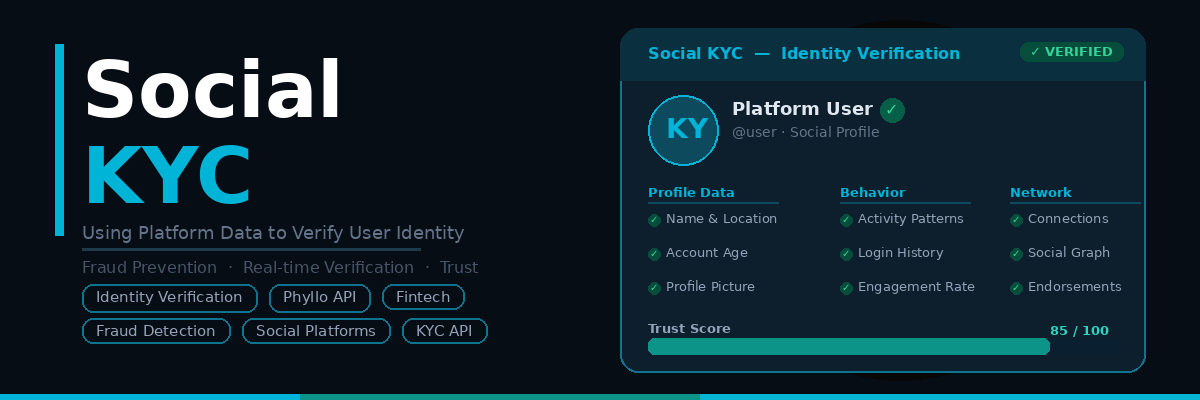


Social KYC leverages data from social and digital platforms to verify user identities quickly and efficiently. It helps businesses reduce fraud, improve onboarding, and enhance trust without relying solely on traditional documents. By analyzing user behavior and profiles, it enables smarter, real-time identity verification.
- Social KYC verifies users with data from their social, gaming, and professional profiles instead of government IDs or in-person checks.
- Phyllo's identity verification API pulls profile, follower, and engagement data from the source platform with the user's consent.
- Fintech lenders apply Social KYC to employment history and professional connections to approve instant loans without credit scores.
- Online marketplaces cross-check accounts against social profiles to flag fake buyers and sellers and cut chargeback fraud.
- Pulling Instagram profile data now requires migrating from the Basic Display API to the Graph API.
What is Social KYC
Social KYC is the acronym for Know Your Customer. It involves the process of user authentication on social media, gaming, and other professional or digital platforms. The information collected via Social KYC are:
- Basic information about the profile, like the name, location, and age
- Network strength and social connections
- Engagement history and activity patterns
- Consistency and authenticity of contents
- Login behavior and device details
The main objective of innovative Social KYC solutions, like Phyllo’s Social KYC, is to avoid cybercrime, reduce anonymity, and protect the social media users.
Why Social KYC is Vital?
Verification of identity has become a prime component for almost every type of business, especially for social platforms, e-commerce, and fintech industries. For this, individuals go through traditional KYC procedures that rely on government-based documents, like the utility bills, government IDs, and in-person verification. However, none of these methods are reliable in the case of social media platforms. Such methods are not only slow but also are prone to fraud.
Here comes the modern approach of Social KYC, which leverages the user data from digital platforms -Facebook API, Marketing API, etc. are prime data sources for identity signals like profile info, connections, engagement history, to detect fraud, and assess authenticity. As a leading identity verification API, it analyzes behavioral patterns, digital footprints, and social connections to provide a fast, scalable, and appropriate identity verification method. For this, Social KYC addresses the problem of identity verification by:
- Allowing real-time verification
- Detecting synthetic or fake identities
- Reducing the onboarding period
- Boosting overall user experience
Scope and Mechanism of Social KYC
Businesses and individuals who refer to the Social KYC API powered by Phyllo may successfully verify digital identity verification of their users directly via the source platform. These include the usernames, profile pictures, number of subscribers or followers - however, it's important to note that recent Instagram API access changes have shifted how this data can be retrieved, requiring migration from the Basic Display API to the Graph API. Moreover, one can even choose to display the obtained data directly or use the same to eliminate fake profiles and add verification badges.
To perform its actions, Social KYC uses a combination of innovative technologies as follows:
- Social media platform data aggregation API to pull any user’s data with his or her consent
- Machine learning algorithms to identify and analyze diverse behavioral patterns
- Graph analysis to detect and evaluate the users’ social connections
- Risk scoring models to judge the credibility of a user’s identity
Real-world Scenarios of Social KYC
Case 1-Digital Fintech Lending Platform/App
A digital fintech type lending platform/app is seeking to approve instant loans or payday loans to its customers without relying on traditional credit scores.
Role of Social KYC
The fintech platform uses Social KYC to analyze the social profile of its applicant/user. Accordingly:
- The app collects details related to the education qualifications, employment history, and professional connections.
- The app uses Social KYC to check the consistent activity of the applicant with time to make sure that he is a genuine user.
- The platform checks various endorsements and connections to identify the users’ credibility.
Outcome
Social KYC operated via Phyllo API gets the entire job within a few minutes. Hence, the fintech platform allows faster loan approvals, and gets genuine users without any formal credit history. On the other hand, a social media user with consistent job updates and properly established professional network becomes a trustworthy applicant.
Case 2-Online Marketplace/E-commerce Fraud Prevention
E-commerce platforms or online marketplaces often face problems with fake buyers and sellers, who create multiple accounts to scam other users or exploit the return policies. In this situation e-commerce companies take help from innovative Social KYC solutions.
Role of Social KYC
- The e-commerce site uses Social KYC to cross-check its user accounts corresponding to their social profiles.
- Secondly, Social KYC analyzes the accounts’ age, users’ engagement patterns, and frequency of the users’ social media activities.
- Social KYC identifies and flags suspicious accounts based on the information, like low activity, and fake connections.
Outcome
Both e-commerce users and e-commerce platforms will get the following outcomes from Social KYC:
- Reduction in creating fake accounts
- Lowering the chargeback fraud
- Improvement in trust among sellers and buyers
Sellers who have their long-standing social media presence and regular interactions are less likely to be involved in any type of fraudulent activity.
Benefits of Social KYC
Social KYC operated via innovative technologies, including the Phyllo API may benefit the social media and other digital platforms as follows:
1. Allows Faster Onboarding
Social KYC verifies the social media users only within a few minutes rather than spending days. It thus improves the conversion rates.
2. Improves in Fraud Detection
Based on behavioral analysis done by Social KYC, one can easily detect synthetic or fake identities effectively as compared to simple document verifications.
3. Significant Reduction in Operational Costs
Social KYC does everything based on social media presence, which reduces the companies’ reliance on traditional verification processes. In this way, businesses expect to lower their operational costs.
4. Improved User Experience
With Social KYC, users no longer need to upload multiple documents, which results in seamless onboarding and improved user experience.
5. Faster Financial Processes
Unlike traditional loan application processes, loan or financing platforms verify their users’ authenticity even when they lack credit history and formal documents. Indeed, it allows faster financial processes with reliability.
Conclusion
Social KYC has led to a major shift in the way businesses verify their user identities. It leverages digital footprints and platform data to provide a smart, fast, and user-friendly alternative to conventional identity verification methods. Moreover, Social KYC has a huge potential to transform onboarding, and reduce fraudulent activities to improve access to several services. Therefore, business organizations should consider Social KYC to build both trust and security in today’s online realm.
Frequently Asked Questions
1. Is Social KYC safe to use?
Yes, Social KYC is safe until the companies or business organizations implement it with the necessary security measures and proper user consent. Platforms should make sure of data encryption, privacy law compliances, and transparent data usage policies.
2. Does Social KYC replace traditional KYC?
No, Social KYC only complements traditional KYC. Even though it enhances speed and fraud detection, many industries still require official document verification for compliance.
3. What kind of data is used in Social KYC?
Social KYC uses publicly available or user-consented data such as profile information, social connections, activity history, and behavioral patterns.
4. Can fake social profiles bypass Social KYC?
Advanced Social KYC systems use AI and behavioral analysis to detect fake or bot-generated profiles. However, no system is 100% foolproof, which is why multi-layered verification is recommended.
5. Which industries benefit the most from Social KYC?
Industries such as fintech, e-commerce, gig economy platforms, and online marketplaces benefit significantly due to their need for fast, scalable, and secure user verification.
What is Social KYC?
Social KYC is identity verification that uses data from a person's social, gaming, or professional platform profiles, such as profile basics, connections, engagement history, and login behavior.
How does Social KYC verify a user's identity?
Consented profile data gets pulled from the source platform, then machine learning reads behavioral patterns, graph analysis maps social connections, and risk scoring rates credibility.
Does Social KYC replace traditional document based KYC?
No. Social KYC complements traditional KYC by adding speed and sharper fraud detection, but many regulated industries still require official document verification for compliance.
What data does Social KYC use?
Publicly available or user consented data: profile information, network strength and social connections, engagement and activity history, content consistency, and login or device details.
Is Social KYC safe to use?
Yes, provided it runs with explicit user consent and real security controls. Platforms should encrypt the data, comply with privacy law, and publish transparent data usage policies.
Can fake social profiles bypass Social KYC?
Good Social KYC systems use AI and behavioral analysis to spot bot generated and fake accounts, but nothing is fully foolproof, so multi layered verification is still recommended.
Which industries benefit most from Social KYC?
Fintech, e-commerce, gig economy platforms, and online marketplaces gain the most, because each one needs user verification that is fast, scalable, and hard for fraudsters to fake.
How does Phyllo's Social KYC API work?
Phyllo is a social data infrastructure platform, and its Social KYC API returns a username, follower count, and profile picture straight from Instagram, Facebook, or Twitter once the user consents.
How much faster is Social KYC than document verification?
Verification drops from days to minutes. That shorter path improves conversion rates and cuts the operational cost of chasing utility bills, government IDs, and manual review.