
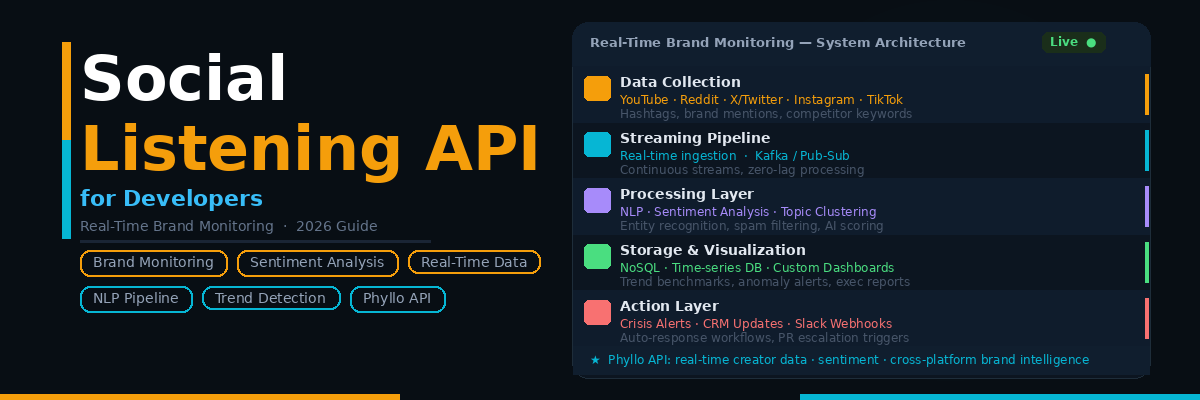


A Social Listening API helps developers collect and analyze real-time data from social platforms to track brand mentions, sentiment, and trends. This 2026 guide explains how to build scalable brand monitoring tools using APIs, automation, and data pipelines. It also covers real-world use cases, helping businesses make faster, data-driven decisions.
- Building a real-time brand monitoring tool takes six layers: data collection, streaming ingestion, NLP processing, storage, dashboards, and an action layer.
- A social listening API for developers returns mentions, sentiment, competitor insights, and trends as raw data rather than a fixed dashboard.
- Over 5 billion social users generate continuous streams, so manual tracking rarely catches a PR crisis in time.
- Phyllo covers Instagram, TikTok, YouTube, LinkedIn, and X in real time through a single integration.
- Secure the pipeline with OAuth 2.0, TLS encryption, and GDPR compliance before scaling to millions of requests.
What is the Social Listening API for developers?
Brands in 2026 often aim to identify the pain points of their customers based on what people say about their products and services on social platforms. Also, marketers and brands aim to find instant solutions to their customers’ pain points. Such a drastic shift has made brand monitoring and social media listing APIs a few critical tools for developers to create real-time and intelligent systems.
Here comes the role of Social Listening API. It involves tracking and analyzing conversations across different social media platforms, blogs, forums, and news to understand the trends, sentiments, and brand perception. It primarily focuses on collecting insights instead of simply counting a few mentions.
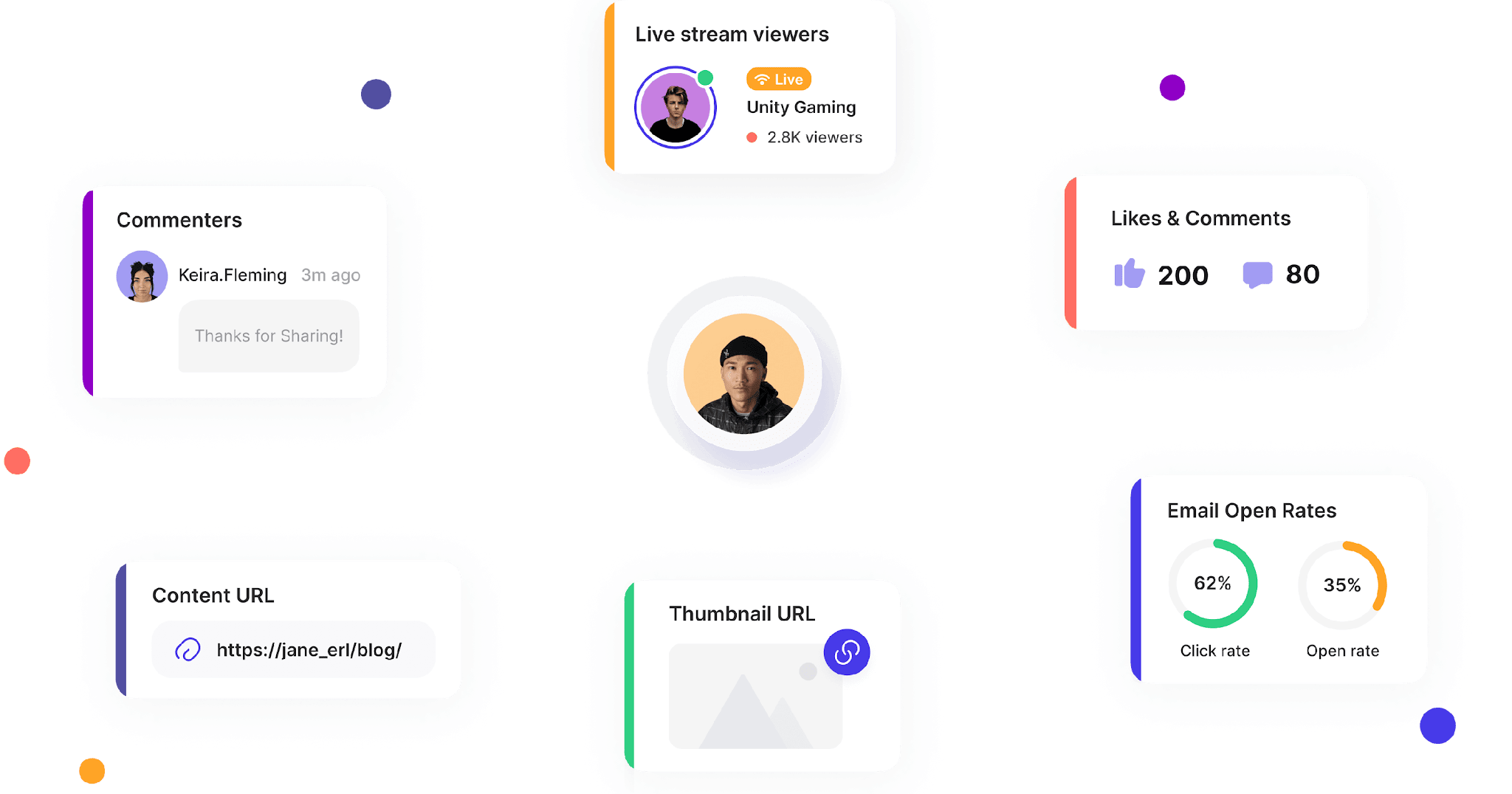
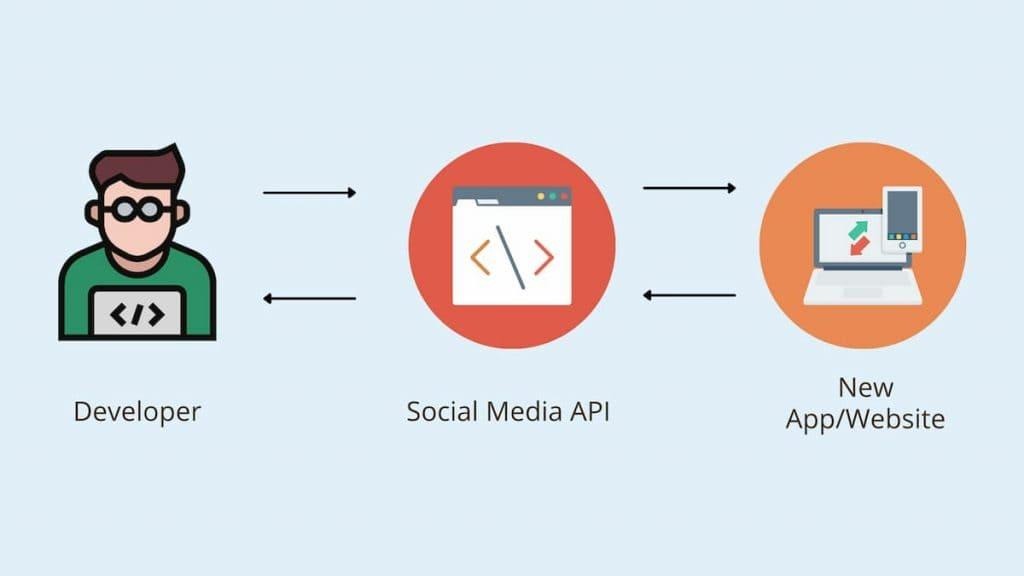
Any Social Media Listening API for developers helps to programmatically analyze and collect conversations, which go on across diverse digital platforms. APIs provide direct access to everything required by brands instead of depending on dashboards. These include but are not limited to:
- Hashtags and keywords
- Brand mentions
- Competitor insights
- Sentiment analysis and
- Trend detection
Hence, to analyze the conversations, developers should put their valuable efforts into creating real-time and scalable brand monitoring tools with the help of APIs, use cases, relevant architecture, and several practical insights. Before diving into the architecture, see our foundational guide on how social media listening and monitoring APIs work — covering the five core API types, the difference between monitoring and listening, and the strategic framework developers need before they start building.
Why Should Developers Refer to Social Listening APIs in 2026
Every brand and marketer faces a massive scale of online conversations with more than 5 billion users generating their continuous data streams. Businesses, brands and developers look for automated systems to meet the following purposes:
- Understand the sentiments of prospects and customers on different social platforms to identify their pain points
- Detect the PR crises in no time
- Track the actions and strategies followed or adopted by competitors
- Identification of the viral trends in advance
Luckily, an advanced social listening API like Phyllo's Social Listening API gets the entire job done instantly — real-time ingestion and analysis across Instagram, TikTok, YouTube, LinkedIn, and X — without any manual tracking effort.
What are the Architectural Components of a Real-time Brand Monitoring System
Brands and developers need the following architectural components to build an innovative production-based tool with the help of social media listening API:
Data Collection Layer
The data collection layer is the first layer of the social listening API. It connects APIs from different platforms, like YouTube, Reddit, X/Twitter, and other social platforms. Secondly, the data collection layer uses keyword-based queries, like hashtags, brand name, and competitors to collect data from social media users.
Streaming Pipeline
Streaming pipeline involves the use of certain tools to allow ingestion of conversations in real-time.
Processing Layer
The processing layer consists of different NLP models needed for clustering of vital topics, recognition of entities, and sentiment analysis.
Storage Layer
The storage layer contains NoSQL to allow flexibility while possessing a time-series DB for the latest trends.
Visualization Layer
Brand monitoring and social listening API must have an effective visualization layer that contains custom UI and dashboards. Simultaneously, the layer should possess options for notifications and alerts.
Action Layer
Action layer is the last layer of the social media listening API, which triggers workflows. The main role of this layer is to display CRM updates, slack alerts, and automated responses.
Key Features to Build in Your API-Based Brand Monitoring Tool
Creating an API-based brand monitoring API tool needs a robust architecture to handle high-velocity data and provide valuable yet actionable insights. Accordingly, the tool must possess a few vital features focusing on broad data acquisition, automated workflows, and AI-driven analysis. These include the following:
- Multi-Channel Data Acquisition
Any brand monitoring API tool must provide comprehensive source coverage. Accordingly, developers should use APIs to track the users’ mentions across different platforms. These include blogs, news sites, forums, social media platforms (TikTok, Instagram, X/Twitter), and review ecosystems.
Secondly, APIs should provide continuous and real-time data streams to identify new posts instantly and track the latest engagement metrics instead of only periodic snapshots. Moreover, the API tool should implement advanced query features to identify keyword variations, common misspells to avoid missing any mention from users.
- AI-Powered Intelligence
Developers should consider AI-powered intelligence as one of the prime factors while choosing the right social media listening API tool. Common AI intelligence features are-
Sentiment Analysis
APIs should categorize the mentions as neutral, positive, or negative automatically to gauge the perception of the public and retain the brand health.
Logo Detection/Visual Recognition
One should use Artificial Intelligence to identify the products and brand logos in images and videos, even when the brand is not highlighted or tagged in any text.
Clustering of Vital Topics
Developers should refer to Artificial Intelligence to group similar mentions into vital themes for identifying the wider narratives, recurring customer complaints, and emerging trends.
Noise and Spam Reduction
One should implement the smart filtering feature to eliminate any irrelevant mentions, duplicate content, and bot activity to achieve high quality data.
- Actionable Analytics
Developers and brands must choose their brand monitoring tools to track and compare their brands’ sentiments and mention volume against direct competitors. The API should specially create customizable visual reports for executive dashboards. Moreover, it must correlate shifts in customers’ sentiment with churn risk, revenue, and other business outcomes.
- Anomaly Alerts and Crisis Detection
APIs should set up the necessary threshold-based alerts to notify the marketing teams via slack, email, or webhooks whenever there is any sudden spike in negative social mentions. Furthermore, the tools should give long-term data to benchmark the existing performance against pre and post campaigns or during the pre-crisis periods.
- Scalable, Secure, and Automated Enterprise-level Infrastructure
Lastly, any brand monitoring or social media monitoring API should possess a scalable architecture to handle millions of requests based on consistent growth of data volume without compromising on the performance. Secondly, APIs should safeguard the sensitive data with the help of TLS/SSL encryption, strict rate limiting, and OAuth 2.0 authentication to avoid abuse. Thirdly, the API should include workflow automation i.e., it should create an incident management workflow to alert different departments, like Marketing, CX, and PR and to track the response times.
Real-World Scenarios of Social Listening APIs for Developers
Scenario 1-Crisis Management of an E-commerce Brand
Any reputed D2C (Direct to Customer) brand identifies a sudden increase in the number of customer complaints for delayed shipping.
Role of API to Deal with Complaints
- Brand monitoring APIs and other related tools will-
- Identify surge in any negative sentiment
- Flags the vital keywords, like “delayed shipping” and “late delivery”
- Transfers real-time alerts
Outcome
As the brand monitoring API tool accomplishes every task within a second, brand may respond to the complaints quickly and avoid all types of PR escalations. In contrast, without API, the delay may go unnoticed for many days or months.
Scenario 2-Tracking and Monitoring of Influencer Tracking
A brand launches a campaign with different creators.
How Social Listening API helps the brand:
- Tracks mentions across different social platforms
- Measures the customers’ engagement and analyze their sentiment
Outcome
APIs will help the brand to identify the influencer driving the highest number of positive conversations. Other than that, brands may easily monitor the ROI associated with their campaigns. For a step-by-step technical walkthrough of this exact workflow — from building a creator shortlist via API criteria to measuring campaign uplift and tracking sentiment post-launch — see our guide on using social listening APIs to track influencer campaign performance.
Best Practices of Social Listening API for Developers in 2026
Based on the real-life scenarios, features, and layers, we should say that the developers must adopt the following practices while designing social listening APIs in 2026:
- Developers should use both emotion detection and AI-powered sentiments obtained from social platforms.
- One should combine listening with the relevant predictive analytics.
- Developers and brands must focus on entire narrative analysis instead of simply the keywords.
- Individuals should make sure of strict data compliance with General Data Protection Regulation.
- Developers should create a modular type of API architecture.
Note:
Developers in 2026 should design their API systems based on predictive social intelligence instead of simple reactive monitoring features.
Conclusion
Overall, a well-designed social listening API solution gives a competitive advantage to every brand of 2026. Therefore, developers should combine AI-driven analytics, real-time data pipelines, and scalable infrastructure to design powerful tools for converting their online conversations into innovative business intelligence.
Frequently Asked Questions
1. What is a social listening API?
A social listening API allows developers to collect and analyze conversations across social platforms programmatically, enabling real-time insights into brand perception and trends.
2. How is a social media listening API different from tools?
Tools provide dashboards, while APIs give raw data access for building custom applications and workflows.
3. Can I build a real-time brand monitoring tool using APIs?
Yes, by combining streaming pipelines, NLP models, and dashboards, developers can create fully real-time monitoring systems.
4. What data can a brand monitoring API provide?
It can deliver mentions, sentiment, engagement metrics, trends, and competitor insights.
5. Are there limitations to social listening APIs?
Yes, platform restrictions and privacy policies limit access to certain types of data.
6. How accurate is sentiment analysis in APIs?
Accuracy depends on the model. Custom-trained NLP models perform better than generic ones.
7. Why is social listening important for developers?
It enables building intelligent systems that convert raw social data into actionable business insights, improving decision-making and customer engagement.
What is a social listening API for developers?
A social listening API pulls conversations from social platforms, blogs, forums, and news programmatically, so developers get mentions, sentiment, and trend signals as data instead of charts.
How is a social listening API different from a social listening tool?
Tools hand you a fixed dashboard. An API hands over raw mentions, sentiment scores, and engagement metrics, so you can build custom monitoring and alerting inside your own product.
What architecture does a real-time brand monitoring tool need?
Six layers do the work: data collection from platform APIs, a streaming pipeline for live ingestion, NLP processing, NoSQL plus time-series storage, visualization, and an action layer.
Which platforms does Phyllo's Social Listening API cover?
Phyllo is a social data infrastructure platform, and its Social Listening API ingests and analyzes conversations in real time across Instagram, TikTok, YouTube, LinkedIn, and X.
How do developers detect a PR crisis with a social listening API?
Set threshold alerts on negative mention volume. When complaints like delayed shipping spike, the API fires Slack, email, or webhook notifications in seconds rather than days later.
How accurate is sentiment analysis in a social listening API?
Accuracy comes down to the model behind it. Custom-trained NLP models beat generic ones, and pairing sentiment scoring with emotion detection gives a truer read on brand perception.
What are the limits of social listening APIs?
Platform terms and privacy policies gate parts of the data, so coverage is never complete. Access is also getting more metered, so re-check each platform before you commit to it.
How do you secure a brand monitoring API at enterprise scale?
Run OAuth 2.0 authentication, TLS/SSL encryption, and strict rate limiting, then size the architecture to absorb millions of requests as data volume grows without losing performance.
Can a social listening API measure influencer campaign performance?
Yes. The API tracks mentions across platforms during a campaign, measures engagement, and scores sentiment, which shows which creator drove the most positive conversation and the ROI.