


The State Department of the United States has recently announced the mandatory social media screening of every H-1B workers and their H-4 family members/dependents from December 15 2025. The recent announcement is the result of the tightened visa-vetting system of the United States. Accordingly, every applicant needs to switch their existing Facebook, LinkedIn, and other social-media accounts’ settings to public to activate the scrutinizing process.
- Social media screening became mandatory for H-1B and H-4 visa applicants on December 15, 2025, under expanded US State Department vetting.
- Applicants must switch Facebook, Instagram, X/Twitter, YouTube, and LinkedIn accounts to public before the consular interview.
- Consular officers review posts, comments, affiliations, and professional profiles for hostility toward the United States or security risks.
- Private profiles or a mismatch with DS-160 details can trigger administrative processing, a follow-up interview, or refusal.
- Phyllo's AI screening tool scans an applicant's accounts and returns a private risk report within 48 hours.
The State Department of the United States has recently announced the mandatory social media screening of every H-1B workers and their H-4 family members/dependents from December 15 2025. The recent announcement is the result of the tightened visa-vetting system of the United States. Accordingly, every applicant needs to switch their existing Facebook, LinkedIn, and other social-media accounts’ settings to public to activate the scrutinizing process.
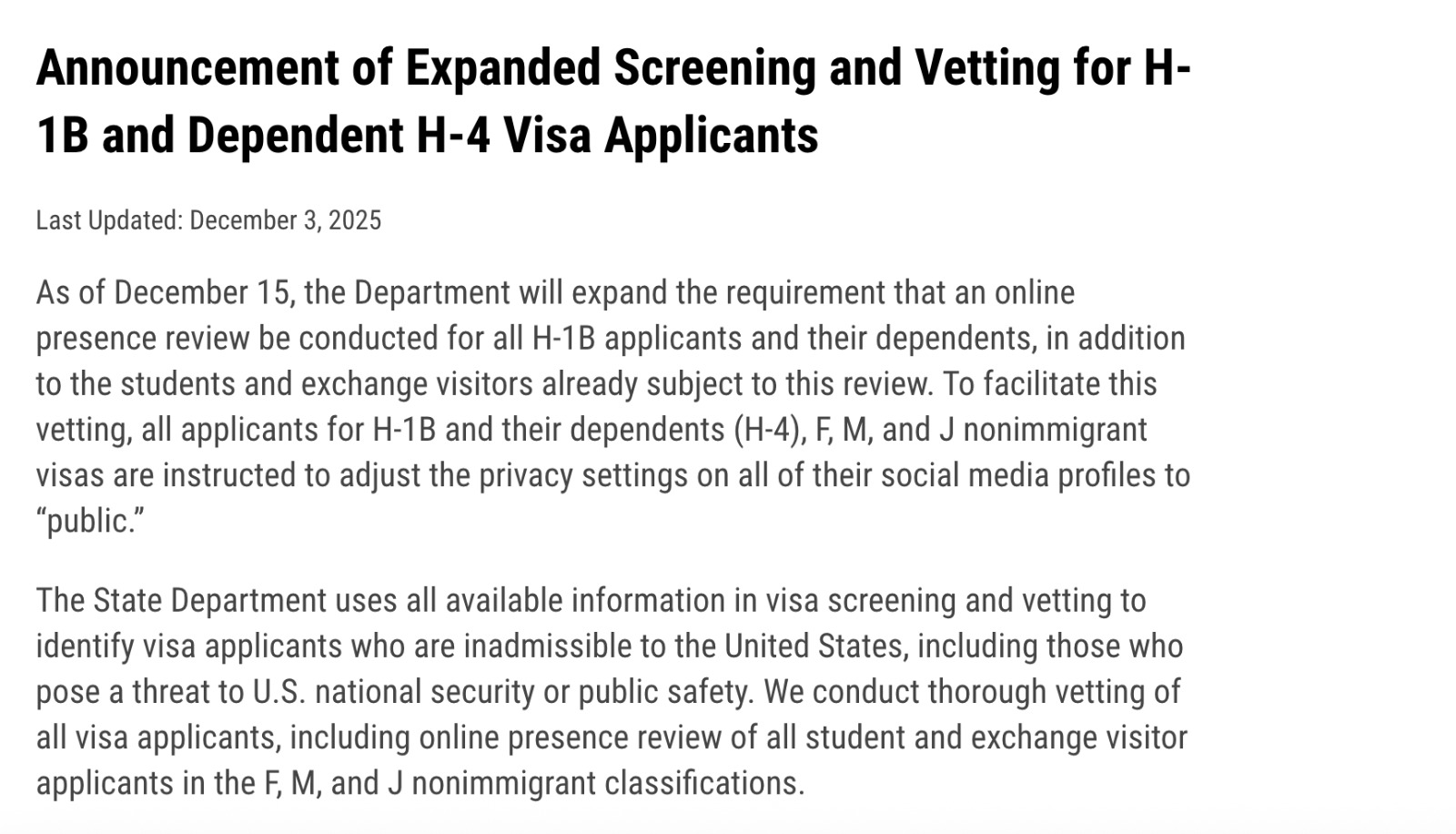
Immigration authorities of the United States have also said that reviewing of the online presence was already there for J, F, and M visa applicants i.e. exchange and student visitors right from late June 2025. Now, the Washington’s digital foot print policy has extended to H-4 and H-1B categories as well. Other than that, applicants will expect more intensive reviews of their social media posts, activities, interactions, and overall digital activity in the later months.
New Visa Vetting Guidelines for the United States’ Consular Officers
The new Visa vetting guidelines will direct the consular officers of the United States to look for the following-
- Hospitality towards the culture, citizens, government organizations/institutions, and founding principles of the United States.
- Indications of any visa applicant, as aiding, advocating, or supporting the designated foreign terrorists and related threats to the national security of the United States or perpetrated unlawful antisemitic harassment and violence.
- Indications of an applicant as stealing the key technical information, spread fake information for political benefits, or exploit the United States’ research and development.
- Whether any applicant highlights his history of political activism or there is any likelihood they would continue the same type of activity within the United States.
In case the consular officer identifies the perceived derogatory information, he or she may refuse the application or call the H-4 visa applicant back to undergo a follow-up interview. Moreover, the identification of any derogatory content may trigger additional reviews to determine and make sure that the foreign national with respect the laws of the United States and participate in activities, which are consistent with the non-immigrant status.
Prime Aspects of the New Visa Vetting Systems as Per the US Department
The US State Department also said that the consular officers will review the public posts, social-media profiles, and other valuable pieces of information across diverse online databases and platforms. Accordingly, updated visa vetting system by the US Department will possess the following prime aspects to boost national security in the process of visa adjudication-
Mandatory Social Media Profiles
Every H-4 and H-1B applications should adjust or change their privacy settings on every social media account to “public” for consular review. These include but are not limited to Facebook, Instagram, X/Twitter, YouTube, and LinkedIn accounts.
Social Media Review Scope
Consular and immigration officers of the US Department will review every publicly accessible social media and online content of the applicants. These are the comments, posts, affiliations, and professional profiles.
Objective of the New Visa Vetting Rules
The new visa vetting rule by the US Department aims to verify the applicants’ employment history, the DS-160 application, identify inconsistencies, and underlying USCID petition. Accordingly, the social media screening associated with visa vet may flag any content that indicates hostility and security risks towards the United States and incompetency associated with the visa classification.
Visa Issuance Delays and Refusal
Any visa applicant fails to set their profiles to public or mismatch between their social media profile and documents leads to extended administrative processing and visa issuance delays. In some cases, applicants may face visa refusal based on discrepancies as well.
Impacts of the New Visa Vetting Requisites
Immigration lawyers and other visa issuance officers have anticipated that the new visa vetting requisites for entering the United States will bring a few huge impacts on the existing visa process-
Processing Delays and Increase in Flagged Cases
Both H-4 visa applicants and their employers will face longer timelines associated with the visa-stamping process. One of the prime reasons behind is the increased workload for immigration and consular officers and an increased likelihood of flagged cases based on extended background checks.
Negative Effect on a Visa Status due to Dependents
In some cases, Facebook, Instagram, or any other social media post/content shared by the family members or dependents may affect the principal visa status of H-1B workers.
In-depth Review in case of Inconsistencies
Whether you apply for a working i.e. H-1B visa or dependent i.e. H-4 visa, as an applicant you must make sure to maintain proper consistency between your formal immigration document, resume, and social media profile. This is because’ any inconsistency will lead to in-depth review of the visa application of your entire family followed by unnecessary delays.
According to Mitch Wexler, the senior immigration counselor, “The new vetting standards will force applicants to face visa refusals or flagged applications because of long waits and lengthy background checks associated with the issuance of working and dependent visas. In other words, H-4 and H-1B visa applicants will experience delays in their ability of entering the United States. Indeed, the mandatory social media screening for H-4 and H-1B visa applicants will be a huge concern for IT professionals in India, as they constitute the largest H-1B cohort.”
Things to Remember for H-4 and H-1B Visa Applicants before Making Visa Appointments
Every H-4 and H-1B Visa applicant should remember the following things while preparing for their visa appointments-
Compliance Failure
Limited visibility or private social media profiles may result in negative credibility inferences. Such inferences will trigger refusal or follow-up questions. Moreover, lack of online presence may cause negative perception as well.
Increase in Scrutiny
Any mismatch between the DS-160 petition details, like the duties, dates, title, and employer and online/social media profiles may prompt administrative processing or additional questioning sessions.
Key Travel Risks
Individuals will expect long timeliness, lengthy administrative processing, and availability of limited appointment. Accordingly, we recommend the applicants to avoid any tight travel and return schedules.
How Phyllo’s Social Screening Solutions May Help Visa Applicants
If you are the one who needs to travel as a H-1B worker to the United States and planning for your visa interview 15th of December onwards, you must take every step cautiously to avoid potential delays. One of the best ways to look for the innovative social screening solutions powered by Phyllo for visa applicants.
Overview of Phyllo’s Social Screening
Phyllo’s social screening serves as an AI-powered solution to help visa applicants perform their social media screening and background checks before applying for the H-1B visa interview to travel to the United States. As the screening solution is powered by machine learning and Artificial Intelligence, it helps visa applicants by scanning their profiles across diverse platforms to identify the potential risks timely.
Role of Phyllo’s Social Screening Tool to Flag Online Content
Social screening tool powered by Phyllo may easily flag online content to make sure that the visa applicants do not face any unnecessary visa processing delay or visa refusal. For this, the AI-powered screening system only asks users to share their diverse social media profiles and enter their personal details. Accordingly, Phyllo’s tool does the complete work automatically to eliminate the need of manually reviewing of any online content or social media posts.
Phyllo’s Social Screening Tool has a Wide Audit Scope
A prime reason to choose Phyllo’s AI-based social screening tool for visa applicants is that it proactively audits an individual’s online and social media presence for diverse activities-
- Political contentions, including the hate speech or offensive political statements
- Cultural misunderstanding and statements on religious controversies
- Misinterpreted comments (any post or comment that may highlight flagged content on the visa applicants’ social media profile)
Phyllo’s Social Screening is Fully Automatic
Whether it is simply collecting the visa applicants’ data, flagging the risk contents, or identifying controversial social media posts, you will expect end-to-end automation while using the Phyllo-powered social media screening tool. However, depending on your requirement, you may even receive human oversight as well.
Phyllo’s Screening System Generates Report Promptly
The best thing about Phyllo’s social screening system is that it generates both H-1B and H-4 visa applicants’ private report within only 2 days i.e. 48 hours.
About Phyllo’s Social Screening
Phyllo offered sophisticated social media screening solutions for student assessments, visa applicants, immigration vetting, influencer vetting, and other forms of employment. We the experts use machine learning and AI-powered systems to conduct social media background checks or vet to provide you context-aware and deeper insights, which you may hardly expect to get from manual checks or traditional resumes.
To get more information, visit to our official website
https://www.getphyllo.com/social-screening and https://www.getphyllo.com/tool/automated-social-media-safety-checks-for-visa-immigration.
When did social media screening become mandatory for H-1B and H-4 visas?
The US State Department made social media screening mandatory for H-1B workers and H-4 dependents from December 15, 2025, as part of its tightened visa vetting system.
Do H-1B and H-4 applicants have to make social media profiles public?
Yes. Every H-1B and H-4 applicant has to switch their social media privacy settings to public so consular officers can review the accounts before the visa interview.
Which social media platforms do consular officers review for H-1B visas?
Officers review Facebook, Instagram, X/Twitter, YouTube, and LinkedIn, and that list is not exhaustive. Any publicly accessible profile or online content can be checked.
What do consular officers look for in an applicant's social media?
They look for hostility toward US culture, citizens or institutions, support for terrorism, antisemitic harassment, theft of technical information, and political activism history.
What happens if an H-1B applicant keeps social media profiles private?
A private or thin profile can create negative credibility inferences, which trigger follow-up questions, extended administrative processing, or in some cases a visa refusal.
Can an H-4 dependent's posts affect the H-1B worker's visa status?
Yes. Content posted by a spouse or child on Facebook, Instagram, or another platform can affect the principal H-1B worker's status and pull the whole family into review.
Will the new social media vetting delay H-1B visa stamping?
Expect longer timelines. Immigration lawyers point to heavier consular workloads and more flagged cases, so applicants should avoid tight travel and return schedules.
Which visa categories faced online presence checks before H-1B and H-4?
J, F, and M applicants, meaning exchange visitors and students, had their online presence reviewed from late June 2025. The policy then widened to H-1B and H-4 in December.
How does Phyllo's social screening help H-1B and H-4 visa applicants?
Phyllo is an AI social media screening platform for visa and immigration vetting. It scans an applicant's profiles for risky content and returns a private report in 48 hours.