

Automated social media screening is an essential aspect for global visa and immigration procedures. It offers fast and data-driven background checks to boost accuracy, detect risks in advance, and give support to transparent and improved decisions.
- Social media screening is now part of visa vetting in the United States, the United Kingdom, Canada, and Australia.
- Officers flag mismatches between a visa form and posts on Facebook, Instagram, LinkedIn, or X, like a business owner applying for a student visa.
- Automated AI vetting cuts processing from weeks to days and sorts applications into high, medium, and low risk tiers.
- Applicants should audit their online footprint, match LinkedIn work history to the form, and avoid unregistered migration agents.
- The Phyllo automated tool takes submitted profile links and runs the screening and risk assessment before a visa application.
Whether it is the United States, the United Kingdom, India, or others, immigration authorities no longer judge the visa applications merely based on the information displayed on a piece of paper. Instead, many visa authorities and embassies worldwide have started analyzing the online data as well.
Accordingly, social media posts, comments, profiles, tagged photos, and other related social media content may now influence decisions for a visa approval. In some cases, applications may be rejected at the country’s border, or candidates may face delays. The United States has recently integrated social media profiles into its existing immigration vetting procedures. However, a few other countries are also looking to follow suit.
If you are a mobility professional, you may face many new challenges based on the new shift to social media profiles. Hence, our blog post will guide you by highlighting a few aspects related to social media screening and how the automated screening feature may transform your global visa and immigration procedures.
Overview of Social Media Screening
Social media screening refers to checking any social media activity and the respective data that is left behind whenever a person uses the internet. These include the email activities, blogs, and online forums. Especially, immigration authorities check the activities done by visa applicants while sharing their social media posts and other interactions done via X/Twitter, Instagram, Facebook, and LinkedIn. For instance, the photos and videos you upload or your comments on any post are categorized under your social media footprint.
Why Immigration Authorities Perform Social Media Screening
Immigration authorities or visa processing authorities have the primary responsibility to check and ensure that the applicants are genuine. Moreover, officers also make sure that the applicant has selected the right category while applying for a visa, whether it is a working visa, study/student visa, visiting visa, or joining family visa. In this situation, suspicious or inconsistent online activity will raise red flags as follows-
- Contractions between your social media posts and the category you select for the visa application. For instance, an individual is promoting his online business but applying for a student visa.
- Any Facebook Post or Tweet highlighting “located permanently somewhere else,” even though the candidate is applying for a visiting visa.
- Involvement in criminal activities or politically sensitive matters while applying for visas in any country that has a strict national policy.
- Misleading claims and fake documentation were exposed based on digital evidence contradicting the mentioned qualifications and backgrounds.
Challenges in Social Media Screening for Visa Applications
Even though many countries have started social media screening as one of the judgment criteria for visa approval, doing so poses many challenges as follows-
- Public access to the visa applicants’ social media accounts may expose them to identity theft and surveillance.
- Mismatches between the visa application details and online/social media profile details, like marital status and work history, lead to deep scrutiny.
Other than that, almost every individual today (including the visa applicants) possesses multiple accounts on diverse social media platforms. In this situation, immigration authorities need to vet data in vast amounts and manage the follow-ups as well. Accordingly, the complete process becomes slow and puts a big burden on administrative officers.
Role of Automated Social Media Screening for Immigration Officers
Automated social media screening has drastically transformed the global visa and immigration procedures. It integrates AI-powered analysis to boost national security, enhances operational efficiency, and comprehensively conducts social media vetting and background checks of the applicants. Let us look at a few of the key transformations in this regard-
Improvement in National Security
Automation in social media screening has helped the government authorities of a few top countries, like the United Kingdom, the United States, Canada, and Australia, to scan social media content in no time. Many tools only allow users to enter the social media links to collect details, like involvement in any extremist ideology or criminal activity, spontaneously.
Reduction in Processing Time and Delays
AI-powered, innovative, and automated screening systems process bulk data at a relatively faster rate than any manual review. The automation helps government officers and agencies to manage a high volume of immigration applications and thereby, reduce the overall processing time from many weeks to a few days. Indeed, human officers may easily focus on high-risk and complex cases.
Detect Fraud Early to Improve Data Verification
Social media content acts as an advanced information layer to verify the visa claims' authenticity, like the identity of a person, their employment history, and travel purpose. Moreover, the use of automated systems may flag inconsistencies between the online profile and official documents of the applicants to prevent misrepresentation and fraudulent activities.
Data-driven Decision Making
AI and data analytics help in informed decisions based on timely and accurate predictions of potential outcomes and identification of risk patterns. Other than that, a few automated AI systems categorize the applications into high, medium, and low risk categories to guide the required human scrutiny levels.
Tips to Manage the Social Media Screening Before You Apply for a Visa
Now, clearly, the social media screening is an essential part of judging a candidate while issuing his visa (regardless of the category and geographical region). Hence, applicants must follow certain tips to manage their social media activities before the visa application-
Audit Your Online Presence
Search your name, email address, and contact number, and make sure that all the information displayed there is accurate. Simultaneously, make private or delete everything, which may lead to information misinterpretation.
Focus on Consistencies
You must be sure that your Facebook, Instagram, LinkedIn, and other social media/online profiles match your visa application based on travel history, education, and employment.
Share Any Post or Plans Cautiously
Strictly avoid sharing or publicly posting any plan or post that may contradict the category of visa application. For instance, never share any post “Moving to the United States permanently” when you apply for a student or a visitor visa.
Stay Away from Unregistered Migration Agents
Lastly, you should make sure to stay away from all unregistered migration agents. These people may create fake narratives to strengthen your application. If any fake narrative is highlighted in your online form or social media profile, you may face a visa ban or visa refusal from the respective country permanently.
How Phyllo Automated Tools Help Social Media Safety Checks Easily
Other than following the valuable tips, candidates looking to apply for a visa may use our latest Phyllo-powered automated social media screening tool for visa immigration. For this, one needs to follow the steps mentioned here-
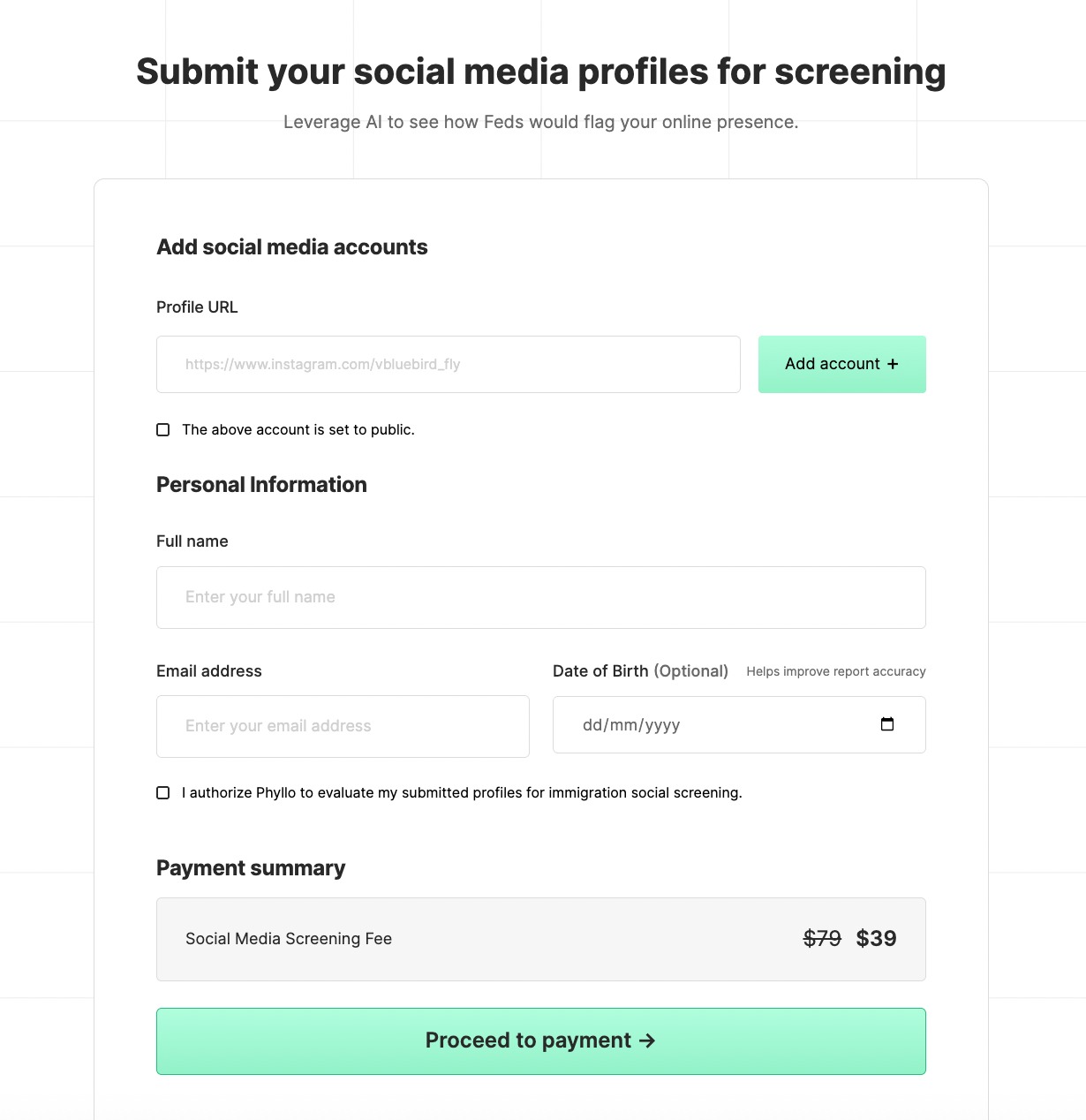
- To start, you must enter the link to your social media profile. If you have multiple profiles, say in LinkedIn, Facebook, Instagram, and others, or two different profiles in Facebook, add them as well. For this, you should click on Add account.
- Tick the box to make your social media account public for Phyllo’s AI-powered analysis system.
- Enter your personal information, which includes your name, date of birth, and email address, in the respective boxes.
- Tick the authorization box to let Phyllo authorize your social media profile for social screening before your visa application.
- Now, click on proceed to make the payment and pay the mandated amount in dollars.
- Once you are done, let Phyllo do the screening and risk assessment task on your behalf.
Implications for Mobility Professionals and Employers
Besides individual visa applicants, employers and mobility professionals should work responsibly based on the prevalence of social media screening. In simple words, employers and mobility professionals should follow some essential practices to ensure compliance and protect the privacy of employees.
Aware/Educate Employees and their Family Members
Employers and companies should regularly teach the effect of public posts on their visa outcomes. This aspect is essential mainly for dependent visa holders.
Use FAQs and General Awareness
Employers should focus on general awareness, FAQ sessions, and provide access to legal counsel separately instead of any prescriptive guidance.
Recommendations on Profile Consistency
Another prime responsibility of every employer or company owner is to recommend that their employees maintain profile consistency. Remember that discrepancies between visa applications and social media profiles will raise red flags.
Get Help from Legal Professionals
Get advice from lawyers or legal professionals to review the mobility policies and internal social media at the time of sharing posts on location, employment, and political views.
Conclusion
Social media screening or vetting in the context of immigration raises several complex ethical and legal questions on free expression, privacy, and due process. Hence, visa applicants, especially mobility professionals, should work responsibly. They must make sure of legally sound internal messages, culturally sensitive content, and stay coordinated across legal, HR, and immigration functions. Overall, social media screening serves as a practical tool to assess risks, verify claims, and spot prospective red flags. Therefore, applicants and mobility professionals must be fully prepared to avoid rejection and receive approval of their visa applications in a timely manner for a safe journey or relocation.
Frequently Asked Questions
What is automated social media screening in visa and immigration processes?
Automated social media screening uses AI tools to analyze applicants’ public online content to verify identity, assess compliance, and detect potential risks. It supports immigration authorities in making more informed decisions.
How does social media screening improve the accuracy of visa evaluations?
AI systems scan large volumes of social data to detect inconsistencies, fraudulent information, or high-risk behavior. This reduces human error, strengthens identity verification, and leads to more reliable assessments.
Does automated screening speed up the immigration process?
Yes, automation reduces the time consumed in manual background checks by instantly reviewing applicants’ digital footprints. This results in faster processing times and quicker visa decisions.
Is social media screening legal and ethical?
Immigration agencies typically analyze only publicly available data and follow strict data protection laws. Ethical concerns remain, but transparency, consent, and regulation help maintain fairness and privacy.
How are governments using AI-powered screening tools today?
Governments use AI to cross-check information, flag suspicious activities, detect fake identities, and support risk-based decision-making. These tools enhance both national security and administrative efficiency.
Does immigration check your social media during visa screening?
Yes. Immigration authorities in countries like the United States, the United Kingdom, Canada, and Australia review applicants' posts, comments, and profiles alongside their paperwork.
What do visa officers look for on social media profiles?
Officers look for contradictions with the visa category applied for, posts about relocating permanently, links to criminal or politically sensitive activity, and unbacked claims.
Can a social media post cause a visa rejection or delay?
It can. Applications get delayed or refused at the border when online activity contradicts the form, and fake narratives from unregistered agents can trigger a permanent ban.
What is automated social media screening in immigration?
Automated social media screening uses AI to scan an applicant's public online content, verify identity, and flag risk, replacing much of the slow manual vetting officers once did.
How much faster is automated screening than manual review?
Automated systems handle bulk applications quickly, cutting overall visa processing from many weeks to a few days and freeing officers to work the high-risk, complex cases.
How should you prepare your social media before a visa application?
Search your name, email, and phone number, hide or correct anything misleading, keep education, work, and travel history matched across profiles, and post travel plans carefully.
How does the Phyllo social media screening tool work?
Phyllo's tool takes your profile links, confirms consent to analyze them, collects your name, date of birth, and email, then runs AI screening and returns a risk assessment.
What should employers do about visa social media screening?
Employers should brief staff and dependents on how public posts affect visa outcomes, run FAQ sessions, recommend profile consistency, and let lawyers review mobility policies.
Is social media screening for visas legal and ethical?
Agencies generally review only publicly available data under data protection law, yet the practice still raises open questions about privacy, free expression, and due process.