

Social screening has recently become a mandatory procedure for issuing of H-1B visa and dependents/family members or H-4 visas to every individual traveling in the United States. According to the latest announcement by the US Department, every H-1B visa applicant and the respective H-4 dependent must undergo a mandatory vetting process of online-presence reviews from December 15.
- H-1B and H-4 visa vetting now includes a mandatory public social media review, effective December 15, 2025.
- Until December 2025, online presence screening applied only to F, M, and J applicants, meaning students and exchange visitors.
- The US State Department tells applicants to set profiles to public, and consulates have cut daily interviews, delaying appointments.
- A one-time $100,000 fee announced in September 2025 applies to new H-1B petitions, not continuing employment filings.
- Phyllo screening reports scan public posts on Facebook, LinkedIn, Instagram, TikTok, Twitter, and YouTube within 24 to 48 hours.
Social screening has recently become a mandatory procedure for issuing of H-1B visa and dependents/family members or H-4 visas to every individual traveling in the United States. According to the latest announcement by the US Department, every H-1B visa applicant and the respective H-4 dependent must undergo a mandatory vetting process of online-presence reviews from December 15. Before, social screening-based vetting process was applicable to only exchange and student visitors i.e., the applicants of J, F, and M categories.
The latest notice by the US department highlighted that social screening is intended to use every information available online or social media platforms to identify the people, who are inadmissible to the USA, especially the ones pose risks to public safety and national security.
Consequences of the Latest Visa Vetting Rules
According to the latest update by the US department, applicants should make their social media and online profiles easily accessible to let the immigration authorities review them. Even though biometrics appointments will continue, there will be limited daily consular interviews that may result in delays in visa processing for visa applicants of every category.
Rescheduling of Multiple Visa Appointments
As discussed here, the US State Department has implemented the new policy to mandate every H-1B applicant and the dependents H-4 applicants to change their social media profile’s status to public from private for undergoing the screening process. The main objective of the updated vetting process effective from December 15 2025 is to supplement the enhanced background checks. However, it forced the consulates to reduce the number of visa-related interviews conducted daily. The step also led to the rescheduling of many appointments to align with a relatively slow processing pace.
Notification of New Dates Post Biometric Procedures
Consulates of the United States have cleared about the deferring of the visa interviews even by several months even though applicants have already scheduled proceedings related to their biometric appointments. Accordingly, consulates and immigration authorities will notify the new dates to both H-4 and H-1B applicants only after they complete their biometric procedures. The new measure will thus affect many appointments made during the middle of December and consulates have expected that the same situation will continue until the queue’s applicants accommodate the updated social screening requirements.
Increase in Regulatory Fees
Other than the new update on the visa vetting process, the US department also introduced an updated H-1B regulations or work visa regulations in the early months of this year. This regulation redefines the specialty occupations and tightens various criteria relevant to degree, and boosts the obligations related to employer compliance.
Other than that, the USA department also announced a one-time fee of $100,000 in September 2025 for the new petitions of H-1B applications and exempted continued employment fillings. Such changes have further led to new positions scrutiny and additional costs to influence hiring strategies and workforce planning for companies relying on H-1B visas.
Concerns of the Indian IT Companies and Other Individuals
IT companies, applicants, and immigration attorneys of India have expressed their huge concerns on the combined effect of broad social media screening, strict occupational definition, and higher regulatory fees. The involved individuals are now expecting that the new adjustments will influence the future’s H-1B recruitment, onsite deployment, and key visa strategies for organizations regularly need to send their employees to the United States.
Does Phyllo’s Social Screening Reports May Ease the Screening Process
The social screening reports shared by Phyllo use AI to evaluate the publicly available digital footprint of a visa applicant in no time. The main objective of this screening tool to assess the potential risks, reputational concerns, compliance issues, red flags in the individuals’ behavior. Later, the generated reports transform the scattered social content into context-based and fully structured insights to support decision-making in visa or immigration vetting areas. Other than that, Phyllo’s screening reports are used for influencer vetting, hiring new candidates, and safety of a brand.
Audit Online Presence Proactively
Based on the latest update, digital background checks now include social media and online activities as essential parts of the eligibility assessment. In this situation, Phyllo’s social screening systems help work visa and student visa applicants to audit their Facebook, Twitter, LinkedIn, and other online/social media presence without putting any manual effort. In other words, Phyllo’s screening process helps users (H-4 applicants) to understand how immigration officials may interpret their publicly visible content, comments, and social media posts.
Identify the Key Risk Indicators
The reports obtained via Phyllo’s screening process will identify a few key risk indicators, like cultural misunderstandings, politically sensitive content, or misinterpreted comments influencing a visa decision. The screening process adopted by Phyllo scans various public profiles across diverse platforms, like Facebook, LinkedIn, Instagram, TikTok, Twitter, and YouTube to help individuals uncover their problems before immigration officials conduct the vetting process.
Perfectly Tailored to Visa Screening Cycles
Reports obtained from the Phyllo’s screening tools are tailored to the visa screening cycle. They provide valuable insights in no time (often within 24 hours to 48 hours) so that users may prepare them or adjust their online footprints. The best thing is that Phyllo always maintained confidentiality of its users. It analyzes completely according to the public content available over the internet.
What Make Phyllo’s Social Screening Reports Unique
The AI-based social screening reports of Phyllo are much more than simple content summaries.
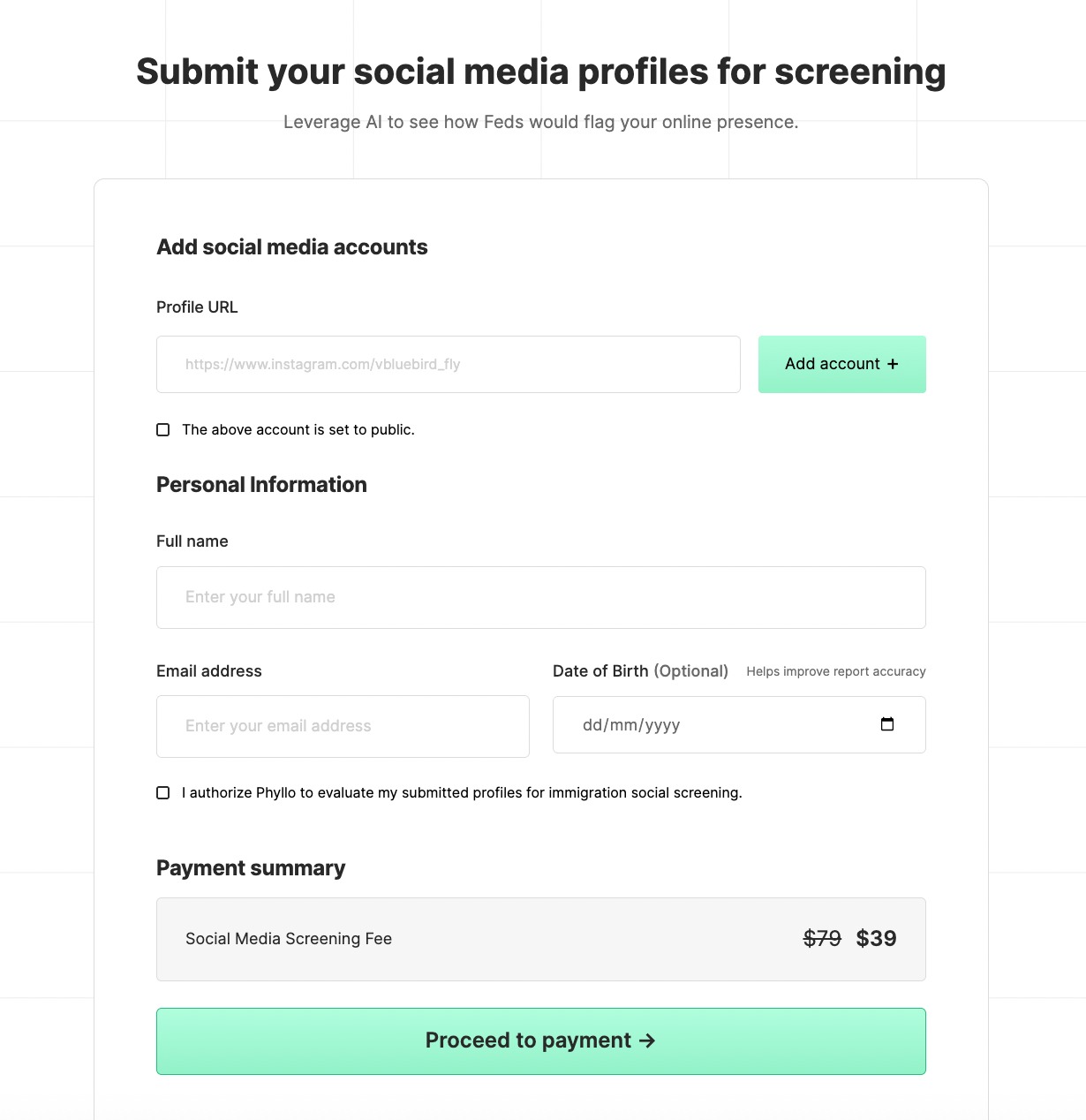
They include the following unique features-
Contextual Analysis Powered by Artificial Intelligence
Phyllo uses AI-powered contextual analysis to go beyond a few keyword flags. In this way, it interprets both nuances and meanings in every type of social media post.
Cover Multiple Platforms
The screening tool aggregates data from different networks to provide a proper overview of a person’s public social media or digital footprint.
Customized Safety Categories
Business organizations and IT companies may easily define and tailor a few relevant risk categories of their employees based on their specific requirements.
Transparent and Automated Reports
Phyllo’s social screening tool generates reports quickly and integrates them with human oversight based on the underlying requirements.
Each of these unique features makes the Phyllo’s reports actionable and scalable to empower visa applicants, IT companies, and other organizations to respond fairly and swiftly to potential digital risks.
Conclusion
Overall, the latest visa vetting updates highlighting enhanced social media vetting, new regulatory fees, and updates have created delays for H-4 and H-1B visa applicants. However, the positive aspect is that many visa applicants may now use the innovative and AI-powered Phyllo screening tool to get their job done automatically and timely.
Everyone knows that online behavior has a strong influence in real-world decisions, including the immigration eligibility process. Luckily, Phyllo’s social screening reports will provide a structured, comprehensive, and ethical way to act and understand the social media risks. Therefore, by converting diverse public social activities into contextual and clear insights, the generated screening reports will help visa applicants, organizations, IT companies, and other individuals to make confident and informed decisions with the highest possible clarity and strict compliance.
Frequently Asked Questions:
What are the recent changes in visa vetting for H-1B and H-4 applicants?
As of December 15, 2025, the U.S. Department of State expanded its online presence and social media screening to include all H-1B work visa applicants and their H-4 dependents. Previously, this review primarily applied to student (F, M) and exchange (J) visa categories. Under the new policy, consular officers may review public social media accounts during visa adjudication, and applicants are instructed to set their profiles to public to facilitate access.
What exactly do consular officers look for in social media content?
While the official guidelines do not list precise standards, officers typically review public posts, comments, photos, affiliations, and professional/educational information on platforms such as Facebook, Instagram, LinkedIn, Twitter/X, TikTok, and YouTube. They may compare this content with the DS-160 visa form, supporting documentation, and stated intentions to identify inconsistencies or potential risk indicators. Applicants are advised to ensure their online activity aligns with their visa narrative.
Why is the U.S. government introducing deeper social media screening for H-1B and H-4 visa applicants?
The expanded vetting reflects the U.S. government’s emphasis on national security and thorough background checks. Consular officers now consider public social media content as part of a comprehensive online presence review to verify identity, affiliations, intentions, and consistency with visa application information. This move is framed as a way to ensure that applicants pose no security risks and accurately represent their background.
How can Phyllo’s social screening reports help H-1B and H-4 applicants prepare for these new vetting requirements?
Phyllo’s screening reports use automated analysis of public social media data to help individuals understand how their profiles might be perceived by authorities. For H-1B and H-4 applicants facing enhanced social media vetting:
- Phyllo can identify posts or content that might raise questions in a visa review.
- The reports provide a structured overview of potential risk categories, such as inconsistent employment history, controversial statements, or publicly available affiliations.
This enables applicants to approach the visa interview and adjudication process with a clearer picture of their digital footprint.
Does Phyllo’s screening tool accesses any private content?
No, Phyllo’s approach focuses strictly on publicly accessible content, never accessing private messages or restricted information. Phyllo’s screening reports are designed to help users understand and manage their public digital footprint responsibly, without violating privacy guidelines. By preparing applicants for what is already visible to consular officers, Phyllo helps navigate the vetting landscape transparently and ethically.
When does expanded social media vetting for H-1B and H-4 visas start?
Expanded online presence vetting applies to every H-1B and H-4 visa applicant from December 15, 2025, when the US State Department made social media review a standard step.
Do H-1B and H-4 visa applicants need to make social media public?
Yes. The US State Department instructs H-1B and H-4 applicants to switch their social media accounts from private to public so consular officers can review the profiles.
What do consular officers look for in an applicant's social media?
Officers review public posts, comments, photos, and affiliations on Facebook, Instagram, LinkedIn, Twitter/X, TikTok, and YouTube, then check them against the DS-160 form.
Which visa categories faced social media screening before this change?
Online presence screening previously covered only F, M, and J applicants, meaning students and exchange visitors. December 2025 added H-1B workers and H-4 dependents.
Will the new visa vetting rules delay H-1B and H-4 appointments?
Yes. Consulates have cut the number of daily interviews and rescheduled many appointments, and applicants receive new interview dates only after finishing biometrics.
How much is the new one-time fee on new H-1B petitions?
The US government announced a one-time $100,000 fee in September 2025 for new H-1B petitions. Filings for continued employment are exempt from that charge.
How do Phyllo social screening reports help H-1B and H-4 applicants?
Phyllo turns scattered public social content into structured, AI-analysed risk insights, so H-1B and H-4 applicants can see how officers may read their digital footprint.
Which platforms do Phyllo social screening reports cover?
Phyllo scans public profiles on Facebook, LinkedIn, Instagram, TikTok, Twitter, and YouTube, and a report usually arrives within 24 to 48 hours of the request.
Does Phyllo's screening tool access private social media content?
No. Phyllo analyses only publicly accessible content and never opens private messages or restricted data, so you see what consular officers can already view.