


Platforms use LinkedIn data and APIs to gather insights about professionals, skills, job trends, and company hiring patterns. This data helps build talent intelligence products that support recruitment, workforce planning, and market assessing. By analyzing profiles, job postings, and industry trends, companies can make smarter hiring and talent strategy decisions.
- Talent intelligence platforms pull LinkedIn data through the LinkedIn API to map skills, benchmark pay, and forecast workforce needs.
- LinkedIn holds more than 950 million member profiles covering skills, connections, and full career histories.
- Skills mapping sets aggregated LinkedIn profiles against internal workforce records so recruiters see gaps by industry, region, or competitor.
- Strategic sourcing uses LinkedIn API job search tools to surface passive candidates and track where top performers moved.
- Phyllo's LinkedIn API is sold in tiers, with free access at the low end and paid plans priced by call volume.
How Platforms Use LinkedIn Data to Build Talent Intelligence Products?
Attracting and retaining top talent in a competitive landscape is essential for business success. However, making informed decisions on people's needs requires data-driven insights. Here comes the role of Talent Intelligence and the world's largest professional network as an exclusive source of critical information.
Here, you will get an overview of talent intelligence. You will also learn how LinkedIn API job search insights help you find the right candidates.
Overview of Talent Intelligence
Talent Intelligence involves many activities, including understanding skill gaps within an organization, benchmarking compensation, identifying external talent pools, and predicting future workforce needs. It leverages different data sources to help organizations gain a strategic benefit in almost every aspect of human capital management.
Why LinkedIn is Preferred to Collect Talent Data?
With more than 950 million members worldwide, LinkedIn has become a vast source of professional data. Every profile highlights a dynamic record of connections, skills, experiences, and career trajectories. Such a large amount of data makes LinkedIn data a highly valuable asset for building Talent Intelligence products.
Platforms specializing in workforce, recruitment, and HR technology are regularly planning to integrate LinkedIn data into their existing offerings. In this way, their users will receive deep and actionable insights. However, LinkedIn data integration is possible only via LinkedIn Application Programming Interfaces.
Overview and Mechanism of LinkedIn API
LinkedIn API allows developers to integrate LinkedIn’s prime functions directly into LinkedIn and workforce-related applications. Accordingly, the API serves as a central interface for developers to interact with any LinkedIn account programmatically. It allows developers to explore LinkedIn's vast professional network and optimize their applications to succeed.
Moreover, LinkedIn offers its own consumer platform to help users promote their brands and foster the right connections. Also, one can gain valuable insights into the performance to boost the business reach and online presence.
How LinkedIn API Access Benefits Recruitment Platforms?
LinkedIn API access benefits recruitment platforms based on the following reasons-
Integration of Profile APIs
A key benefit of LinkedIn API access is that it supports networking across many apps. It does this by giving access to LinkedIn profiles.
Content and Credential Sharing
An API for LinkedIn plays a vital role in boosting a user's expertise visibility. Simultaneously, it simplifies posting accomplishments across diverse company pages.
Connectivity with Companies
Users may get several company page features powered by LinkedIn to boost the brand exposure.
Offers Customization
One key benefit of LinkedIn’s API job search is that it uses data from your LinkedIn profile. It uses this data to show you job results that fit you better.
How LinkedIn API Works for Developers?
The LinkedIn API for developers is a suite of tools designed primarily to integrate data. It allows diverse functionalities, which include the following-
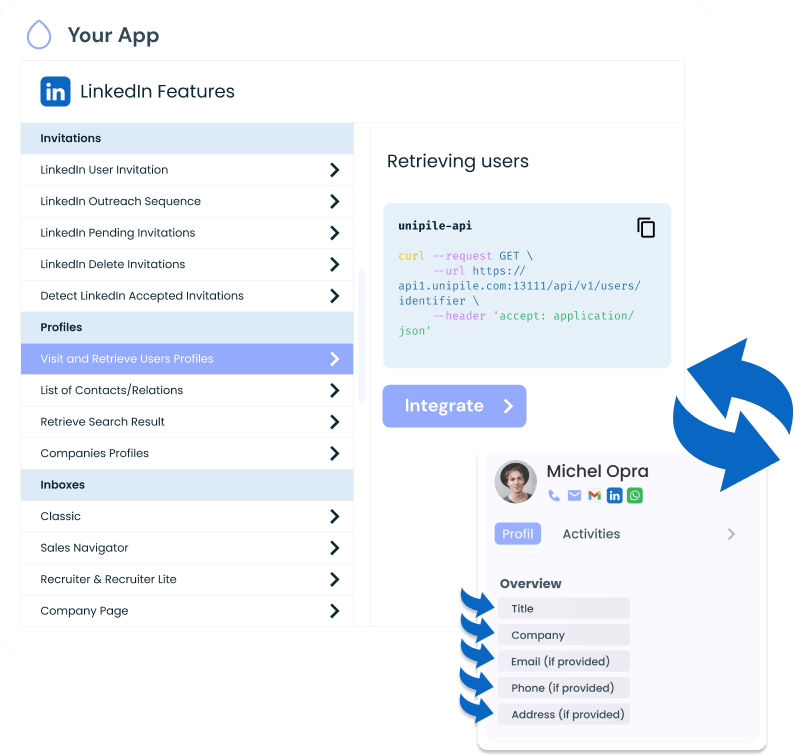
Retrieval of Profile Data
Linked API documentation uses public profile data with members’ consent. It fills LinkedIn candidate profiles, analyzes skill patterns, and maps career paths.
Insights into Professional Connections
Different insights into API-to-professional connections may help developers understand talent flows and the potential for referrals.
Access to Job Postings
Developers may use the LinkedIn API Jobs option to aggregate job listings. Also, the LinkedIn API job search option helps analyze market trends and find new skills for specific roles.
How Job Platforms Use LinkedIn API or LinkedIn Data?
Now, we will explore a few ways job platforms may use LinkedIn API access to create powerful Talent Intelligence tools-
Skills Mapping
Skills mapping is a valuable job application. Talent Intelligence platforms compare combined profile data to find common skills in an industry, region, or competitor group. Recruiters may compare external benchmarks to internal workforce data to help organizations easily identify skills gaps.
Strategic Sourcing of Talents
Talent Intelligence platforms today adopt a proactive approach. It leverages the LinkedIn API for developers and uses certain tools associated with the LinkedIn API job search. Accordingly, the platforms identify passive candidates with the precise skills, expertise, and experience needed for a role.
On the other hand, recruiters use API tools to build targeted pipelines. They track the career paths of top performers and connect with strong candidates.
Modeling Workforce Scenarios
Long-term strategic planning needs foresight into diverse future talent requirements. Organizations may now use LinkedIn API documentation and Talent Intelligence platforms to analyze historical data on industry trends and career progressions to model different workforce scenarios.
For example, any company entering a new market may use Talent Intelligence tools. These tools help assess local talent, career paths, and regional professionals. They also show average pay rates. Such a data-driven approach helps recruiters make informed decisions about the right office location, team structures, and the skills to prioritize for future hires.
Regularly Track DE & I Goals
Many organizations focus on DE & I initiatives, for which they need Talent Intelligence platforms to leverage anonymized and aggregated LinkedIn data. Accordingly, companies benchmark their diversity metrics against industry averages. Such analysis may identify bias areas in the recruitment process and track DE & I Goals over time. Moreover, the LinkedIn API provides the data required to implement impactful changes.
Overall Cost of LinkedIn API
Once you are familiar with the LinkedIn API features and its role in Talent Intelligence, HR platforms, and their developers should know the overall cost to use the LinkedIn API, along with its limitations. For this, we should say that the Phyllo LinkedIn API tool offers different tiers.
Some tiers provide free access. Other tiers are paid for bulk commercial use. Moreover, LinkedIn API costs also differ depending on the data access level required and API call volume.
Real Life Scenario of Talent Intelligence and LinkedIn API Access
Suppose a fast-growing IT company has plans to expand its existing Artificial Intelligence solutions. For this, the company wants to hire about 40 to 50 engineers in the coming months. Simultaneously, the company personnel identify the right location for the new office and the demanding skills for the recruitment. These include Machine Learning, Python, and so on.
Role of Talent Intelligence Tools
Companies and hiring platforms will use talent intelligence tools. These tools will analyze talent supply and demand in Indian cities. Examples include Pune, Hyderabad, and Bangalore. Also, the Talent Intelligence tools will identify the workforce skill gaps, track the hiring trends of competitor companies and benchmark the employees’ salaries.
For instance, Talent Intelligence data may show that Bangalore City has more AI engineers. It may also show high competition among rival companies. In contrast, Hyderabad has multiple talents and hiring them will incur low costs. Accordingly, companies may avoid guesswork and come up with data-driven hiring decisions.
How LinkedIn API Lets Recruiters to Access the LinkedIn’s Professional Data?
LinkedIn API gives well-structured and professional LinkedIn data to recruitment platforms. Key data insights include-
- User profiles with their educational qualification, skills, and work experience
- Hiring trends and diverse job postings
- Company’s workforce data
- Network insights and connections
How Platforms Integrate LinkedIn API Data with Talent Intelligence?
Talent intelligence and recruitment platforms integrate the LinkedIn API data to-
- Create talent pools according to their experience and skills
- Analyze the job trends and career transitions
- Map hiring patterns and talent networks
- Create dashboards to use them for diverse HR teams
Conclusion
LinkedIn data, when accessed responsibly through robust APIs, helps drive the development of innovative Talent Intelligence solutions. These platforms transform bulk professional information into different actionable insights to empower organizations to make fair, smart, and strategic decisions.
FAQs:
What is Talent Intelligence, and why should companies consider it?
Talent Intelligence fulfills the first objective of identifying the talent pools by considering the applicants data available online. However, companies may even use it to understand the skill gaps, benchmark their workers’ compensation, and forecast the workforce needs in future.
How Talent Intelligence helps in fair and strategic hiring decisions?
Talent Intelligence converts professional data obtained from diverse recruitment plants into actionable insights to promote smart workforce planning and smart recruitment followed by strategic and fair hiring decisions.
Why do companies and recruitment platforms use LinkedIn platform to find talent data?
Until now, the LinkedIn social media platform succeeded to have approximately 1,000 million members. Accordingly, it offers a dynamic view of industrial professionals by covering skills, connections, careers, and experiences. Such a vast scale and depth make LinkedIn the most preferred source to find valuable talent insights.
What is the LinkedIn API?
LinkedIn API i.e. the Application Programming Interface refers to the set of tools and protocols, which helps developers to access and integrate the LinkedIn’s data programmatically and adopt diverse functionalities into the existing workforce applications.
What is the scope of LinkedIn API for developers?
LinkedIn API gives proper access and consent to retrieve profile data from diverse public profiles based on member consents. It also derives insights into diverse professional connections to understand the referral potential and talent flows. Also, one can access job postings to identify the emerging skills, analyze the current market trends, and optimize listings.
How do platforms use LinkedIn data to convert into actionable Talent Intelligence?
Recruitment platforms use the LinkedIn API to collect structured data from the LinkedIn social media platform, which include job trends, skills, and profiles. They review and use the data across different cases to find available talent, hiring trends, and skill needs. Especially, recruitment platforms use LinkedIn data for strategic sourcing to identify the passive candidates, creating targeted pipelines, and finding the high performers.
How access to LinkedIn API benefits recruitment platforms?
Access to the innovative LinkedIn API benefits recruitment platforms by leveraging the LinkedIn data to target the precise candidates, improved talent matching, and faster sourcing. It also helps in credential sharing and streamlined content, cross-app networking, connectivity of the company page to improve its brand exposure, and lots more.
What is the overall cost of accessing LinkedIn API for any recruitment platform?
Cost to access the LinkedIn API depends solely on both the service scope and the service provider. For instance, the most reliable Phyllo-powered LinkedIn API possesses diverse tiered plans. Accordingly, one can use a few free tiers and look for paid ones to fulfill the commercial uses. Moreover, the overall cost of LinkedIn API depends on the level of data access you need and the API call volume.
How do platforms use LinkedIn data to build talent intelligence products?
Platforms pull structured LinkedIn data through the LinkedIn API, then turn profiles, job postings, and hiring trends into skills maps, talent pools, and HR dashboards.
Why is LinkedIn the preferred source for talent data?
LinkedIn carries more than 950 million member profiles, each a live record of skills, connections, and career moves, which gives talent teams unmatched scale and depth.
What data does the LinkedIn API give recruitment platforms?
The LinkedIn API returns profile data covering education, skills, and work history, plus job postings, hiring trends, company workforce data, and network insights.
How much does LinkedIn API access cost?
Pricing runs in tiers. Phyllo's LinkedIn API has free tiers for light use and paid plans for bulk commercial access, with cost scaling by data access level and call volume.
What is talent intelligence in recruitment?
Talent intelligence means using workforce data to spot skill gaps, benchmark compensation, identify external talent pools, and predict future hiring needs across an organization.
Can talent intelligence platforms track diversity goals with LinkedIn data?
Yes. Platforms use anonymized, aggregated LinkedIn data to benchmark diversity metrics against industry averages, flag bias in hiring steps, and follow DE and I progress over time.
How do recruiters find passive candidates with the LinkedIn API?
Recruiters run LinkedIn API job search tools to surface professionals matching a role's skills and experience, then build targeted pipelines by tracking where top performers move.