
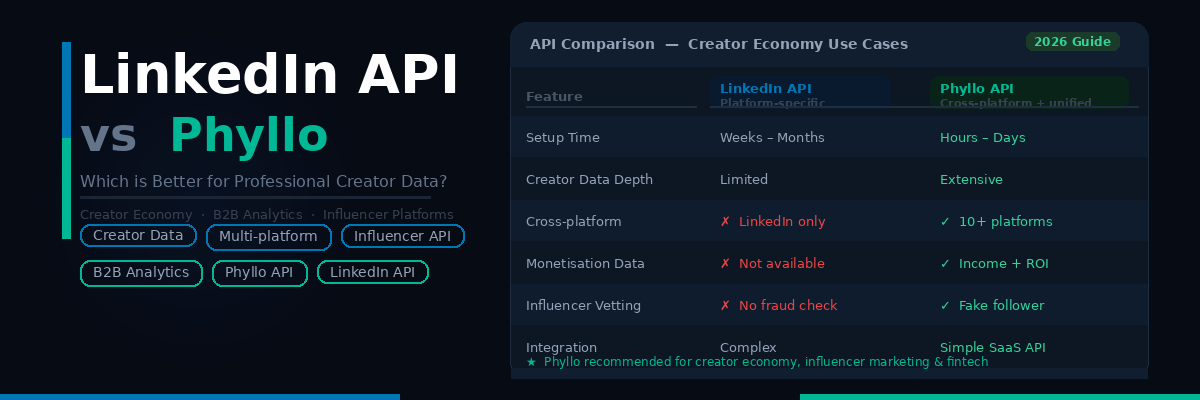


TL;DR Summary: The LinkedIn API enables direct access to professional profile data, networking features, and platform-specific insights, making it ideal for single-platform use cases and B2B integrations. On the other hand, Phyllo aggregates permissioned creator data across multiple platforms, offering unified, real-time insights and simplified integration for influencer marketing and creator economy applications. In short, LinkedIn API suits platform-specific needs, while Phyllo is better for scalable, cross-platform creator data and advanced analytics.
- LinkedIn API vs Phyllo comes down to access, since LinkedIn gates useful creator data behind partner approval while Phyllo serves it through one open SaaS API.
- Phyllo setup runs hours to a couple of days, against the 3 to 6 month LinkedIn partner approval process.
- Phyllo covers 5M+ B2B LinkedIn creator profiles with 20+ search filters, real-time engagement tracking, and audience demographics.
- LinkedIn's API returns no creator earnings or monetization data, so fintech income verification needs an aggregated source.
- Pick the LinkedIn API for native features like Sign In with LinkedIn, Recruiter access, or enterprise ad and page analytics.
What are the Differences Between LinkedIn API and Phyllo API?
Phyllo API is the perfect option for multi-platform and comprehensive creator data. It also serves as a unified API to simplify access to any LinkedIn creator data. On the other hand, LinkedIn API is better to perform deep and authentic B2B professional vetting with direct integration to social platforms. For this, LinkedIn API needs direct but compliance, restrictive, and technical integration.
Detailed Analysis of LinkedIn API vs Phyllo API
Accessing well-structured and reliable professional creator data in today’s fast-growing economy of content creators is vital for brands, SaaS tools, and fintech platforms. Whether you create an influencer platform, verify creator income, or run B2B campaign, your right selection between the Phyllo, the advanced influencer marketing API and the traditional LinkedIn API will define the success of your product. For this reason, we will compare both APIs based on their abilities, key features/highlights, and real-world scenarios.
What is Phyllo API
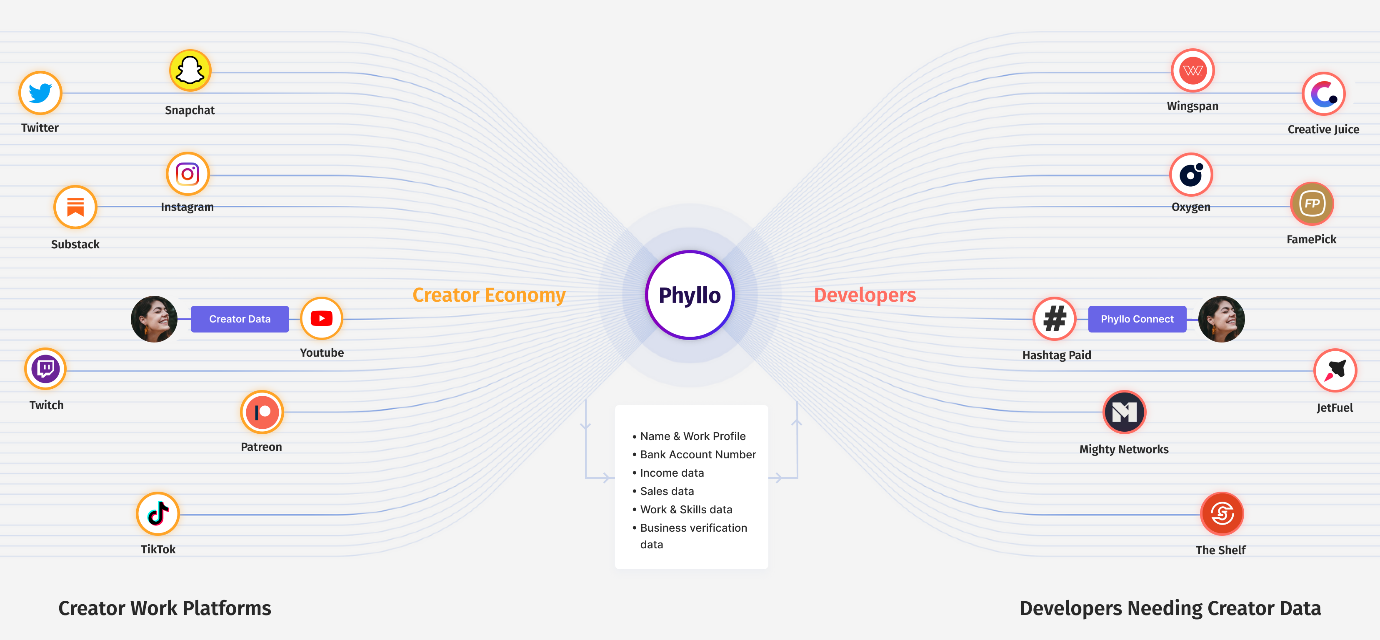
Phyllo is one of the universal data API platforms. Experts have designed it for the creator economy to let developers access the data permitted by content creators across diverse social platforms in a standard format. Moreover, Phyllo performs its functions as a single gateway to access and analyze:
- Engagement metrics
- Creator profiles
- Financial and income data with
- Cross-platform analytics
Another key aspect of Phyllo API is that it connects with diverse platforms to provide real-time and normalized data feeds.
What is LinkedIn API
The LinkedIn API refers to a set of various developer tools provided by LinkedIn to access the necessary platform data. These include the company pages, user profiles, job postings, and limited engagement metrics. However, LinkedIn API provides limited access and users need its approval during special cases. For a complete breakdown of every LinkedIn API tier, what data each unlocks, pricing, and the most common integration challenges developers face, see our detailed guide on how the LinkedIn API works.
Key Differences between Phyllo API and LinkedIn API
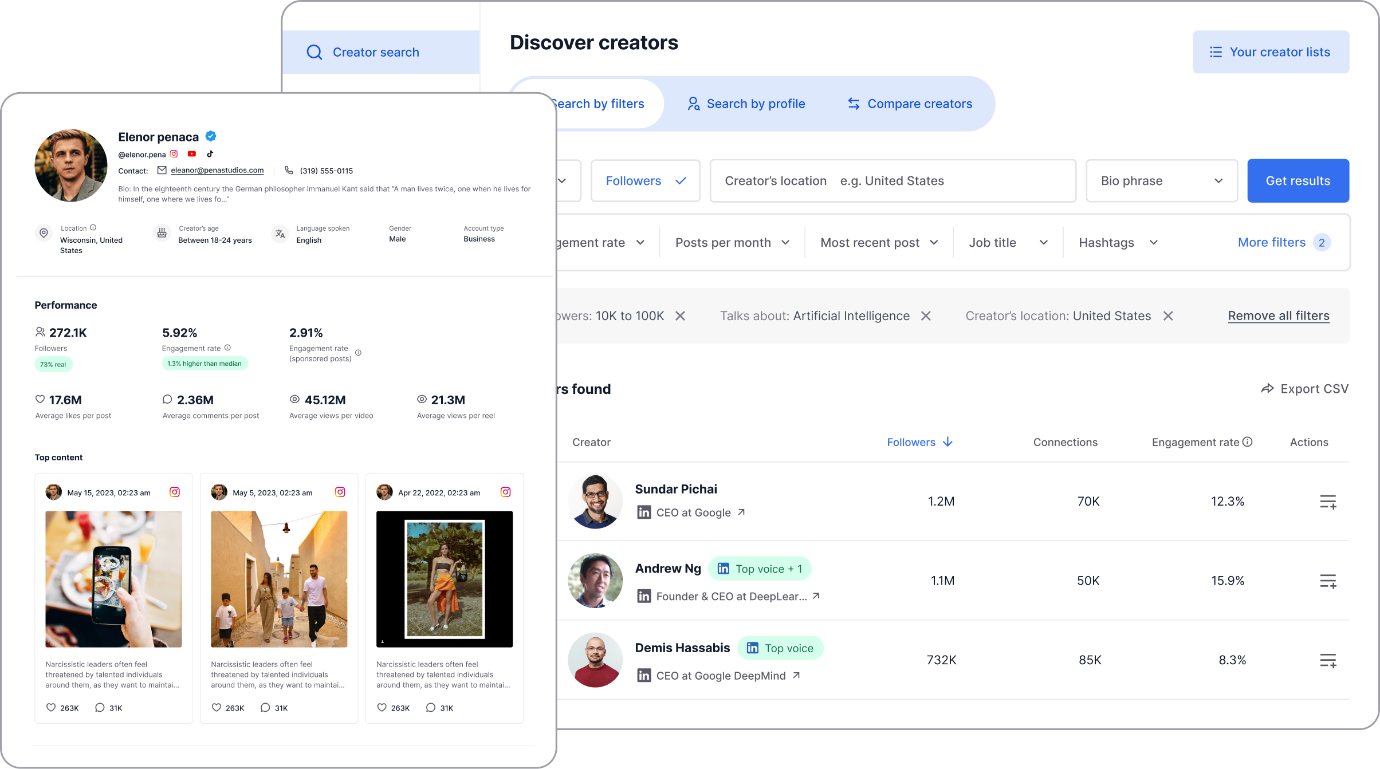
Outcome: Phyllo allows richer insights on influencers and creators based on its fast go-to market. For a step-by-step guide on executing this in practice — from finding the right LinkedIn creators to tracking campaign performance — see our complete guide on B2B LinkedIn influencer marketing campaigns.
- Data Accessibility and its Scope
LinkedIn API offers raw but the most accurate data but it is strongly restricted. Moreover, access to connections, profile details, and messaging needs special permissions and strict consent from users.
On the other hand, Phyllo API works as a layer above API to unlock or access a few specific data, like the creator insights in detail, contact information, like the email addresses, and audience demographics. Before this, such information is difficult to retrieve.
- Compliance with Data Privacy Laws
Developers and marketers willing to use LinkedIn API must have strict compliance with platform-specific data policies and API-based privacy laws. In contrast, Phyllo claims to provide compliant and safe access. It helps developers to adhere strictly with the vital LinkedIn policies without any issue related to violating data limits.
- Social Platform Coverage
LinkedIn API performs its functions only within its ecosystem. However, Phyllo integrates with different platforms, like Instagram, TikTok, YouTube, and many more to work well for multi-platform strategies.
- Platform Integration
The operation of LinkedIn API requires a robust infrastructure development to deal with authentication, API version changes, and rate limits. On the other hand, Phyllo provides a universal API to provide structured data across LinkedIn and many more social platforms. Moreover, Phyllo does the job with consistency to save the valuable development period.
- Applications/Use Cases
Brands, marketers, and developers online use LinkedIn API to build official apps that need deep and specialized access to Talent Solutions, marketing, and Sales Navigator data. In contrast, use the Phyllo API solution to launch influencer marketing platforms rapidly, conduct social listening, perform brand safety checks, and find B2B creators.
Comparison of LinkedIn API and Phyllo in Table Form
Key Benefits of Phyllo for Content Creator Data
Phyllo offers a unified API to access consented and real-time data, like income, identity, and engagement across diverse social platforms. It also offers authentic and high-quality data to verify content creators. Track the KPIs of different campaigns, prevent fraud, and reduce integration costs to up to 80%. Prime strengths of Phyllo are daily updates, easy onboarding, and detailed audience insights. Besides, it offers the following benefits-
Authentic and Consented Data
Phyllo’s architecture is always based on consents to allow legal access of any data from different sources or social platforms, like YouTube, Instagram, and TikTok. In this way, it avoids the use of any unreliable and scrapped data.
Comprehensive Platform Coverage
Phyllo covers different social platforms, which include YouTube, Instagram, Twitch, TikTok, Discord, Substack, and Shopify.
Universal API Access
Phyllo has a single and universal API connection to provide access to more than 50 different data fields. These include the engagement metrics i.e., likes, comments and shares, follower counts, audience demographics, and creators’ income.
Instant Verification with Real-time Tracking
Phyllo instantly verifies the profile of a content creator based on location, gender, and other audience insights. Simultaneously, it tracks influencer-driven content in real-time.
Improved Fraud Protection
Unlike LinkedIn API, Phyllo prevents influencer fraud, like fake followers to let the brands approach the genuine content creators only.
ROI Tracking for Campaigns
Brands and marketers may use Phyllo to track the ROI of their campaigns, and get data on content engagement and previous collaborations.
Reduce the Development Costs
Both creators and marketers may save approximately 80% on overall integration costs with the help of a standard Phyllo-powered API for different platforms.
Real-world Scenarios of LinkedIn API and Phyllo Comparisons
Scenario 1-B2B Influencer Marketing Platform
A startup company designing an influencer marketing platform aims to identify the LinkedIn creators.
Option 1-Task via LinkedIn API
- Limited access to data related to the creator engagement
- Absence of standardized influencer metrics
- Needs approval from partners
Option 2-Task via Phyllo API
- Access to more than 5M+ creator profiles — the largest B2B LinkedIn creator database available
- Insights on target audience and their engagement
- Allows faster onboarding
Outcome
Phyllo allows richer insights on influencers and creators based on its fast go-to market.
Scenario 2-Fintech Platform
A fintech company needs a sophisticated API tool to verify its LinkedIn creators’ income to approve their loans.
Option 1-Use of LinkedIn API
- There is no direct access to the earnings of LinkedIn creators
- Absence of monetization data
Option 2-Use of Phyllo-powered API
- Phyllo-powered APIs provide every minute detail on the income verification of various LinkedIn creators/influencers.
- The API aggregates the creators’ earnings across diverse social platforms, including LinkedIn.
- Phyllo activates and highlights risk scoring for creators.
Outcome:
Phyllo API serves as the single and the most effective yet viable solution.
LinkedIn API Vs Phyllo-When to Choose the One
Whether one should choose LinkedIn API or Phyllo depends solely on the specific requirements. Accordingly-
Situations When LinkedIn API is the Right Choice
- Deep Integration
LinkedIn API is preferred to design native LinkedIn functionality, such as LinkedIn Sign in, access any Recruiter system, or post something on behalf of other users.
- Bulk Corporate Usage
Do you work at the enterprise-level? Go with the LinkedIn API to gain high-frequency access to paid Ad data and company’s page analytics.
- Networking or Recruitment
Lastly, one can choose LinkedIn API for recruitment and networking, as the API allows users to access any company’s data and basic profile easily.
Scenarios When Phyllo is Preferred
- Convenience and Speed
Based on the features and detailed comparison between LinkedIn API and Phyllo, we have found that Phyllo’s set up time is only a few hours to up to 1 or 2-day. Accordingly, one should choose it to prevent the time-consuming 3 months to 6 months approval process from LinkedIn partners.
- Multi-Platform Access
Phyllo is the best option when developers, marketers, and brands need to access data from different social platforms, like Instagram, YouTube, and TikTok, along with LinkedIn data in a single unified API.
- Simple Integration
Phyllo is selected when there is a demand for simple and easy implementation instead of managing many complex LinkedIn endpoints.
- Influencer Vetting
Phyllo is demanded when companies and brands audit the authenticity of various LinkedIn creators based on checking their followers’ quality.
- Creator Analytics
Phyllo is helpful to gain in-depth data on engagement metrics, followers’ counts, content performance and audience demographics.
Conclusion
Selection of a reliable and appropriate API is crucial in the creator economy. For this, remember that the LinkedIn API is, although powerful, fails to fulfill the creators’ requirement and it is restricted as well. On the other hand, Phyllo acts as an advanced influencer marketing API. It bridges the gap with easily accessible, rich, and scalable creator data. Phyllo's LinkedIn APIs give you instant access to a database of 5M+ B2B LinkedIn creators — with 20+ search filters, real-time engagement tracking, and audience demographics — without the weeks-long partner approval process LinkedIn requires. According to the statistics of 2026 and higher, social platforms often leverage creator intelligence instead of simple raw profile data. Therefore, Phyllo stands out and becomes the first choice for professional content creators.
Frequently Asked Questions
1. What is the main difference between LinkedIn API and Phyllo?
The LinkedIn API is designed for platform integrations like recruitment and ads, while Phyllo is an influencer marketing API focused on creator data, analytics, and monetization insights.
2. Is LinkedIn API suitable for influencer marketing?
Not really. It lacks deep creator insights and requires restricted access, making it less ideal for influencer marketing platforms.
3. Why is LinkedIn API hard to access?
LinkedIn requires developers to join its Partner Program, which has strict eligibility criteria and limited approvals.
4. Can Phyllo access LinkedIn creator data?
Yes, Phyllo provides access to LinkedIn creator data along with other platforms through a unified influencer marketing API.
5. Which API is better for startups?
Phyllo is better for startups due to easy integration, faster onboarding, and creator-focused features.
6. Does LinkedIn API provide engagement analytics?
Only limited analytics via marketing APIs; it does not offer detailed creator-level engagement insights.
7. Can I verify influencer income using LinkedIn API?
No. LinkedIn API does not provide monetization or income data.
8. Is Phyllo compliant with data privacy laws?
Yes, Phyllo uses consent-based data access and follows compliance standards, making it safer for scaling applications.
What is the difference between the LinkedIn API and Phyllo?
LinkedIn's API powers native features like Sign In and Recruiter, while Phyllo is social data infrastructure that returns normalized LinkedIn creator profiles and analytics.
How long does LinkedIn API partner approval take?
LinkedIn partner approval usually runs 3 to 6 months and can be rejected without a stated reason. Phyllo skips that queue, with setup measured in hours or a day or two.
Can you verify a LinkedIn creator's income with the LinkedIn API?
No. LinkedIn exposes no earnings or monetization data. Phyllo aggregates creator income across LinkedIn and other platforms and adds risk scoring for lending decisions.
Does Phyllo give access to LinkedIn creator data?
Yes. Phyllo covers 5M+ B2B LinkedIn creator profiles with 20+ search filters, audience demographics, and real-time engagement tracking, plus YouTube, Instagram, and TikTok.
Is the LinkedIn API enough for an influencer marketing platform?
Rarely. It gives no standardized creator engagement metrics or audience demographics, so most B2B influencer platforms add an aggregated creator API on top of it.
Is Phyllo compliant with data privacy laws?
Phyllo runs on consented, permissioned access instead of scraped data, and it serves both public and authenticated creator data, so platform policies stay intact as you scale.
When should you choose the LinkedIn API over Phyllo?
Pick LinkedIn's own API for native builds such as Sign In with LinkedIn, Recruiter and Talent Solutions access, posting for users, and enterprise ad or page analytics.
How much does a unified creator API cut integration cost?
Teams save roughly 80% on integration costs with one unified API instead of a separate build per platform, since auth, versioning, and rate limits are handled in one place.