

LinkedIn API restrictions in 2026 are limiting access to creator data, making traditional outreach and analytics more challenging for brands. This shift is pushing marketers to rethink their B2B influencer marketing strategies and explore alternative data solutions. As a result, businesses are adopting smarter tools and unified APIs to scale campaigns efficiently while staying compliant.
- LinkedIn API restrictions in 2026 cap most tokens at 100 calls a day and limit stored data to 24 to 48 hours.
- Basic profile fields stay open on LinkedIn, while messages, connections, and advanced search now need approved partner access.
- B2B influencer marketing has shifted from automated outreach to manual engagement through posts, comments, and DMs.
- Brands now build their own influencer databases from CRM data and native analytics instead of API discovery.
- Sales Navigator alternatives include influencer marketplaces, intent data platforms, and APIs that cover multiple platforms.
The B2B influencer marketing world is regularly undergoing transformations in 2026. Accordingly, the tight API ecosystem of LinkedIn lies at the center of the shift. LinkedIn API was a powerful gateway for lead intelligence, automation, and influencer discovery. However, today the same API has become a compliance-driven, controlled, and a highly restricted API.
Founders, marketers, and developers willing to create a new or modern LinkedIn marketing strategy, have found the changes both technical and strategic. They have started redefining the way in which brands identify the right influencers, scale the advertisement campaigns, and measure their performance.
Our blog will explore the ways by which LinkedIn API restrictions have reshaped the B2B influencer landscape based on strategic insights, practical alternatives, and real-world scenarios.
Key Changes in the LinkedIn API Access of 2026
LinkedIn has recently moved to a partner-first and closed API model. Today, it prevents the access of many advanced abilities for general developers unlike an open ecosystem. A few of the restrictions imposed by LinkedIn API are:
- Access to the basic profile field and other similar types of limited user data access
- Prevention of access to messages, connections, and advanced search without proper approval
- Strict access based on partners for sales and marketing APIs
- Rate limits up to 100 API calls in one day per token
- Restrictions related to data storage, which is 24 hours to 48 hours for only a few datasets
LinkedIn API imposed the respective changes to protect its users’ privacy, prevent data scraping, and protect LinkedIn's premium products. However, the changes or the restrictions also affected the regular operations of B2B influencer marketing.
Why LinkedIn Restrictions Bother B2B Influencer Marketing
Today, LinkedIn has become a fast-growing B2B engagement platform based on its frequently rising interaction rates and multiple professional communities. Accordingly, API restrictions imply the following-
- One cannot easily automate the discovery of its influencers.
- One cannot extract audience insights on a large scale.
- One cannot build any scalable outreach system.
Each aspect has forced many brands and developers to change their existing LinkedIn marketing strategy to a relationship-first model from the old automation-first one.
5 Ways LinkedIn API Restrictions Are Reshaping the Industry
![What Is LinkedIn API? Complete Guide On How It Works [2026]](https://cdn.prod.website-files.com/6284f7327b63a63510a796c8/69f8442f99bc41d96897f115_928dc19d.png)
Besides brands and developers, LinkedIn API restrictions are reshaping the entire industry in the following 5 ways:
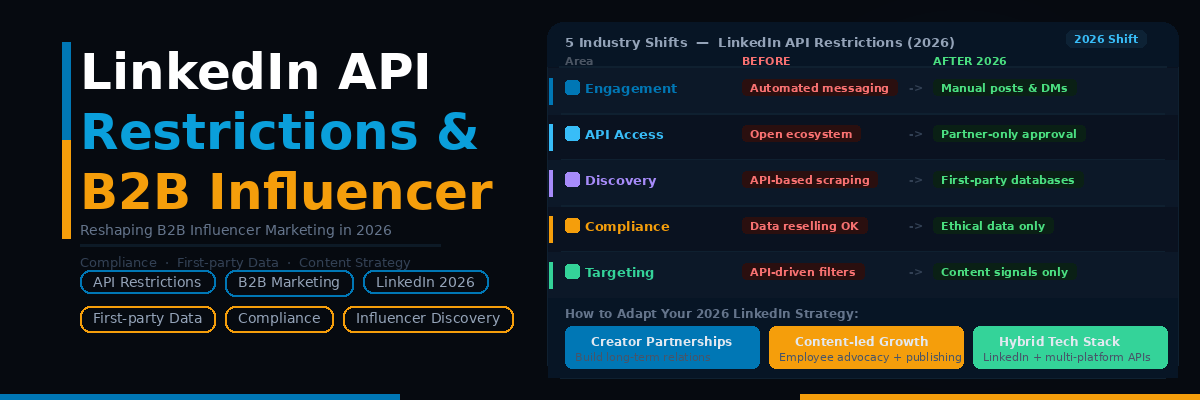
- Authentic Engagement Instead of Automated Engagement
Before the imposition of LinkedIn API restrictions, many brands used tools to automate the messaging process, requests for connections, and outreach their influencers.
After Restrictions
Now, LinkedIn API has completely banned or restricted automation. Instead, it has started prioritizing manual engagement via posts, comments, and DMs.
Influence/Outcome
Human-led influencer marketing has started replacing automation and heavy funnels.
- Increase in Dependencies on Approved Tools
Today, LinkedIn APIs need partnership approval. Because of this-
- One can only select the SaaS platforms to gain in-depth access.
- Other users may rely on aggregated APIs or workarounds.
Influence/Outcome
LinkedIn API restrictions have led to drastic growth of social listening tools, influencer platforms, and a few LinkedIn Sales Navigator alternatives.
- First-party Influencer Databases Instead of API-based Discovery
Limited API data access often prevents brands from relying on external enrichment or data scraping. Accordingly, data should be authentic and must come from owned audiences, CRM integrations, and native analytics only.
Influence/Outcome
Companies have started creating first-party influencer databases and stopped relying on discoveries driven by APIs.
- Compliance Driven Marketing Ecosystem
LinkedIn API restrictions implemented a few strict rules, which are-
- Avoid combining the LinkedIn data with any other external dataset
- Prevention of data reselling
Influence/Outcome
Marketers started to focus on only ethical data usage and strictly avoid the use of any scrap-based tool.
- Content as the New Targeting Engine
Based on the LinkedIn API restrictions imposed for this 2026, you cannot filter any influencer easily without taking help from deep search APIs. Rather, companies and brands must check and track various content performance signals to guide discovery, which include the shares, likes, and comments.
Influence/Outcome
Replacement of various API-driven targets with influencer discovery led by content.
Real-life Scenarios of LinkedIn API Restrictions
Scenario 1: A SaaS Company Scaling Thought Leadership
Before LinkedIn restrictions, SaaS Company and its developers often use API tools to identify any influencer or top voice in SaaS. Moreover, the developers use the automated outreach campaigns.
After LinkedIn API Restrictions
SaaS companies started relying on employees’ advocacy, manual engagement, and commenting on content creators or influencers’ posts.
Outcome:
SaaS Companies will achieve higher conversion rates but low scale and may easily set up strong relations with influencers.
Scenario 2-A Startup Company willing to Create a LinkedIn Automation Tool
Any startup company willing to create a LinkedIn automation tool before uses a few planned features. These include lead scraping, auto messaging, and profile enrichment. However, now API restrictions have blocked the core LinkedIn API features.
Updated Strategies
- The startup company should focus on creating a multi-platform based social media API tool.
- The company must focus on only aggregated insights across different platforms.
Outcome
The Startup Company seeking to build LinkedIn automation tools become strict compliant and expand beyond LinkedIn.
What are LinkedIn Sales Navigator Alternatives
As LinkedIn restricts lead extraction, search, and outreach automation, brands, businesses, and developers have started exploring the following LinkedIn Sales Navigator Alternatives:
- Influencer marketplaces
- Intent data platforms
- Multi-platform data APIs
Such tools will reduce dependency on any LinkedIn API and provide a broad data coverage.
How to Adapt Your LinkedIn Marketing Strategy in 2026
Whether you are a brand, a SaaS Company, or a developer, you must adapt yourself to the 2026 LinkedIn Marketing Strategies as follows-
Focus on Creator Partnerships
Every brand, marketer, and SaaS developer should put their efforts into creating long-term relations. Simultaneously, individuals should strictly avoid any transactional influencer or outreach campaign.
Invest in Growth Based on Content
Businesses and brands should publish unique, relevant, and informative content regularly. Also, they should leverage their employee’s influencers.
Hybrid Tech Stacks’ Applications
Brands must combine their external platforms and LinkedIn tools to use hybrid tech stacks.
Create Owned Data Systems
One should use first-party analytics and CRM to create owned data systems.
Strict Compliance is Vital
Lastly, brands should respect the mentioned API rates and API limits to avoid data scrapping. By doing so, one will strictly stay compliant with the LinkedIn API Restrictions.
Conclusion
LinkedIn API restrictions for the year 2026 have no longer remained limitations for brands. Instead, they now serve as reset buttons for the modern industry. Such restrictions are consistently pushing brands to set up only genuine relations, focus on quality content, and rely more on strategies rather than automation. Moreover, the future of B2B influencer marketing has now become a matter of credibility, trust, and meaningful customer engagement instead of simply scaling through different APIs.
Therefore, brands and businesses willing to adapt the existing LinkedIn marketing strategy must consider the LinkedIn API shift as an excellent opportunity to stand out in a more human and less automated ecosystem.
Frequently Asked Questions
Why is LinkedIn restricting its API?
LinkedIn is prioritizing user privacy, platform integrity, and monetization of premium tools. Restrictions help prevent misuse, scraping, and unauthorized data access.
Can I still use LinkedIn API for influencer marketing?
Yes, one can continue to use LinkedIn API for influencer marketing but get only limited features until and unless you become an approved partner. The workflows of many influencers should now rely on hybrid and manual approaches.
What are the biggest limitations of LinkedIn APIs in 2026?
Major limitations of LinkedIn APIs in 2026 are failure to access to messages or connections, strict API rate limits, limited LinkedIn profile data, and restricted access to analytics.
How do API restrictions impact B2B influencer marketing?
They reduce automation and data access, forcing brands to focus on authentic engagement, content, and long-term relationships.
What are the best LinkedIn Sales Navigator alternatives?
There are many LinkedIn Sales Navigator alternatives available today. However, a few of the popular alternatives include the following:
- Multi-platform APIs
- Intent data tools
- Influencer marketplaces
Each alternative offers broad insights beyond the existing LinkedIn ecosystem.
Is LinkedIn still effective for B2B influencer marketing?
LinkedIn continues to be effective for B2B influencer marketing. Even LinkedIn serves as the top platform for thought leadership and professional engagement.
How can I scale influencer campaigns without API automation?
One can easily scale the influencer campaigns without the need of API automation by simply focusing on employee advocacy, content amplification, strategic partnerships, and community engagement.
Are third-party LinkedIn automation tools safe to use?
Yes, third-party LinkedIn automation tools are safe to use. However, a few of the tools may violate LinkedIn policies. Especially, the use of non-compliant tools may cause bans or account restrictions. Hence, the key here is to be cautious.
Why is LinkedIn restricting its API in 2026?
LinkedIn tightened API access in 2026 to protect user privacy, stop scraping, and defend its premium products, so deeper data now sits behind partner approval.
What is the LinkedIn API rate limit in 2026?
Most LinkedIn API tokens are capped near 100 calls per day in 2026, and some datasets can only be stored for 24 to 48 hours, which rules out bulk influencer discovery.
Can I still use the LinkedIn API for influencer marketing?
Yes, but only with limited features unless you are an approved LinkedIn partner. Most influencer workflows now mix manual engagement with data from other platforms.
How do LinkedIn API restrictions affect B2B influencer marketing?
Restrictions cut automation and audience data, so B2B influencer marketing leans on real commenting, employee advocacy, content signals, and long term creator relationships.
What data can you still pull from the LinkedIn API?
Basic profile fields remain available. Messages, connections, advanced search, and the sales and marketing APIs all sit behind partner approval from LinkedIn in 2026.
What are the best LinkedIn Sales Navigator alternatives?
Influencer marketplaces, intent data platforms, and data APIs that span several social networks cover most Sales Navigator use cases and reduce reliance on LinkedIn alone.
How can you scale influencer campaigns without LinkedIn automation?
Scale comes from employee advocacy, content amplification, strategic creator partnerships, and community engagement rather than the automated messaging LinkedIn now restricts.
Are third party LinkedIn automation tools safe to use in 2026?
Some are, but tools that scrape or automate messaging can breach LinkedIn policy and trigger account bans, so check compliance before wiring one into a workflow.
How does Phyllo help when LinkedIn API access is limited?
Phyllo is a social data infrastructure platform that delivers creator and audience data across many social networks through one API, covering both public and consented sources.