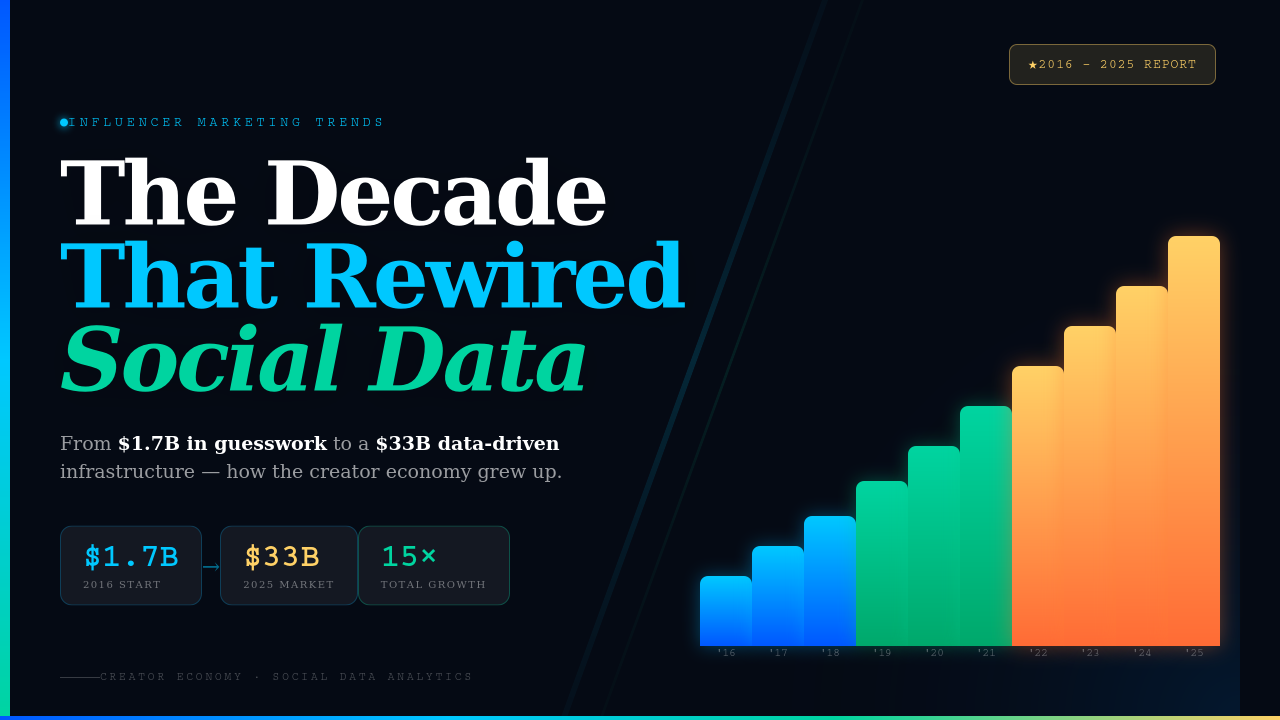


Between 2016 and 2025, influencer marketing trends shifted the entire industry from guesswork to verified, data-driven infrastructure. The market grew nearly 15x — from $1.7B to $33B — forcing brands to move beyond vanity metrics and build real measurement systems. Social data analytics is no longer a nice-to-have. It is now the backbone of every serious creator program.
- Influencer marketing grew from $1.7 billion in 2016 to roughly $33 billion in 2025, nearly 15x in under a decade.
- Brands swapped follower counts and CPMs for conversions, incremental revenue, affiliate GMV, and customer acquisition cost.
- GDPR in 2018, CCPA in 2020, and Apple's App Tracking Transparency in 2021 pushed the most valuable creator data behind consent walls.
- Influencer fraud detection turned into an enterprise risk function covering audience quality analysis, bot flagging, and FTC disclosure monitoring.
- By 2026, the frontier of influencer marketing trends is intelligence, built on a five layer social data stack from consent to activation.
Download the 2025 Influencer Marketing Trends eBook (Free)
Key Takeaways:
- Influencer marketing grew from $1.7B (2016) to $33B (2025) — nearly 15x in under a decade.
- Privacy regulations permanently changed how social data is collected and used.
- Real-time social data analytics replaced manual, screenshot-based campaign reporting.
- Authenticity and influencer fraud detection became core enterprise priorities.
- Creators are now recognized as financial entities — SMBs with verifiable income.
- The next era is about intelligence, not just influence
When "Followers" Were Enough (2016)
In 2016, influencer marketing was simple — and largely unaccountable. If a creator had a million followers, they were considered "influential." Brands bought reach. Agencies reported impressions. Campaign reporting meant screenshots pasted into PowerPoint decks sent weeks after a campaign ended.
The influencer marketing trends of that era were driven by visibility, not verification. According to Influencer Marketing Hub, the global industry was valued at roughly $1.7 billion in 2016. Back then, the ecosystem had no standardized verification systems, loosely governed platform APIs, immature influencer fraud detection tools, and zero recognition of creators as financial entities by banks or institutions.
Influence was visible — but not accountable.
Nobody predicted that within a decade, social data analytics would become the financial infrastructure powering a $33 billion industry.
The $33 Billion Wake-Up Call
By 2025, influencer marketing exceeded $30–33 billion globally (Influencer Marketing Hub, 2024/2025). That is nearly 15x growth in under ten years — one of the fastest growth trajectories in the history of digital marketing.
When a market scales this fast, two things inevitably happen. Budgets shift from experimental to strategic. And finance teams start asking harder questions.
Brands stopped asking: "How many followers does this creator have?"
They started asking: "What did this campaign actually generate?"
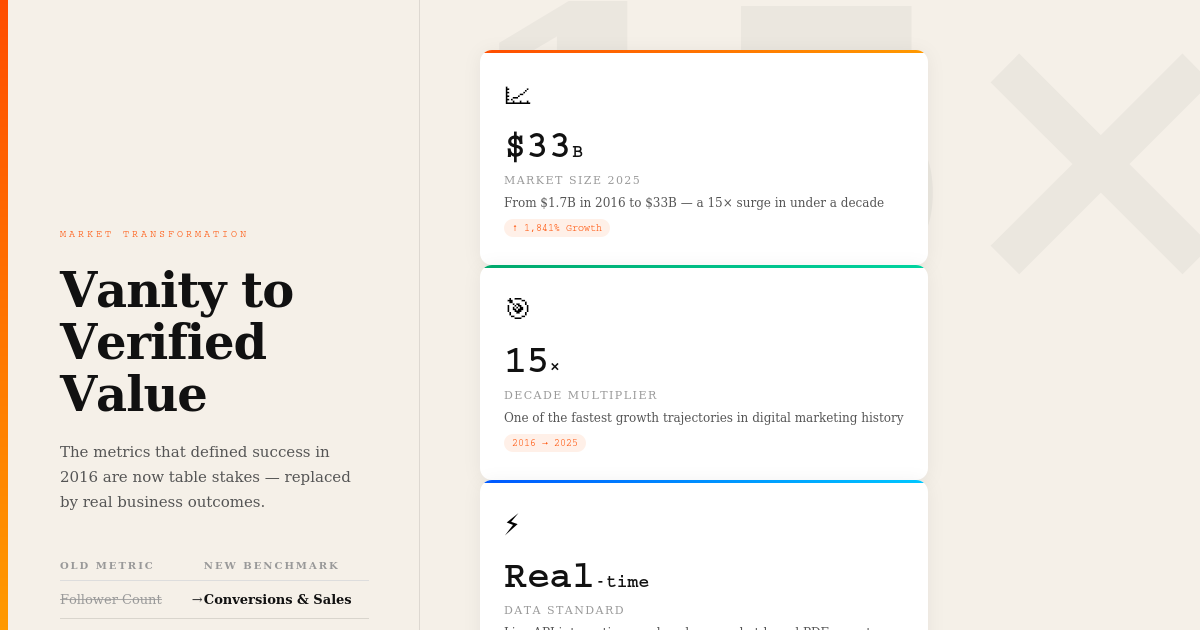
Reach was no longer enough. CPMs were not enough. Even engagement rates fell short. The new benchmarks for influencer marketing in 2025 became concrete business outcomes:
When money scales, measurement must mature. Social data analytics had to evolve from a marketing reporting function into a true business intelligence layer. This is the central influencer marketing trend that defined the decade — and the one that still separates leading brands from the rest.
To understand how brands are building better measurement systems today, read our piece on how creators and brands use data to build better influencer partnerships.
Privacy Changed Everything
Between 2018 and 2023, regulation and platform governance permanently reshaped the creator data ecosystem. The era of scraping public social profiles without consent began collapsing — quietly at first, then all at once.
Key milestones that redefined how social data could be collected:
- GDPR (2018) — The EU redefined consent and personal data processing across the board
- CCPA (2020) — California strengthened consumer data rights, affecting global platforms
- Apple's App Tracking Transparency (iOS 14.5, 2021) — Required explicit user opt-in for cross-app tracking, disrupting ad targeting at scale
- Platform API restrictions — Instagram, Facebook, Twitter/X, and others progressively tightened third-party data access
- FTC disclosure updates (2023) — Stricter transparency rules around paid influencer partnerships
The signal this sent to the industry was unambiguous. Public no longer meant accessible.
The most valuable creator data signals moved behind permission walls: verified audience demographics, reach and impressions, creator earnings, advanced engagement insights, and commerce performance metrics. Brands that had built their influencer programs on scraped or approximated data suddenly found themselves with unreliable foundations.
This marked a structural shift in influencer marketing trends: social data became permissioned infrastructure, not public exhaust.
See how Phyllo approaches consent-driven creator data through our universal API for influencer marketing.
From Screenshots to Real-Time Social Data Analytics
In 2016, campaign verification looked like this:
- Creators sent screenshots of their post metrics.
- Agencies manually compiled everything into spreadsheets.
- Brands received PDF reports weeks after a campaign ended.
- Discrepancies between reported and actual numbers were common.
- Data was static, delayed, and deeply fragmented.
By 2025, the influencer marketing trends around measurement have completely reversed. Enterprise teams now expect real-time API integrations that pull platform-sourced metrics directly, automated campaign dashboards that update continuously, and cross-platform normalization so that TikTok, Instagram, and YouTube data can be compared on equal terms.
Instead of manually verifying Instagram Stories views, brands now pull authenticated performance data directly via APIs — with no manual intervention.
The difference is not cosmetic. It is structural.
Static reports cannot power always-on commerce ecosystems. Real-time social data analytics can. Teams that analyze performance in real time can optimise content while trends are still live. Teams that wait for periodic reports react too late, every time.
Learn how influencer analytics tools have evolved to meet this demand: A Guide to Influencer Analytics Tools.
The Rise of Multi-Format, Multi-Platform Influence
The 2016 creator landscape was dominated by three formats: Instagram posts, YouTube long-form video, and Facebook pages. Then the landscape fragmented.
TikTok's global breakout in 2019–2020 changed everything. Instagram Reels, YouTube Shorts, Twitch live streaming, live commerce formats, and affiliate storefronts followed in rapid succession.
Content became shorter, faster, algorithmically distributed, commerce-enabled, and multi-platform by default. A creator today might post a TikTok, repurpose it as a Reel, cross-upload to Shorts, drive affiliate sales via their bio link, and go live for a conversion burst — all in a single day.
This velocity made monthly reporting cycles obsolete. Brands shifted from episodic influencer campaigns to always-on creator channels.
The new rule of influencer marketing trends in 2025 is simple:
If you learn in real time, you optimize. If you wait 30 days, you lose momentum.
Speed became a strategic advantage — and only brands with real social data analytics infrastructure could move fast enough to capture it.
Influencer Fraud Detection Became a Board-Level Priority
As influencer marketing budgets crossed $30 billion, fraud scaled proportionally. The common forms: fake followers, bot engagement, engagement pods, audience geo-mismatch, and undisclosed paid partnerships.
According to studies by HypeAuditor and Statista, fraudulent activity in influencer marketing cost brands hundreds of millions annually in the late 2010s. As the decade progressed, this moved from a marketing concern to an enterprise risk management issue.
By 2025, serious creator programs now require systematic influencer fraud detection:
- Audience quality analysis to verify real engagement
- Suspicious activity detection to flag bot behavior
- Disclosure monitoring for FTC compliance
- Identity verification to confirm creator authenticity
- Cross-platform consistency checks to spot mismatched metrics
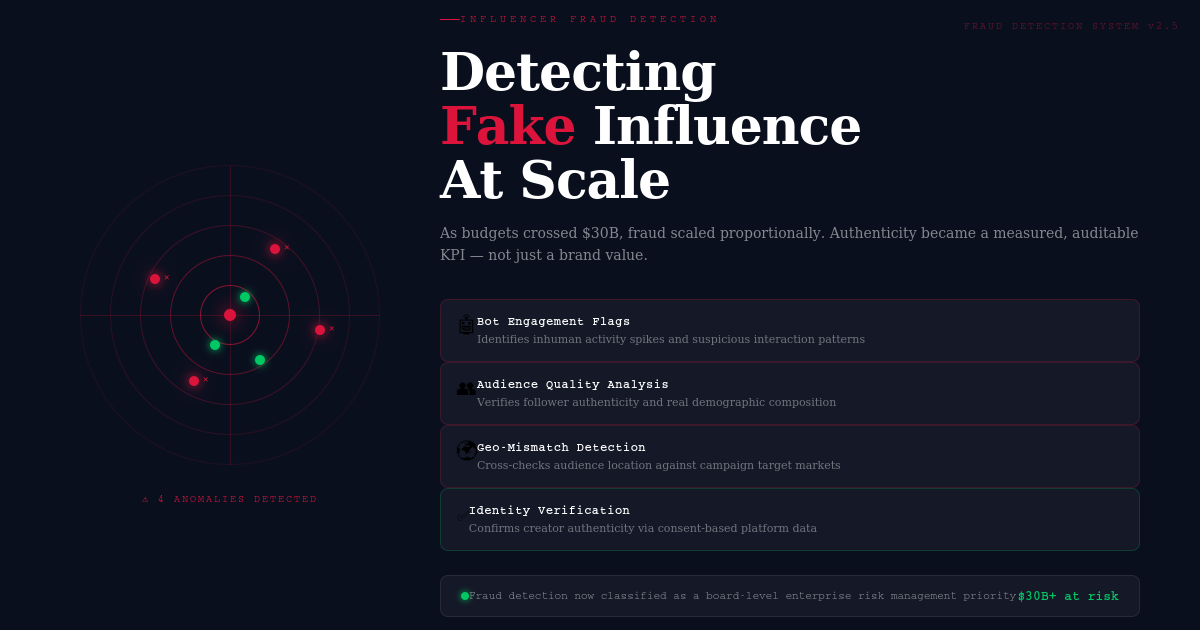
Authenticity moved from being a brand value to being a measured, auditable KPI. Influence was no longer just creative — it became governed.
Phyllo addresses this directly through verified, consent-based data. Read more: Influencer Authenticity: Why It Matters and How to Ensure It.
Social Commerce Raised the Stakes for Social Data
The biggest structural shift of the entire decade? Social platforms became transaction engines.
TikTok Shop expanded aggressively across Southeast Asia, the UK, and the US, with some markets seeing triple-digit LIVE commerce growth. Instagram integrated shopping natively. YouTube expanded affiliate and product tagging. Pinterest strengthened shoppable pins. In China, live commerce had already proven the model — creators generating billions in GMV through single livestream sessions. Western markets caught up fast.
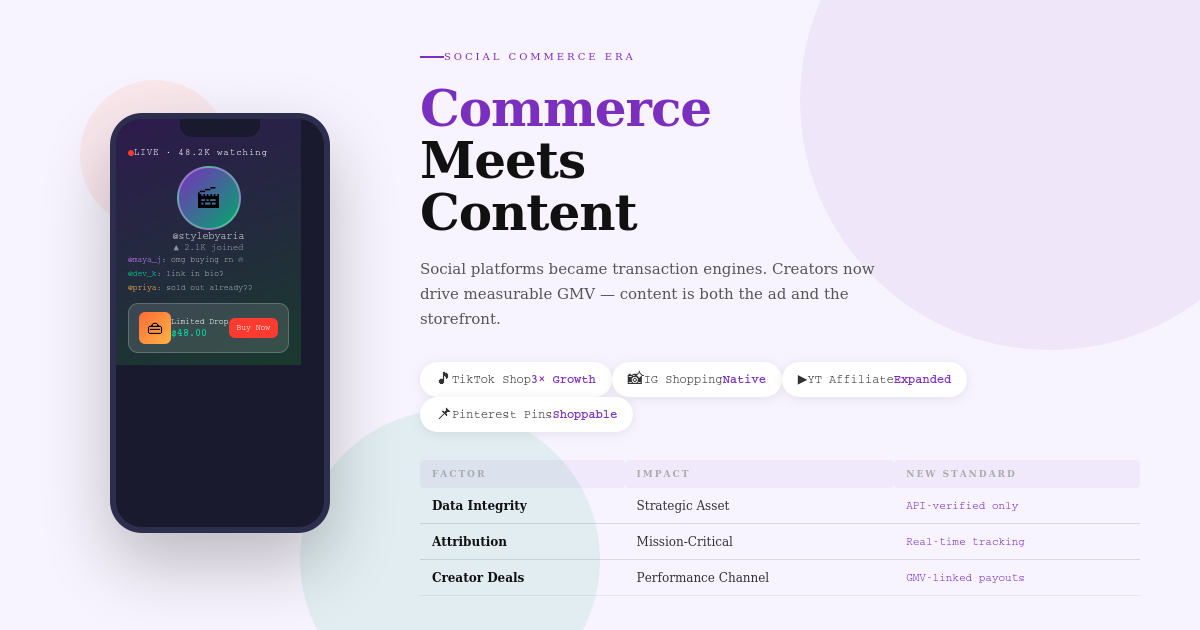
When content drives measurable revenue, the stakes for social data analytics change completely:
Social media stopped being just an awareness channel. It became a distribution and conversion channel — and measurement expectations followed accordingly.
Creators Became Financial Entities
One of the most underreported influencer marketing trends of the decade is what happened to creator status in the financial system.
In 2016, most banks classified creators as high-risk, inconsistent earners with unverifiable income profiles. Fast forward to 2025, and platforms like YouTube, Patreon, Substack, and TikTok now generate predictable, recurring revenue streams for millions of creators.
Fintech startups began underwriting based on platform earnings, subscriber retention curves, revenue consistency, and engagement stability. Some lenders now use creator dashboards and verified income APIs to assess creditworthiness.
A YouTuber with recurring AdSense revenue, high subscriber retention, and predictable CPMs may present more measurable income stability than a traditional freelance worker without documented financial history. Social data evolved into financial documentation. Creators became SMBs.
Discover how Phyllo's social data infrastructure supports creator financial services use cases through our guide to creator economy metrics that matter.
The Modern Social Data Analytics Stack
Today, mature organizations that take influencer marketing seriously operationalize creator data in structured layers. Understanding this stack is essential for any brand building a program designed to scale.
Most brand failures in influencer marketing happen in Layers 1 through 3 — not in strategy or creative. AI cannot compensate for broken data foundations.
Once data is authenticated and normalized, AI unlocks a genuinely powerful layer on top: anomaly detection, sentiment analysis, comment intelligence, predictive campaign performance, and creator lookalike modelling. But intelligence is always downstream of infrastructure.
See how Phyllo powers this infrastructure for influencer marketing platforms: How can influencer marketing agencies access data from creator economy platforms?
When Influence Became Infrastructure
As influencer marketing matured through the decade, global holding companies began acquiring creator platforms specifically to strengthen their data and measurement capabilities. These acquisitions were not talent plays. They were infrastructure bets.
The industry had arrived at a structural truth that the best teams understood clearly:
Influence without reliable data is volatile. Influence supported by infrastructure is scalable.
Over ten years, social data analytics evolved from visible metrics to verified systems, from isolated dashboards to integrated pipelines, and from vanity signals to genuine business intelligence. The creator economy did not just grow — it matured.
The Role of Infrastructure Builders in the Creator Economy
The problem was never a lack of social data. It was fragmentation.
Each platform operates its own API with different metrics, different authentication rules, and different privacy constraints. For brands running multi-platform creator programs, this fragmentation creates enormous operational overhead — and serious data quality risks.
Infrastructure companies emerged specifically to solve this. By unifying consent-based data access, normalizing cross-platform metrics, and providing developer-ready APIs with enterprise compliance layers, they transformed social data from scattered signals into operational systems.
This is precisely what Phyllo's universal API was built to solve — a single, consent-driven data layer across 100+ creator platforms.
2026 and Beyond: The Intelligence Era
The next chapter of influencer marketing trends will not be about more influence. It will be about intelligence.
Three forces will define where the industry goes from here:
- Standardization Across Platforms: Cross-platform identity and metric harmonization will become a baseline expectation, not a competitive advantage.
- Privacy-First Pipelines: Consent-driven, authenticated data ecosystems will become the regulatory requirement and the commercial standard simultaneously.
- AI-Native Creator Workflows Automated optimization, predictive campaign modelling, and dynamic content testing will define which brands move fastest.
The transformation the industry is undergoing can be mapped simply:
The decade-long shift was quiet at first. In 2025, it is impossible to ignore.
FAQs:
1. What are the biggest influencer marketing trends in 2025?
The biggest trends in 2025 are the shift from vanity metrics to business outcomes (conversions, GMV, CAC), the rise of social commerce on TikTok Shop and Instagram, the adoption of real-time social data analytics for campaign measurement, and the growing importance of influencer fraud detection as budgets scale.
2. How has social data analytics changed influencer marketing?
Social data analytics transformed influencer marketing from a gut-feel, screenshot-based process into a data-driven discipline. Brands now use real-time API integrations to pull verified creator performance data directly from platforms, enabling always-on campaign optimization rather than periodic reporting.
3. What is influencer fraud detection and why does it matter?
Influencer fraud detection refers to the systematic identification of fake followers, bot engagement, engagement pods, and audience misrepresentation. As influencer marketing budgets have scaled past $30 billion, fraud detection has become a board-level enterprise risk management priority — not just a marketing concern.
4. What are best practices for using data in influencer marketing strategies?
The best practices include: building on a consent-based data foundation so metrics are verified at source, normalizing data across platforms before comparing performance, using real-time dashboards rather than periodic reports, implementing systematic influencer fraud detection before signing partnerships, and tying every campaign metric to a concrete business outcome like sales, CAC, or GMV.
5. How did privacy regulations change social data collection?
GDPR (2018), CCPA (2020), and Apple's App Tracking Transparency (2021) collectively ended the era of scraping public social profiles without consent. The most valuable social data signals moved behind permission walls, making consent-based, authenticated data infrastructure the only reliable foundation for influencer marketing programs.
6. Are creators now considered financial entities?
Yes. Fintech companies and lenders now assess creators' creditworthiness using verified platform earnings, subscriber retention, and revenue consistency — treating creators like small-to-medium businesses (SMBs) rather than high-risk individuals with unverifiable income.
Want to see how Phyllo powers creator data infrastructure for brands and developers? Get a free demo →
What are the biggest influencer marketing trends in 2025?
Budgets moved from vanity metrics to outcomes like conversions and GMV, social commerce scaled on TikTok Shop and Instagram, and real-time analytics replaced screenshot reporting.
How big is the influencer marketing industry in 2025?
Influencer marketing reached roughly $33 billion globally in 2025, up from $1.7 billion in 2016 per Influencer Marketing Hub. That is close to 15x growth in under ten years.
What is influencer fraud detection?
Influencer fraud detection is systematic screening for fake followers, bot engagement, engagement pods, and geo-mismatched audiences, plus disclosure checks for FTC compliance.
How did privacy rules change social data collection?
GDPR in 2018, CCPA in 2020, and Apple's App Tracking Transparency in 2021 ended casual scraping. Verified demographics, reach, and earnings now sit behind consent and authentication.
What does a modern social data analytics stack look like?
Five layers: consent and authentication, verified API retrieval, cross-platform normalization, governance and compliance, then activation. Most programs break in layers 1 to 3.
Do lenders treat creators as financial entities?
Yes. Fintechs and lenders underwrite creators on verified platform earnings, subscriber retention, and revenue consistency, treating them as SMBs instead of high risk individuals.
How does Phyllo support influencer marketing platforms?
Phyllo is a social data infrastructure platform with one consent-driven API across 100+ creator platforms, serving public and authenticated metrics normalized for measurement.