
.png)


- Social media data APIs split into three products: publishing, public data reading, and consent based reading, and the wrong category costs more than the wrong vendor.
- Phyllo returns both consented and public social data from a single API across more than 20 platforms including LinkedIn.
- Proxyway tested 11 scraping APIs in December 2025 and found Instagram blocked them about 40 percent of the time while YouTube succeeded 93 percent of the time.
- LinkedIn data vendor Proxycurl shut down in July 2025 under a permanent injunction ordering deletion of over 401 million scraped profiles.
- Only consented access reports Instagram or TikTok audience demographics straight from the platform's own analytics, while public vendors estimate them.
Choosing the best social media data API comes down to a question most comparison guides skip: whether you need to publish content, read public data, or read data a creator has to give you permission to access. Those are three different products, and almost every guide on this term answers only one of them without telling you which. If you have not settled that question yet, start with creator data APIs versus public social APIs.
There is a second gap worth knowing about before you start shortlisting.
Research this term across the market and you will notice that Coresignal, People Data Labs, HypeAuditor and Upfluence barely come up, even though all four are established vendors a buyer would reasonably consider.
The reason is structural rather than deliberate. Most guides on this topic are published by scraping-infrastructure companies or social-publishing companies, and neither competes with creator-data or professional-data vendors, so neither has a reason to list them.
The practical effect is that the market you see when you search is smaller than the market that exists.
One thing to state upfront
we build Phyllo, and Phyllo is first in the list below.
We put it there because we think it fits the widest range of read use cases in this category. That is our view, and you should treat it as such.
Every vendor here, including us, carries a section on where it falls short. Every figure carries a source and a date, and where we could not verify something we say so rather than rounding it into a claim.
Take the call yourself.
How we researched this
We assessed all eleven against their own documentation, pricing pages and platform lists, published customer feedback, and independent benchmarks where they exist. Where a vendor's own pages contradict each other we say so. Unverified numbers are marked as such.
What to look for in a social media data API in 2026
Six things decide whether a vendor can do the job. Only one of them appears on most pricing pages. If you are new to the category, what a social data API actually is covers the groundwork.
1. Access model, before anything else
Public, consent-based, or both. This decides what data is legally and technically reachable, whether creators need to authenticate into your product, and what you can do with the output. Get it wrong and no amount of vendor comparison helps.
2. Field-level coverage, not platform counts
"Supports 25 platforms" tells you nothing about whether the fields you need return non-null values on the handles you care about. Instagram coverage and LinkedIn coverage are not the same product, and depth varies significantly inside a single vendor's platform list. Ask for a field-by-field breakdown per platform, then test it.
3. How the data was derived
This matters most for audience demographics. A figure inferred by a model over scraped follower signals and a figure read from the creator's own platform analytics are both labelled "audience age and gender". They are not comparable, and only consent-based access can produce the second.
4. Freshness, measured rather than claimed
Ask for refresh cadence per data type, what happens on a profile the vendor has never seen before, and whether "real-time" means live retrieval or a recently warmed cache. Most vendors do not publish this, which is itself informative.
5. Reliability on the platforms you actually need
Public collection is harder on some platforms than others, and the difference is larger than most vendors admit.
The one independent benchmark in this space is Proxyway's Web Scraping API Report from December 2025. It tested 11 scraping APIs and found Instagram blocked them roughly 40% of the time on average, while YouTube succeeded 93% of the time.
It did not test TikTok, LinkedIn, X or Facebook at all. For those platforms there is no independent data available, so you will have to test yourself.
6. Who maintains the collection layer
Vendor-operated, community-maintained, or an undisclosed third party. This decides what happens when a platform changes its markup, and whether that becomes your on-call problem or theirs. It is the single most useful question to ask in a first call.
The 11 best social media data APIs in 2026 at a glance
All figures verified 5 August 2026.
| Tool | Best for | Access model | Coverage | Free tier | Where it's NOT the pick |
|---|---|---|---|---|---|
| Phyllo | Breadth: consented and public data from one API | Consent + public | 20+ platforms including LinkedIn | Sandbox | Researching accounts that will never opt in |
| EnsembleData | High-volume public pulls on TikTok, Instagram, YouTube | Public | 8 platforms, uneven depth | Yes, 50 units/day | Consented metrics, audience demographics, or any UI |
| Modash | Creator discovery with audience quality scoring | Public | 3 platforms (IG, TikTok, YouTube) | 14-day trial | Platforms beyond those three, or a sub-five-figure API contract |
| HypeAuditor | Fraud detection and audience-quality vetting | Public | 5 platforms | Limited free tier | Facebook, LinkedIn or Pinterest coverage; consented metrics |
| Bright Data | Bulk public social snapshots at scale | Public | 6.5B+ social records, 11 platforms | 5K records/mo on Scraper API | Always-live per-creator metrics, or consented data |
| Apify | Long-tail platform coverage via a scraper marketplace | Public | 8,429 social actors, ~0.7% first-party | Yes, $5 credit | A uniform multi-platform schema under one SLA |
| SociaVault | Cheap self-serve public pulls with MCP support | Public | 17 documented namespaces, 10 social | Yes, 50 credits | Audience demographics, authenticity scoring, or a long track record |
| SocialCrawl | A single normalised schema across many sources | Public | Stated several different ways on its own site | Yes, 100 credits | Anything with a procurement or vendor-maturity gate |
| Coresignal | Bulk B2B professional and company data | Public | 4.5B+ records, 15+ sources | 7-day trial, 2,000 credits | Creator or social-audience data of any kind |
| People Data Labs | Person and company enrichment at scale | Public + licensed | 18M companies verified | Yes | Creator or influencer social metrics, it has none |
| RapidAPI | Discovery and prototyping across many publishers | Both, publisher-dependent | Undefined by design | Publisher-dependent | Any production pipeline |
Publishing, public data or consented data: which one do you actually need?
Three product categories compete for the same search term. This is the fastest way to tell them apart.
| Category | Publishing APIs | Public-data APIs | Consent-based APIs |
|---|---|---|---|
| What they do | Post and schedule on behalf of your users | Read what is visible without logging in | Read first-party data the creator authorises |
| Examples | Buffer, Ayrshare, Zernio | EnsembleData, Bright Data, Apify | Phyllo (which also covers public data) |
| Creator involvement | Connects their account to post | None | Authorises access once |
| Fails at | Any read use case | Anything private or verified | Creators who will never opt in |
If you are building a scheduling tool, stop here and read a publishing-API comparison instead. Everything below concerns reading data.
What each access model can actually return
This table describes what is structurally possible under each access model, which is more durable than any vendor ranking.
| Field | Public data | Consent-based |
|---|---|---|
| Follower and following counts | Yes | Yes |
| Public posts, captions, hashtags | Yes | Yes |
| Public engagement counts (likes, comments) | Yes | Yes |
| Engagement rate | Computed from public signals | Computed from platform-reported metrics |
| Audience age, gender, geography | Inferred by a model over scraped audience signals | Read from the creator's own platform analytics |
| Saves, shares, story completion | No | Yes |
| Non-public reach and impressions | No | Yes |
| Verified identity | No | Yes |
| Earnings and monetisation | No | Yes |
| Contact email | Sometimes, from public bios, unreliably | Yes |
| Creators who never opt in | Yes | No |
Why two vendors report different audience demographics for the same creator
Look at the demographics row in that table again, because it is the one most likely to catch you out.
Almost every vendor here sells you "audience age, gender and location". Query the same creator with two of them and the numbers will not match. That is not a bug in either product. They are producing the figure in two completely different ways.
Public-data vendors estimate it: They take a sample of the creator's followers, then run classifiers over public signals such as names, profile photos, bios and what those followers post about. The result is a statistical projection from that sample to the whole audience.
Consented access reports it: When an account owner connects their account, the platform hands over the demographics it has already calculated from its own logged-in user data. There is no sampling and no inference.
So an estimate and a measurement arrive in the same field, under the same label, and nothing in the response tells you which one you are holding.
Both are useful, for different jobs. An estimate is fine for building a shortlist, where you only need a rough sense of who follows someone. A measurement is what you need when the figure goes into a media plan a client signs off, a payout decision, or anything you may have to defend later.
The question to ask any vendor: What sample size sits behind this number? A vendor that estimates should be able to answer precisely. Most cannot, and that tells you something on its own.
1. Phyllo: Best for coverage across both consented and public data
Phyllo is social data infrastructure covering both access models from one integration
We build this, so weigh the section accordingly. The claim is specific: Phyllo provides both consented access to user-authorised data and access to public social data, across 20+ social and creator platforms including LinkedIn, through a single API.
It is built for teams who need both halves and do not want to assemble them from separate vendors.
What makes it unusual is having both behind one API. Public data tells you what is happening across a market, consented data tells you what is verifiably true about an account that has connected, and together they give you a complete picture rather than half of one. That is what lets a single integration serve several use cases as your product grows.
If you have ever had a data pipeline break because a page structure changed on a Saturday, that is the specific problem this removes.
Phyllo is sometimes described as the consent-based option, which is accurate about the differentiator and incomplete about the product. Public data is fully in scope.
What Phyllo actually returns
- Consented, from the creator's own platform analytics: Audience demographics, non-public reach and impressions, saves and shares, content performance, verified identity, and income and monetisation data
- Public data: Profile fields, public content, engagement counts, and creator search across a public index
- Coverage across 20+ social and creator platforms including LinkedIn: Both consented and public data from the same API, so a use case that starts with public discovery can extend to verified data without a second integration
- Refresh by webhook: Per the documentation, updates are pushed "as soon as we find any updates", with on-demand refresh available. You are notified when something changes rather than polling to find out
- No collection infrastructure on your side: No scrapers, no proxy pool, no anti-bot handling, no per-platform maintenance
- The data arrives as raw material, not a finished product: Phyllo returns the underlying fields and leaves the interpretation to you, the way a set of colours leaves the painting to the painter. Two teams can pull the same data and build a discovery engine from one and an underwriting model from the other.
What Phyllo customers say
The recurring theme from customers is the disappearance of maintenance work.
Where Phyllo hits friction
- Consented data requires consent: If your product researches accounts that will never sign in, that half is unavailable to you and a public-data vendor covers the job. This is a structural limit, not a roadmap item.
- Pricing is not published: Access is gated behind a sales conversation, which suits enterprise procurement and frustrates a developer who wants to check budget fit before talking to anyone. Our breakdown of social data API pricing per 1,000 profiles gives you benchmarks in the meantime.
- Twitch coverage is thinner than the major platforms: Depth on Twitch does not match what you get on Instagram, TikTok, YouTube and LinkedIn, and full analytics are not always available.
What to know before you integrate Phyllo
- It is a social data platform, not a point solution for one network: The value shows up when you need several platforms and more than one type of data. If you only ever need public Instagram profile data, a single-platform option will be cheaper and just as good.
- The collection layer is not yours to run, and that is the point: No proxy pools, no anti-bot handling, no scraper repair when a platform changes its markup overnight. Every other read option here either hands you that work or hands it to a community developer you do not employ.
- Platform changes are absorbed before they reach you: When Instagram deprecated the Basic Display API and when TikTok changed token expiry behaviour, customers shipped no fix.
- Sandbox access needs no sales conversation: You can test the schema and field coverage against your own handles before anyone talks to you about pricing.
2. EnsembleData: Best for high-volume public pulls on TikTok, Instagram and YouTube
EnsembleData is raw scraping infrastructure sold to developers, not a platform
There is no dashboard to speak of and no discovery layer. You get endpoints, a unit-based meter and documentation. That focus is the point, and the company has been running since 2020.
Its access model is stated plainly on the homepage: "You never need to share account credentials or create throwaway social media accounts. EnsembleData only accesses publicly available data through our own infrastructure."
The pricing page adds that "we scrape neither private nor sensitive information". There is no OAuth path, so there is no consented data.
What EnsembleData actually returns
- Profile fields: Username, follower and following counts, bio, verification and private flags, user ID and full name, all public-derived
- Post metadata: Views, likes, shares, comments and timestamps
- Comment data: Text, author and timestamp, capped at 30 comments per credit
- Hashtag search: 20 posts containing a hashtag per credit
- Music and sound data: Sound ID and usage, genuinely useful for TikTok trend work
- Follower and following lists: 100 follower records for 2 units
- No consented metrics: No impressions from the account's own analytics, no story data, no audience demographics
What EnsembleData does well
- Fast to integrate: A few lines of code returns usable data, because there is no abstraction layer to learn.
- Direct support: It is a small team, and the founder is visible in support channels.
- TikTok is the deepest coverage: Nine endpoints against one for Snapchat, which tells you where the engineering has gone.
Where EnsembleData falls short
- Depth is uneven across the eight platforms: TikTok has nine endpoints and Instagram eight, but Snapchat has one and Twitch has two. The platform count is accurate and still misleading if Snapchat is your target.
- Units reset daily, not monthly: Its documentation states daily units reset at 00:00 UTC. That penalises bursty backfills, since you cannot save a month of quota for one large job.
- No published rate limits or SLA: The homepage claims millions of requests per day, and no documented limit backs that up. For contrast, TikTok's own API rate limits are published in full.
- No UI and no discovery layer: If anyone on your team needs to look at the data without writing code, this is the wrong product.
What to know before you integrate EnsembleData
- Unit costs are per-result rather than per-request, so forecasting means modelling result volumes, not call volumes
- Failed requests caused by internal errors are not charged, which is fairer than several vendors here
- The top tier is sales-gated; everything below is self-serve with no card on the free tier
3. Modash: Best for creator discovery with audience quality scoring
Modash is a full influencer marketing platform that also sells a data API
The SaaS product handles discovery, outreach, tracking and payments. The API is a separate purchase with separate pricing, and the two should not be conflated when you evaluate.
Its position on access is explicit and well argued: "Influencers and creators do not opt-in to our database, but they can opt out at any time. Modash is an open network database. We list publicly available info only." The discovery page markets "No creator opt-in" as a feature, and for discovery use cases it genuinely is one.
What Modash actually returns
- Follower count and engagement rate: For every public profile above 1,000 followers on its three platforms
- Fake-follower and audience-quality rate: Its most-cited feature
- Audience demographics: Age, gender, location including city level on Instagram, language and interests, all inferred from public signals
- Growth rate: Over time
- Publicly listed email: Where the creator has published one
- Past brand collaborations: As a timeline
- Content topics: No consented data of any kind
What Modash does well
- Audience quality scoring is the reason to buy it: Fake-follower and audience-overlap analysis is the most established part of the product.
- Shipping pace is visible: The product changes noticeably month to month.
- Transparent SaaS pricing: Published tiers on the app, which is more than most of this list offers.
Where Modash falls short
- Three platforms only: Instagram, TikTok and YouTube. No LinkedIn, Twitch or Snapchat.
- Search relevance is inconsistent: Filters return creators who match the criteria without matching the brief, so shortlisting still takes manual work.
- The API carries a hard annual minimum: Discovery API starts at $16,200 a year and the Raw API at $10,000, with no monthly or pay-as-you-go option and payment by bank transfer.
- Its own profile count is inconsistent: The site says 380M+ profiles, while its product listing elsewhere says 250M+.
What to know before you integrate Modash
- The SaaS trial does not include API access, those are separate commercial conversations
- Unused Discovery API credits roll over month to month while the contract is active
- If you are weighing this against consented access, we have written a direct Phyllo vs Modash comparison, and a wider roundup of Modash alternatives
4. HypeAuditor: Best for fraud detection and audience-quality vetting
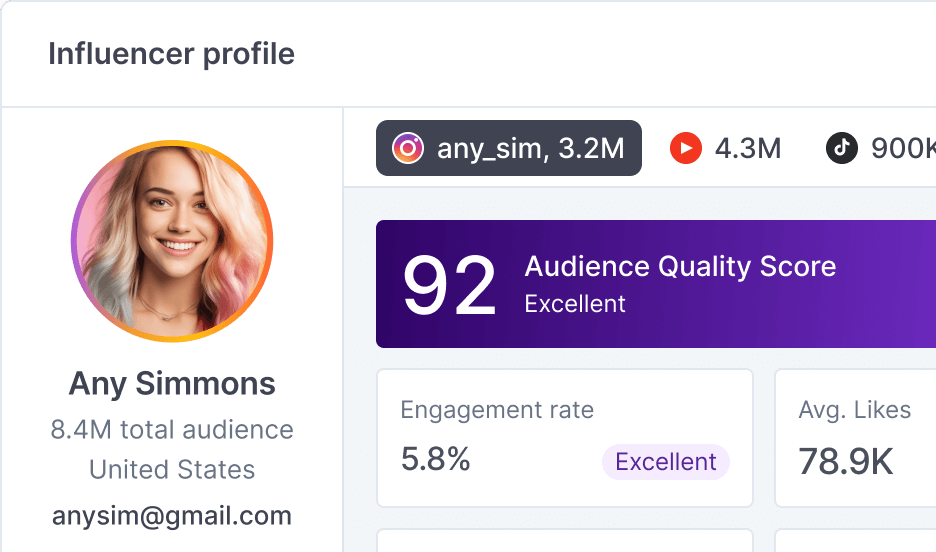
HypeAuditor is built around a single question: is this audience real?
Discovery, outreach and campaign management are all assembled around the fraud and audience-quality engine. If authenticity scoring is your primary requirement, this is the most developed product in the comparison.
What HypeAuditor actually returns
- Audience Quality Score: A 1 to 100 composite of eight metrics across engagement rate, active audience type, growth and comments authenticity
- Quality Audience percentage: Defined as "followers whose activity is not identified as suspicious"
- Audience demographics: Age and gender split, geography to city and state level, ethnicity and languages
- Audience interests and brand affinity: Comments authenticity percentage
- Follower and following growth graphs: Estimated reach and earned media value
- Contact email: The company markets 35+ vetting metrics across five platforms: Instagram, TikTok, YouTube, Twitch and X.
What HypeAuditor does well
- The most developed authenticity scoring here: Audience Quality Score combines eight metrics across engagement, audience type, growth and comment authenticity.
- Usable without specialist knowledge: Filtering and scoring are built for a marketer rather than an engineer.
- Deep demographic breakdowns: Age, gender, geography to city level, ethnicity and languages, plus brand affinity.
Where HypeAuditor falls short
- Coverage gaps: Five platforms only. No Facebook, LinkedIn, Pinterest or Snapchat.
- Its figures are estimates, and the methodology is not published: The scores are model outputs over sampled public signals. No sample size or confidence interval appears anywhere on the site, and engagement rates frequently disagree with other tools measuring the same profile.
- Credits are consumed per network: The same creator across three platforms costs three times.
- Bundling: Discovery is sold alongside campaign management, so you buy both whether or not you need both.
- A wording note worth catching: The homepage markets a "global creator database with first-party data", while the methodology page confirms the data is scraped public data. "First-party" here means HypeAuditor's own dataset rather than creator-authorised, which is easy to misread when you are comparing on access model.
What to know before you integrate HypeAuditor
- Demographics and fraud scores are model outputs. Its own blog concedes fraud detection "is probabilistic, not perfect", so treat figures as directional and ask for methodology in writing. The mechanics of how APIs detect fraudulent partnerships are worth understanding before you rely on any score.
- Credits are consumed per network, so the same creator across three platforms costs three times
HypeAuditor's access model and limits
Public only, five platforms, sales-gated. Entry tier from $299 a month billed annually, with roughly 1,000 contact emails a month and restricted Discovery filters below the higher tiers. If the price or the coverage gaps rule it out, there are HypeAuditor alternatives for influencer analytics.
5. Bright Data: Best for bulk public social snapshots at the largest scale

Bright Data sells social data as pre-collected datasets, not as a live per-creator API
This is the distinction most comparisons miss.
You buy a snapshot, optionally a field subset, and optionally subscribe to refreshes. Separate real-time Scraper APIs exist, but datasets are the centre of gravity.
A snapshot is a fundamentally different shape from a request-response API.
What Bright Data actually returns
On the TikTok Profiles dataset: account_id, nickname, biography, followers, following, likes, awg_engagement_rate, comment_engagement_rate, like_engagement_rate, bio_link, predicted_lang, is_verified and creation timestamps. Instagram Profiles adds fbid, post count and business account flags. Delivery is JSON, NDJSON, CSV or Parquet to Snowflake, S3, Google Cloud, Azure or SFTP.
Coverage is the largest here: over 6.5 billion social records, 1.1 billion on Instagram alone, 293.8 million across four TikTok datasets, and 31 datasets spanning 11 platforms including LinkedIn.
Freshness, documented properly
Bright Data is one of the few vendors here that publishes cadence: "you can get updates to your TikTok dataset on a daily, weekly, monthly, or custom basis", with refresh tiers priced accordingly and a "Smart Data Updates" option to pay only for new or updated records. That is more transparency than most of this list offers.
What Bright Data does well
- The largest coverage here by a wide margin: Over 6.5 billion social records across 31 datasets and 11 platforms, including LinkedIn.
- Published refresh cadence: Daily, weekly, monthly or custom, with an option to pay only for new or updated records. Very few vendors publish this at all.
- Flexible delivery: JSON, NDJSON, CSV or Parquet to Snowflake, S3, Google Cloud, Azure or SFTP.
Where Bright Data falls short
- Snapshots are not live data: For anything needing current per-creator state, such as payout verification or real-time monitoring, a periodically refreshed snapshot is the wrong instrument regardless of size.
- Cost at volume: Minimum order is $250, at up to $0.0025 per record, and the pricing model rewards large commitments.
- Failed requests are billable: Unlike some vendors here, unsuccessful queries can still consume budget.
- Documentation assumes familiarity: The dataset model takes some working out if you arrive expecting a request-response API.
What to know before you integrate Bright Data
- The $250 minimum order makes small-scale evaluation awkward, though the Scraper API free tier of 5,000 records a month is a reasonable way in
- If LinkedIn data is in scope, read the section on data-source risk below before designing around any scraped LinkedIn source, and weigh web scraping against social data APIs on enterprise risk
6. Apify: Best for long-tail platform coverage via a scraper marketplace
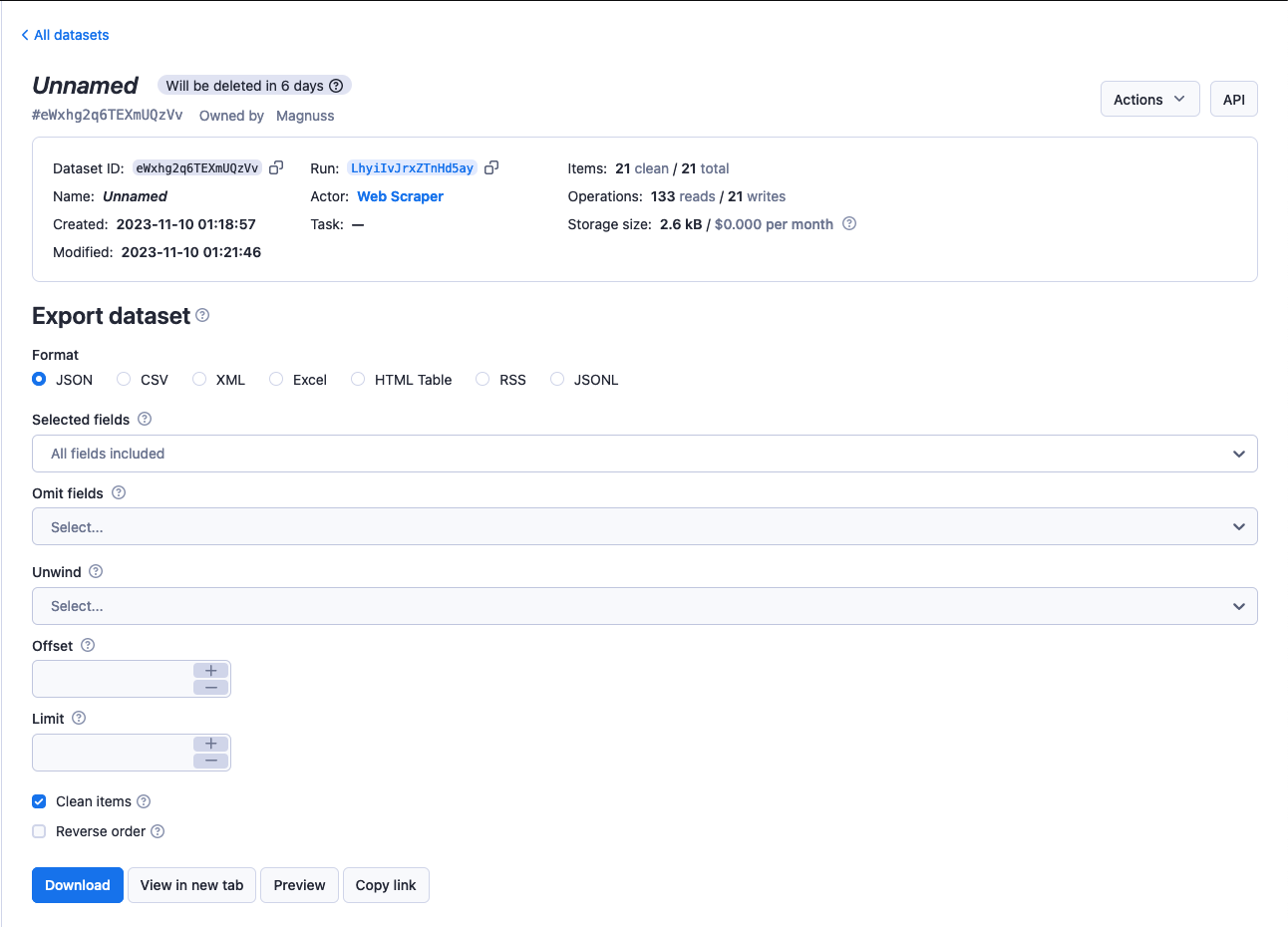
Apify is a marketplace, and that single fact determines everything else
There are 8,429 actors in its social media category, which is more coverage than any vendor here offers first-party.
But counting by publisher account, Apify-run accounts hold roughly 57 of them, about 0.7 percent. The rest are community-maintained.
That has a concrete consequence. The leading Instagram, Facebook, TikTok and YouTube actors carry a "Maintained by Apify" badge. The leading X, LinkedIn and Reddit actors are all "Maintained by Community."
There is also no cross-platform schema normalisation, because two platforms means two response shapes written by two different developers.
What Apify actually returns
Per its own Instagram Scraper: post identifiers and URLs, captions, hashtags, mentions, image and video URLs, carousel children, engagement covering likes, comments, views and plays, plus location, owner and music context. Profile calls return bio, followers and websites.
Real per-1,000 pricing from the actor pages, 5 August 2026:
| Actor | Maintainer | Price | Users |
|---|---|---|---|
| Instagram Scraper | Apify | from $1.50 / 1,000 results | 352K |
| TikTok Scraper | Apify (Clockworks) | from $1.70 / 1,000 | 231K |
| YouTube Scraper | Apify (Streamers) | from $2.40 / 1,000 videos | 101K |
| Facebook Posts Scraper | Apify | from $2.00 / 1,000 posts | 95K |
| Tweet Scraper | Community | from $0.40 / 1,000 tweets | 61K |
| LinkedIn Profile Scraper | Community | from $4.00 / 1,000 profiles | 5.6K, rated 2.7 |
| Reddit Scraper | Community | $45/month plus usage | 14K, rated 2.5 |
What Apify does well
- Unmatched long-tail coverage: 8,429 actors in the social category. If a platform exists, something on Apify probably reads it.
- Managed anti-blocking infrastructure: Proxy rotation and anti-bot handling are handled at the platform level rather than per actor.
- Broad integration surface: It slots into automation tooling easily, which matters if the pipeline is not purely code.
Where Apify falls short
- Only about 0.7 percent of social actors are first-party: Apify-run accounts hold roughly 57 of 8,429. The leading Instagram, Facebook, TikTok and YouTube actors carry a "Maintained by Apify" badge. The leading X, LinkedIn and Reddit actors do not.
- Community actors break when platforms change: When a target changes its page structure, you wait for a third-party developer to fix it or you debug someone else's code.
- No cross-platform schema: Two platforms means two response shapes written by two different developers.
- Layered pricing is hard to forecast: Compute units, platform fees and actor rental fees stack on top of each other, unused credits expire at the end of each billing cycle, and 2,120 social actors charge a flat monthly rental on top of usage.
- Quality varies across 8,000+ listings: Duplicates and abandoned actors are common, and support response times differ from one actor to the next.
What to know before you integrate Apify
- Check the maintainer badge on every actor you depend on before you build
- Actor documentation goes stale, one actor's header advertises $2.00 per 1,000 while its own FAQ still says $5.00
7. SociaVault: Best for cheap self-serve public pulls with MCP support
SociaVault is a credit-based scraping API with unusually straight positioning
Its homepage badge reads: "Public Data Only, No login bypass, no private data, no authentication workarounds." That clarity is creditable, and its own comparison content discloses commercial bias in the first sentence, which almost nobody in this category does.
What SociaVault actually returns
- Profile fields: Handle, follower count, likes count, verification status
- Posts and reels: With captions, hashtags, likes, comments, views and shares
- Comments and replies: With engagement
- AI-generated transcripts: Across Instagram, TikTok, YouTube, X, Facebook, LinkedIn and Reddit
- Keyword, hashtag and user search: Plus trending feeds
- Followers and following lists: On TikTok
- TikTok audience demographics: Though the documentation says this "currently includes audience country distribution" only
- TikTok Shop products and reviews: Plus ad-library creatives
What SociaVault does well
- Cheapest self-serve entry here: One-time credit packs rather than a subscription, and credits never expire.
- Straight positioning: Its homepage states plainly that it accesses public data only, with no login bypass and no authentication workarounds. Not every vendor in this category is that direct.
- MCP support: Useful if you are wiring social data into an AI agent rather than an application.
Where SociaVault falls short
- The "25+ platforms" claim does not hold up: Counting distinct namespaces in its own documentation gives 17, of which 10 are social platforms. The rest are ad libraries, Facebook Marketplace, TikTok Shop and Google Search.
- "No rate limits" is contradicted by its own documentation: The homepage promises no throttle and no per-minute caps, while the docs specify hard result caps including roughly 1,500 results on ad-library search, up to 3 posts per request on Facebook group posts, and a maximum of 20 tweets per request.
- Demographics are close to nonexistent: TikTok only, and country distribution only.
- Founded in 2024: There is very little independent track record to check, so verify anything load-bearing yourself.
What to know before you integrate SociaVault
- One-time credit packs rather than a subscription, and credits never expire, which is the friendliest commercial model here
- Some advanced endpoints cost 20+ credits, and paginated requests are charged per page
- The company was founded in 2024, so verify anything load-bearing yourself
8. SocialCrawl: Best for a single normalised schema across many sources
The idea is good and the execution is unproven
SocialCrawl captures the pain well: call three APIs, get back followerCount, fan_count and edge_followed_by.count, then spend two weeks writing adapters for data that should have been identical. One key, one envelope, one field name is the right answer to that problem, and it is the usual reason teams land on buying rather than building social API integrations.
We include it because it ranks and you will encounter it. What we found is mixed.
Where SocialCrawl hits friction with consistency and maturity
- It states its own platform count several different ways across its own site: Ranging from 21 to 46, with endpoint counts from 108 to 375. For a product whose only differentiator is consistency, that is hard to overlook when you are trying to size coverage.
- The response schema is documented three incompatible ways: Across the docs, the blog and the MCP README, using snake_case, dot-notation and camelCase respectively.
- It does not operate its own collection layer: Its Public Data Notice states that data "is retrieved on demand through specialised third-party data providers, or through the platforms' own official public APIs". Worth knowing if you assumed a first-party pipeline.
- No independent validation exists: No third-party review presence anywhere, and the single testimonial on its homepage could not be verified outside its own site.
- Maturity signals are thin: Incorporated July 2024, product launched April 2026 by its own description.
What to know before you integrate SocialCrawl
If you have a procurement gate, an uptime commitment or a vendor-risk review, a product launched four months ago with no third-party reviews will not clear it. The unified-schema requirement is now met by several established vendors.
9. RapidAPI: Best for discovery and prototyping, not production
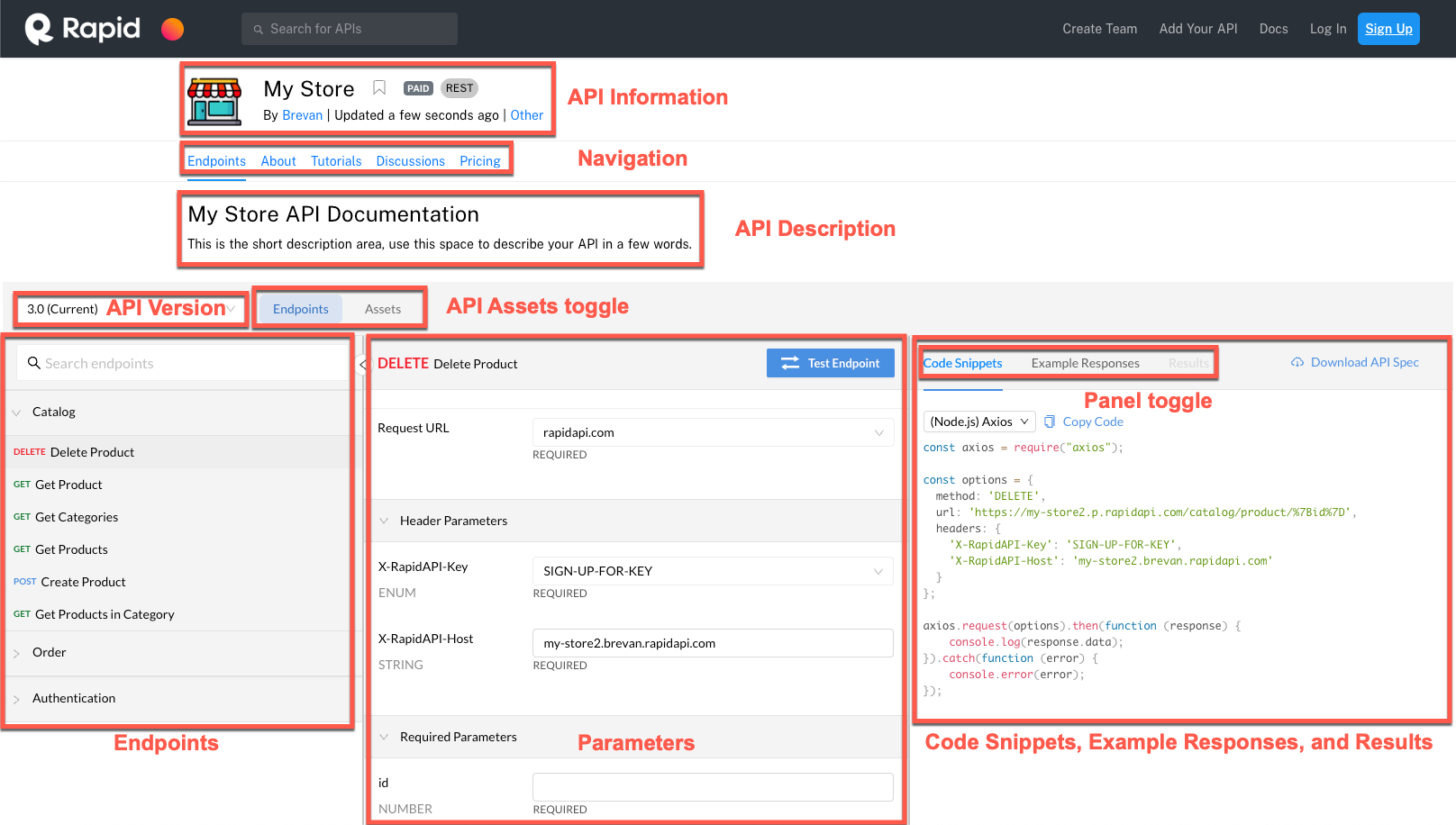
RapidAPI is a storefront, and it maintains none of the data
Now branded API Hub and owned by Nokia since November 2024, it supplies the catalogue, one key, a proxy and billing. Its own documentation concedes "there can be times when an API provider has listed an API that does not provide the functionality advertised".
What buying through a marketplace actually means
- The schema is a per-publisher lottery: Nothing is normalised across listings. The only fields guaranteed on every response are the marketplace's own rate-limit headers.
- Refunds are not RapidAPI's to give: "We cannot issue refunds without the permission of the API provider."
- Quota policing is on you: "You are required to keep track of your quota usage to prevent overages."
- The reliability metric can be gamed: Service Level counts 2xx against 5xx responses, so a publisher returning HTTP 200 with an error body displays 100 percent regardless of whether it worked.
Where RapidAPI falls short
Sentiment splits sharply depending on who is talking. Developers evaluating the catalogue rate it well. Customers who have been billed rate it far lower, and overage disputes are the most common complaint.
That gap is structural rather than accidental. RapidAPI takes a 25 percent marketplace fee and, since December 2025, charges $1 per additional gigabyte beyond the 10GB included in each subscription. But it does not control the quality of what is listed, cannot issue a refund without the publisher's agreement, and routes support to the publisher.
What to know before you integrate RapidAPI
Excellent for finding out whether a data source exists and what its response looks like. Poor for anything you intend to run in production, for structural reasons rather than any failing of a particular publisher.
10. Coresignal: Best for bulk B2B professional and company data
Coresignal is professional data, not social data, and buyers confuse the two
Operating since 2016, it sells company, employee and jobs data as bulk datasets and live APIs. If your product needs firmographic data for talent intelligence, B2B enrichment or market mapping, it is a serious option that no competing guide lists. If you need social engagement metrics, it is the wrong category.
What Coresignal actually returns
- Company: 500+ fields across 70 million companies, including headcount trends, funding, financials and technographics.
- Employee: 300+ fields across 895 million profiles, with a per-record last-updated timestamp.
- Jobs: 85+ fields across 468 million postings.
- No social engagement data: No follower counts, engagement rates or audience demographics.
Freshness, documented clearly
"The update frequency of datasets varies by dataset and subscription terms, and is daily, weekly, or monthly. The database connected to our APIs is refreshed in real time." That is among the clearest freshness statements any vendor here publishes.
Every quote on Coresignal's site is attributed to an unnamed category such as "Lead generation client", with no named customer behind any of them.
What to know before you integrate Coresignal
APIs are self-serve from $49 a month with a 7-day trial. Datasets are sales-gated from $1,000 on a yearly contract. Rate limits scale by tier from 5 to over 100 requests per second, which is unusually transparent. Monthly credits expire each cycle.
11. People Data Labs: Best for person and company enrichment at scale
People Data Labs is enrichment infrastructure with no social layer at all
It appears here for the same reason as Coresignal. Buyers evaluating "social data" often actually need person or company enrichment, and no competing guide lists either option.
What People Data Labs actually returns
Person and company records covering name, job title with normalised levels, employer, work and personal emails, phone, social profile URLs, location, experience, education, skills and a last-verified timestamp. Delivery is REST APIs plus licensed flat files to S3, Azure, GCP, Snowflake or Databricks.
There is no social engagement dataset: No follower counts, no engagement rates, no post data, no audience demographics.
Freshness is the main caveat
The published table gives monthly updates via API and monthly or quarterly for licensed files, with major changes quarterly. For employment data that changes weekly, that cadence is the main thing customers push back on.
What to know before you integrate People Data Labs
Minimum self-serve purchase is roughly $98 a month, moving to enterprise sales above 100,000 credits. Search results cap at 100 per page and all responses carry a 1MB limit. The widely cited "3B+ person records" figure could not be verified on any first-party page.
What happens if your data source disappears
One recent event illustrates a risk that appears on no feature comparison.
Proxycurl was the default answer when a developer searched for a LinkedIn data API. It was a real business, with a LinkedIn-keyed enrichment API and a bulk dataset of over 401 million profiles.
In January 2025, LinkedIn and Microsoft sued it. On 4 July 2025 it shut down rather than fight, and its founder said so publicly.
LinkedIn's Legal VP described the outcome. The resolution "requires Proxycurl to permanently delete all LinkedIn data obtained through unauthorized means and stop accessing LinkedIn unlawfully. The Court has entered these requirements as a permanent injunction, which Proxycurl is obligated to send to its customers."
Read that last clause again. Customers were notified, and the data they had built on had to be deleted.
The practical takeaway for your evaluation
When a vendor claims coverage of a platform that restricts access, ask how it obtains that data before you build on it.
Not because scraping is always wrong, but because the answer tells you whether your roadmap depends on an arrangement that could end with a court order. That belongs in your vendor assessment alongside uptime and price, and it is the difference between a compliant data pipeline and a scraping pipeline.
Match the access model to what you are building
This is the section to act on, because it decides everything downstream.
Some products need data that only exists with consent. Some need reach across creators who will never sign in. A few need both at different points in the customer lifecycle.
If your product makes a financial or trust decision, you need consented data
Creator payouts, lending, income verification and identity checks all fall here.
The reason is not that public estimates are inaccurate. It is that you cannot evidence their provenance to a risk or compliance function.
An inferred earnings figure will not survive an audit. A platform-reported one will.
If your product researches creators who have no relationship with you, you need public data
Competitor intelligence, brand safety monitoring, discovery and prospecting all fall here.
Consent is not available because there is nobody to ask. Any vendor telling you otherwise has misunderstood your use case.
If your product does both at different stages, you need both
This is more common than most guides acknowledge.
An influencer marketing platform discovers creators publicly, then needs verified analytics once a creator signs on. A creator marketplace prospects publicly, then verifies for payouts.
Running two vendors for those two jobs means two integrations, two schemas and two failure modes. That is the specific problem a both-models vendor solves.
| If you are building | You need | So your access model is |
|---|---|---|
| Influencer discovery and search | Breadth of creators, audience estimates, fraud signals | Public works. Both is better if you also serve signed creators |
| Creator payouts, lending or underwriting | Verified identity and earnings you can evidence | Consent only, inferred figures cannot be evidenced to a risk function |
| Talent management for a signed roster | Accurate analytics for creators you have a relationship with | Consent, your creators will authorise so use the better data |
| Brand safety and ad verification | Large volumes of current public content | Public, you are monitoring people you have no relationship with |
| Competitor intelligence | Public content and public metrics only | Public only, consent is not available to you by definition |
| Social commerce | Product, store and creator-partnership data | Public, plus commerce endpoints |
| Talent intelligence or B2B enrichment | Professional and firmographic data | Public, and a different vendor category entirely |
Run your own comparison in an afternoon
Every vendor will demo a creator that works well. Here is how to find out what happens on yours.
1. Pick five test handles that span your real distribution: Use one mega creator, two mid-tier, one micro under 10,000 followers, and one on your hardest platform.
2. Run identical queries with identical handles across every vendor: Request the same fields with the same parameters, so the only variable is the vendor.
3. Compare the field-level output rather than the response envelope: Count how many fields come back empty. That count is your real coverage number, and it will differ from the marketing.
4. Pull the same handle twice, several days apart: The difference between the two responses is your actual staleness, whatever "real-time" means on the pricing page.
5. Query a creator who posted within the last hour: This shows you how the vendor behaves on content it has never seen, which is where cached responses give themselves away.
6. Ask two questions in writing: What is the refresh cadence per data type, and what sample size sits behind the audience demographics. Note who answers precisely and who does not.
7. Score on the axes that matter to you, not the vendor's feature list: A vendor's comparison table is built around what it wins on. Yours should be built around what you are shipping.
Step three matters more than it sounds, because published success rates in this category are thin.
The most rigorous independent test available is Proxyway's Web Scraping API Report from December 2025, which measured 11 scraping APIs against 15 protected websites. Instagram defeated them roughly 40 percent of the time, at a 59.54 percent average success rate.
TikTok, LinkedIn, X and Facebook were not tested at all. For most social platforms there is no independent success-rate data in existence, so the only reliable number is the one you generate yourself.
An agency evaluating us in July ran exactly this process across its whole shortlist. It costs an afternoon, and it will tell you more than any comparison article including this one.
Which social media data API is best for you?
Settle the access-model question before you compare vendors, because it decides what is possible. Everything after that is preference.
- Creators will authenticate into your product: Use consented data for anything verified. Phyllo covers that plus public data across 20+ platforms from one API.
- You need accounts that will never sign in: Public data is mandatory. EnsembleData for cheap high-volume TikTok, Instagram and YouTube pulls, Modash or HypeAuditor if you also need audience estimates and fraud scoring, Bright Data for bulk snapshots rather than per-call access.
- You do not want to run scrapers and proxies: Phyllo and Bright Data keep that layer behind the API. Apify and the scraping options give you control and leave the maintenance with you, or with a community developer you do not employ.
- LinkedIn is in scope: The field narrows sharply and the question becomes compliance rather than coverage. Ask any vendor claiming LinkedIn data exactly how it obtains that data, because LinkedIn's API restrictions are what narrow the field.
- Fraud and authenticity scoring is the core job: HypeAuditor is the most developed, with the caveat that its figures are model estimates and the methodology is not published.
- You actually need professional rather than social data: Coresignal and People Data Labs are the right category, and neither appears in any other guide on this topic.
- Procurement needs SOC 2, a DPA or an SLA: That eliminates several options here on vendor maturity alone, regardless of product fit. Ask early, it is cheaper than finding out at contract stage.
Conclusion
The vendor you choose matters less than the access model you choose first. Get it right and most of this list resolves itself. Get it wrong and you will rebuild, because no amount of vendor switching turns an inferred number into a platform-reported one.
If you need both public and consented data, across more than a couple of platforms, without adding scraper maintenance to your roadmap, that is the specific job Phyllo was built for.
See whether it fits
Schedule a demo and we will walk through your use case, your platforms and the fields you need. Bring your own test handles and we will run them live rather than showing you a curated example.
If it is not the right fit, we will tell you which option on this list is, because a bad fit costs us more than it costs you.
What is the difference between a public and a consented social media data API?
A public data API reads visible data without a login, working on any creator but missing private metrics. A consented API needs one authorization, then unlocks first-party earnings and identity data.
Can you get audience demographics without a creator's permission?
Yes, but only as an estimate. Public data vendors infer age, gender, and location from models trained on scraped follower signals, and most never publish a sample size behind that estimate.
Do I have to run my own scrapers to get social media data?
No. Unified providers like Phyllo absorb platform changes and deprecations before they reach your codebase, while scraper marketplaces leave that repair work to you or an unpaid community developer.
Which social media data APIs actually cover LinkedIn?
Fewer than the marketing suggests. LinkedIn has litigated against scrapers, and Proxycurl shut down in July 2025 under an injunction, so ask any LinkedIn vendor exactly how it obtains that data.
How often does social media data actually refresh?
It depends on access model more than vendor. Consented data can push an update the moment a platform reports a change, while public data sits on a crawl cycle running daily to monthly.
What did the Proxyway report find about scraping social platforms?
Its December 2025 report tested 11 scraping APIs on 15 protected sites and found Instagram blocked them roughly 40 percent of the time, while YouTube succeeded about 93 percent of the time.